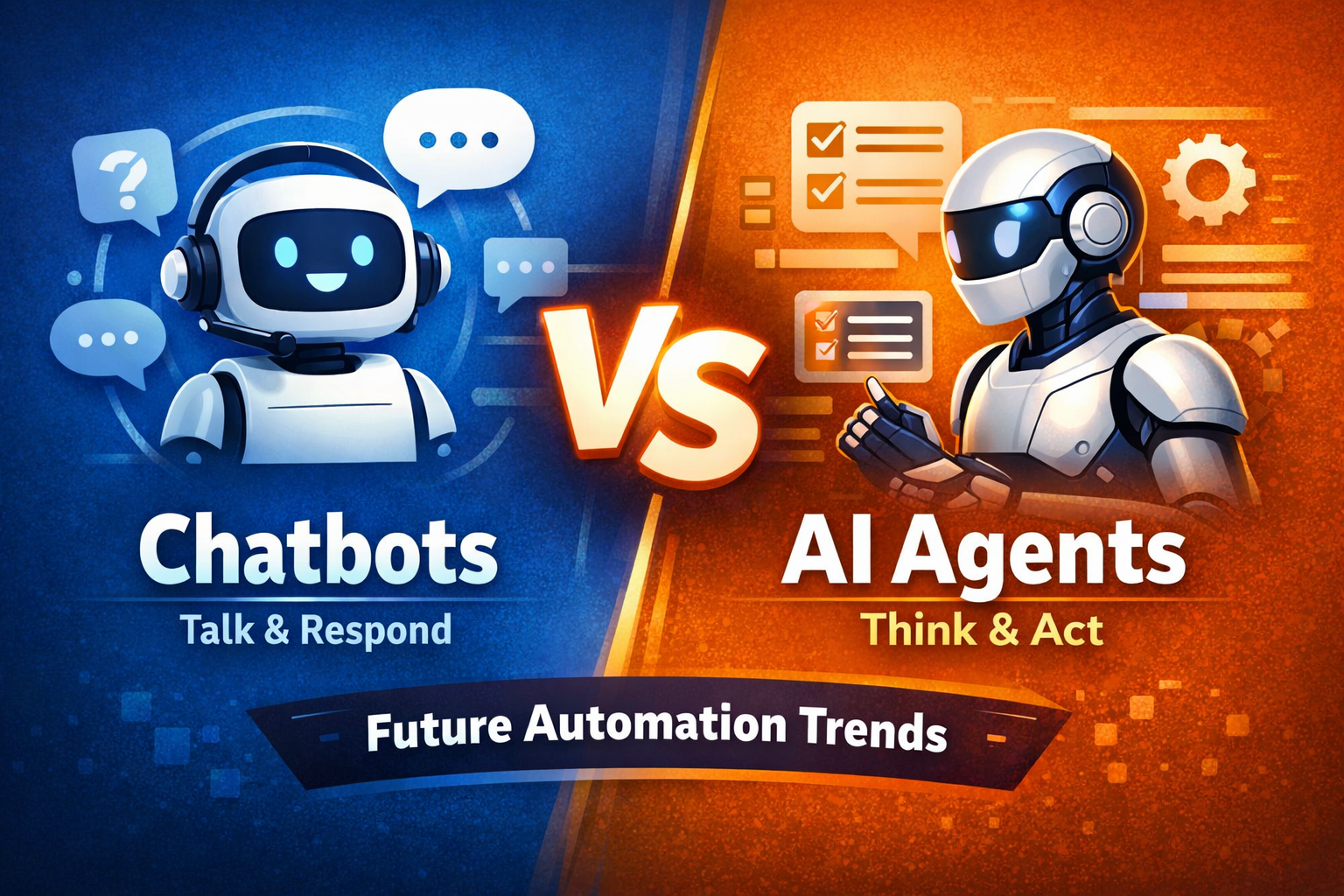
The digital interface is undergoing a profound transformation. The static websites and simple scripted responders of the past are giving way to dynamic, intelligent systems that don’t just communicate but act. At the heart of this shift lies a critical evolution: from the reactive Chatbots we know today to the proactive AI Agents defining tomorrow. As we stand in 2026, this isn’t merely an upgrade in technology; it’s a fundamental reimagining of how businesses operate, how services are delivered, and how value is created in an automated world. Understanding the distinction between these two paradigms is essential for any organization navigating the future.AI Agents vs Chatbots: Future Automation Trends
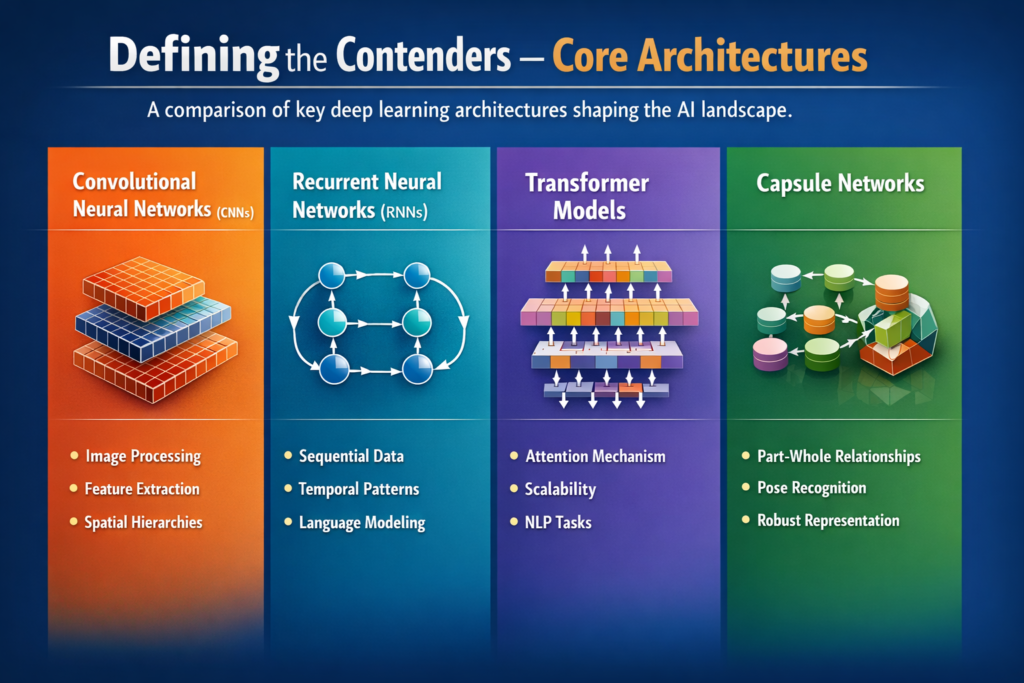
Part 1: Defining the Contenders – Core Architectures
Chatbots: The Rule-Based Responders
A chatbot is a software application designed to simulate human conversation, primarily through text or voice interfaces. Its architecture is fundamentally reactive and deterministic.
- Technology Core: Traditionally built on rule-based systems or, more recently, Natural Language Processing (NLP) and Machine Learning (ML) models, like the transformer architectures powering Large Language Models (LLMs).
- How It Works: A user provides an input (a query). The chatbot analyzes this input against a set of pre-defined rules, intents, and trained dialogues. It then selects the most appropriate pre-programmed response or generates a relevant text string based on its training data. Its primary function is conversation.
- Key Limitation: Its universe is confined to the chat window. It can inform, answer, and guide based on its knowledge, but it cannot, on its own, execute actions in external systems. It’s a sophisticated, sometimes remarkably fluent, interface layer.
AI Agents: The Autonomous Goal-Completers
An AI Agent is a system that perceives its environment, makes decisions, and takes actions to achieve specific goals autonomously. It uses a foundation model (like an LLM) not as the end product, but as its reasoning engine.
- Technology Core: Built on an “agentic” framework that typically includes a planning module, a memory (short-term and long-term), and tool-use capabilities via APIs. The LLM acts as the core reasoning and planning brain.
- How It Works: Given a high-level goal (e.g., “Plan and book a full business trip to Berlin for me next week”), the agent:
- Plans: Breaks the goal into sub-tasks (research flights, check calendar, find hotels matching preferences, book restaurant).
- Acts: Uses its available tools—a flight booking API, a calendar app, a web browser, an email client—to execute each task.
- Observes: Reviews the results of its actions (e.g., “Flight booked, confirmation number XYZ”).
- Iterates: Loops this plan-act-observe cycle until the goal is completed or it encounters an unrecoverable error requiring human intervention.
- Key Strength: Its universe is the entire digital (and, increasingly, physical) ecosystem it can access via its tools. It is an autonomous operator.
| Feature | Chatbot | AI Agent |
|---|---|---|
| Core Function | Conversation & Response | Goal Completion & Action |
| Architecture | Reactive, Dialog-Focused | Proactive, Goal-Oriented |
| Intelligence | Pattern Recognition, Language Generation | Strategic Planning, Sequential Decision-Making |
| Scope | Confined to its interface/application | Expands across any connected tool or system (APIs, web, software) |
| Output | Information, Answers, Guidance | Completed Tasks, Transactions, Created Assets |
| Autonomy Level | Low (follows script/rules) | High (makes decisions to achieve goals) |
| Example Metaphor | A knowledgeable librarian who can answer questions. | A personal assistant who receives an instruction and handles the entire project. |
Part 2: The State of Play in 2026 – From Support to Strategy
By 2026, the landscape has clarified. Chatbots have not disappeared; they have matured and found their definitive role. AI Agents, meanwhile, have moved from research labs and proofs-of-concept into the operational backbone of leading enterprises.
Chatbots in 2026: The Hyper-Personalized Front Door
The chatbot of 2026 is vastly more capable than its predecessors. Powered by fine-tuned, domain-specific LLMs, it delivers hyper-contextual support.
- Ubiquitous & Specialized: They are embedded everywhere—websites, internal HR portals, product interfaces—but are no longer generic. A banking chatbot understands complex financial products; a healthcare bot navigates medical jargon and privacy protocols.
- Multimodal Mastery: Conversation seamlessly blends text, voice, and visual elements. A customer can show a broken part via camera, and the bot identifies it, pulls up the manual, and initiates a warranty process.
- Primary Role: Tier-0/Tier-1 support, qualification, and personalized engagement. They handle ~80% of routine inquiries, collect rich context, and warm-transfer highly complex issues to human agents with full transcripts and sentiment analysis.
AI Agents in 2026: The Silent Workforce
AI Agents have become the “silent workforce” automating end-to-end processes across departments.
- In Operations & IT: Self-Healing Systems. An IT operations agent monitors network performance, predicts a failure based on trends, provisions a replacement resource, re-routes traffic, and logs a ticket—all before a human is aware of an issue.
- In Finance & Accounting: Autonomous Bookkeepers. An agent receives receipts, categorizes expenses against policy, populates the ledger, reconciles transactions, and flags anomalies for review, closing the books in real-time.
- In Sales & Marketing: Personalized Campaign Executors. Given a goal to “increase engagement with leads from the last webinar,” an agent segments the audience, generates personalized email copy, schedules sends, monitors responses, and updates the CRM, iterating on subject lines based on open rates.
- In Software Development: Full-Stack Contributor. A developer agent, given a feature spec, can write code, run unit tests, debug errors, submit a pull request, and even respond to review comments, acting as a true (if junior) team member.
The dichotomy is clear: Chatbots are primarily about interaction; AI Agents are about execution.
Part 3: The Technical & Ethical Frontier: Challenges in an Agentic World
The rise of autonomous AI Agents brings a host of complex challenges that 2026 is actively grappling with:
- The Hallucination & Reliability Problem: An agent making decisions based on an LLM’s flawed reasoning can have real-world consequences. A booking agent might misinterpret a policy and reserve a non-refundable flight on the wrong date. Solutions in 2026: Robust validation frameworks where agents must cite sources, propose actions for human sign-off on critical steps, and run simulations in “sandboxed” environments before live execution.
- Security & Authorization: An agent with access to email, financial systems, and databases is a powerful attack vector. The principle of least privilege is paramount. Solutions in 2026: Advanced agent-identity management and dynamic permissioning systems that grant temporary, context-specific access tokens, coupled with continuous behavioral anomaly detection.
- The Orchestration Problem: As companies deploy dozens of specialized agents (sales agent, support agent, logistics agent), they must collaborate. How does the customer service agent hand off a upsell opportunity to the sales agent seamlessly? Solutions in 2026: Emergence of Agent Orchestration Platforms (AOPs) that manage inter-agent communication, conflict resolution, and workflow handoffs, creating a cohesive “agent team.”
- Cost & Latency: Autonomous reasoning chains involving multiple LLM calls and API interactions are computationally expensive and slower than a single chatbot response. Solutions in 2026: Widespread use of smaller, specialized “reasoning models” that are cheaper and faster than monolithic LLMs, combined with optimized agentic frameworks that minimize redundant steps.
- Job Transformation & The Human-in-the-Loop: The narrative has shifted from “replacement” to “augmentation.” In 2026, the most valuable employees are “agent managers” or “orchestrators.” Their role is to define goals, supervise agent output, handle exceptional cases, and provide the ethical and strategic oversight that machines lack. The demand for critical thinking, creativity, and emotional intelligence has skyrocketed.
Part 4: The Future is Hybrid: Symbiotic Systems
The most powerful automation systems in 2026 are not purely agentic. They are hybrid, symbiotic architectures that leverage the strengths of both paradigms.
The Customer Experience Loop:
- A Chatbot (the engaging interface) first interacts with a customer, understanding their need in natural language.
- Recognizing a complex, multi-step request (e.g., “I want to modify my subscription and get a refund for last month because I didn’t use feature X”), it hands off context to an AI Agent.
- The AI Agent (the silent executor) goes to work: it pulls the customer’s usage logs, validates the claim against policy, calculates the prorated refund, processes the subscription change in the billing system, and initiates the refund transaction.
- The Chatbot is notified of the agent’s completion and returns to the customer to deliver the outcome in a friendly, conversational manner: “All done! I’ve changed your plan and a refund of $XX is on its way to your original payment method in 5-7 days.”
This creates a seamless experience where the user enjoys natural interaction while complex backend operations are handled autonomously.
Part 5: Looking Beyond 2026 – The Trajectory of Automation
As we peer past 2026, the trajectory points toward:
- Swarm Intelligence: Teams of agents collaborating in real-time, much like an ant colony, to solve massive, complex problems (e.g., dynamic global logistics optimization, real-time urban traffic management).
- Embodied Agents: AI agents moving beyond the digital realm to control physical machinery—robots in warehouses, maintenance drones in factories, autonomous delivery vehicles—with the same goal-oriented reasoning.
- Strategic Co-Pilots: Agents evolving from task-completers to strategic partners. An agent could be tasked with “maximizing profitability in the Asia-Pacific region Q3” and would autonomously analyze markets, adjust digital ad spend, recommend pricing shifts, and identify partnership opportunities, presenting a full strategic plan for executive approval.
Conclusion: The New Automation Imperative
The journey from chatbots to AI agents represents the maturation of AI from a tool of assistance to a driver of autonomous action. In 2026, chatbots remain vital as the sophisticated, humane face of digital interaction. But the transformative power lies with AI Agents, the silent engines automating core business processes and driving unprecedented efficiency.
For organizations, the imperative is clear. The question is no longer “Should we have a chatbot?” but “Where can we deploy goal-oriented autonomy?” The future belongs to those who can effectively orchestrate these hybrid human-agent systems, leveraging chatbots for unparalleled engagement and AI agents for unstoppable execution. The automation future is not about talking to machines; it’s about building machines that work for you.