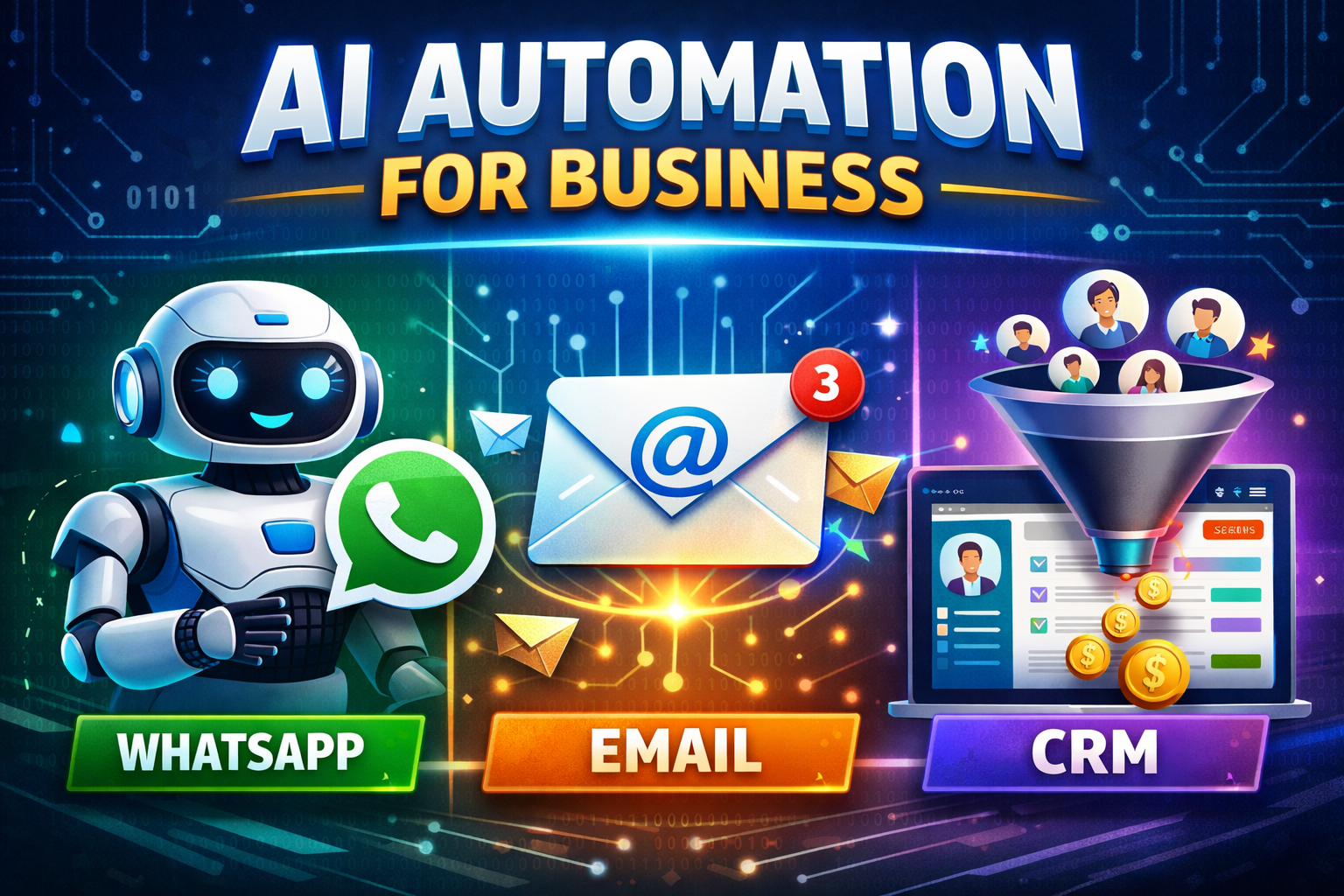
Discover how AI automation transforms WhatsApp, Email, and CRM systems. This comprehensive 3000-word guide explores strategies, tools, and real-world applications to boost efficiency, enhance customer engagement, and drive revenue—all with a focus on SEO-rich, original insights.AI Automation for Business
In today’s hyper-competitive digital landscape, businesses face a relentless challenge: to do more with less, to personalize at scale, and to be available 24/7 without exhausting human resources. The answer to this modern dilemma lies in Artificial Intelligence (AI) automation. By integrating AI into core communication and customer relationship management channels—specifically WhatsApp, Email, and CRM systems—companies are not just optimizing tasks; they are fundamentally redefining their operational DNA.
This deep dive explores the transformative power of AI automation across these three critical pillars. We move beyond buzzwords to provide a actionable, detailed blueprint for leveraging AI to enhance customer experience, streamline sales funnels, and unlock data-driven insights that were previously inaccessible. From the conversational power of WhatsApp bots to the predictive analytics of smart CRMs, we will examine how to build a cohesive, intelligent ecosystem that drives tangible business growth.
The Indispensable Trio – Understanding the Channels
Before delving into automation, it’s crucial to understand the unique role each channel plays in the modern business stack.
- WhatsApp Business & API: With over 2 billion users globally, WhatsApp has evolved from a personal chat app to a vital business tool. Its strengths are immediacy, high open/response rates, and rich media support. It excels in conversational commerce, real-time support, and personalized notifications.
- Email Marketing: Often declared obsolete, email remains the backbone of digital marketing. It is unparalleled for delivering structured, rich content, nurturing leads over time, and driving conversions through targeted campaigns. Its asynchronous nature allows for thoughtful, detailed communication.
- Customer Relationship Management (CRM): The CRM is the central nervous system of customer data. It consolidates interactions, purchase history, preferences, and communication logs from all channels. Its power is not in outward communication per se, but in organization, insight, and triggering automated workflows.
The synergy between them is where magic happens: A WhatsApp interaction updates the CRM, which triggers a personalized email sequence, the engagement from which is logged back into the CRM to refine the customer’s profile.
AI Automation for WhatsApp Business – The Conversational Frontline
AI transforms WhatsApp from a simple messaging tool into an intelligent conversational interface.
1. AI-Powered Chatbots & Virtual Assistants:
- 24/7 Customer Support: Handle FAQs, track orders, process returns, and book appointments instantly. An AI chatbot uses Natural Language Processing (NLP) to understand intent, not just keywords, providing human-like responses.
- Interactive Lead Qualification: Engage website visitors who click a WhatsApp CTA. The bot can ask qualifying questions (budget, timeline, needs), score the lead, and route high-intent leads directly to a sales agent with full context.
- Secure Transactions & Cart Recovery: Guide users through product selection, facilitate payments via secure gateways, and send automated reminders for abandoned carts within the WhatsApp chat.
Smart Notification & Campaign Automation:
- Personalized Broadcasts: Move beyond blasts. Use CRM data to segment audiences and send personalized product launches, offer alerts, or milestone greetings (e.g., “Happy Birthday! Here’s a special gift for you.”).
- Transactional Updates: Automate shipping confirmations, delivery ETAs, and booking reminders with real-time updates, reducing customer anxiety and support tickets.
Implementation & Tools:
- Platforms: Leverage official WhatsApp Business API through providers like Twilio, MessageBird, or Respond.io. These platforms offer built-in bot builders, analytics, and CRM integrations.
- AI/NLP Engines: Integrate with Dialogflow (Google), IBM Watson, or Amazon Lex to build sophisticated, context-aware conversational flows.
- Best Practice: Always provide a clear and quick option to escalate to a human agent. Transparency (“You’re chatting with a virtual assistant”) is key to trust.
AI-Driven Email Marketing – Beyond the Blast
AI injects precision, personalization, and predictive power into every email sent.
1. Hyper-Personalization at Scale:
- Dynamic Content: AI algorithms can customize entire email blocks based on user behavior, demographics, or past purchases. One recipient sees hiking gear, another sees running shoes—all from the same campaign.
- Predictive Product Recommendations: Like Amazon’s “customers who bought this…” but for email. AI analyzes browsing and purchase history across all users to predict what a specific individual is most likely to want next.
- Send-Time Optimization: Instead of guessing, AI analyzes individual recipient open patterns to determine the exact day and time each person is most likely to engage, dramatically increasing open rates.
2. Intelligent List Management & Segmentation:
- Behavioral Triggers: Automate emails based on user actions (e.g., browsed a category but didn’t buy, downloaded a whitepaper, visited pricing page). AI can define complex segments (e.g., “high-engagement, price-sensitive leads”).
- Churn Prediction & Reactivation: AI models identify subscribers showing signs of disengagement (e.g., declining open rates). It can automatically trigger a targeted win-back campaign before they are lost for good.
3. Content & A/B Testing Evolution:
- Subject Line & Copy Optimization: Tools like Phrasee or Persado use generative AI to create and test thousands of subject line variations, learning which emotional and linguistic triggers drive the best results for your audience.
- Automated A/B Testing: Go beyond testing two subjects. AI can continuously multivariate test subject lines, images, CTAs, and send times, automatically rolling out the winning combination to the broader list.
Implementation & Tools:
- Advanced ESPs: Platforms like Brevo (formerly Sendinblue), HubSpot, ActiveCampaign, and Mailchimp now bake significant AI features into their core offerings.
- Specialist AI Add-ons: Consider Seventh Sense for send-time optimization or Zeta Global for advanced predictive analytics.
- Best Practice: Use AI to enhance human creativity, not replace it. The strategy and brand voice must be human-led; AI executes and optimizes.
The AI-Powered CRM – The Intelligent Brain Center
Modern CRM systems, or “Customer Data Platforms (CDPs),” are no longer just databases. They are proactive, predictive engines.
1. Predictive Analytics & Scoring:
- Lead Scoring 2.0: Traditional scoring rules are static. AI-driven scoring analyzes thousands of data points (website visits, email engagement, social activity, firmographics) to dynamically rank leads based on their real-time likelihood to convert.
- Forecasting Accuracy: AI models analyze pipeline data, historical win rates, and deal velocity to provide far more accurate sales forecasts, removing gut feeling from the equation.
2. Automated Data Hygiene & Enrichment:
- Smart Data Entry: AI can automatically log emails, calls, and meetings, populate missing contact information, and even suggest relevant notes or tags based on conversation content.
- Duplicate Merging & Cleansing: Continuously identify and merge duplicate records, ensuring a single, accurate customer view.
3. Prescriptive Insights & Next-Best-Actions:
- Sales Assistant AI: Tools like Salesforce Einstein or HubSpot AI analyze deal stages and communication patterns to recommend the “next best action”—e.g., “Send a case study to this prospect now,” or “Follow up on the pricing question from last week.”
- Churn Risk Alerts: For existing customers, AI can flag accounts showing red flags (e.g., reduced usage, support ticket sentiment turning negative), enabling proactive retention efforts.
Implementation & Tools:
- Native AI CRMs: Salesforce (Einstein), HubSpot (AI Features), Zoho CRM (Zia) are leaders with deeply integrated AI.
- Integration-First Approach: Ensure your chosen CRM has robust native integrations or API connections (via Zapier or Make) with your WhatsApp and email platforms to create a closed-loop system.
- Best Practice: AI in CRM is only as good as the data fed into it. Prioritize clean, consistent data entry processes from the start.
Integration – Building Your Cohesive AI Automation Ecosystem
The true exponential value is realized when WhatsApp, Email, and CRM are not automated in silos but are integrated into a single, intelligent workflow.
The Seamless Workflow in Action:
- A lead submits a “Request a Demo” form on your website.
- CRM Action: The lead is created in your CRM, triggering an AI scoring model.
- Email Action: Instantly, an automated, personalized confirmation email is sent with relevant resources.
- WhatsApp Action: Simultaneously, an AI chatbot sends a WhatsApp message: “Hi [Name], saw you requested a demo for [Product]. Are you looking to solve [problem based on form data]? I can help schedule or answer quick questions now!”
- CRM Update: The lead’s response (or non-response) on WhatsApp is logged in the CRM, updating their score and profile.
- Next-Best-Action: The CRM’s AI recommends the sales rep to send a specific case study via email the next day if the WhatsApp engagement was high.
This creates a omnichannel, context-aware conversation with the prospect, managed and optimized by AI.
The Strategic Imperative – Overcoming Challenges and Future-Proofing
Key Challenges & Mitigations:
- Data Privacy & Compliance: Adhere strictly to GDPR, CCPA, and WhatsApp’s policies. Obtain explicit consent, be transparent about AI use, and allow easy opt-outs.
- Loss of Human Touch: Use AI for scalability and efficiency, but design workflows that seamlessly hand off complex, emotional, or high-value interactions to skilled humans.
- Implementation Cost & Skill Gap: Start small. Pilot AI automation on one high-impact use case (e.g., lead qualification). Invest in training for your marketing and sales teams to work with AI.
The Future Horizon:
- Generative AI Integration: Tools like ChatGPT will move beyond copywriting to generate entire, personalized communication sequences across channels based on a customer’s journey stage.
- Predictive Customer Journeys: AI will not just react but proactively design and map out the optimal next steps for each individual customer across all channels.
- Voice & Multimodal AI: Voice notes on WhatsApp could be analyzed by AI for sentiment, and future CRMs might integrate visual data from customer interactions.
Conclusion: Embracing the AI-Augmented Business
AI automation for WhatsApp, Email, and CRM is not a futuristic concept—it is an operational necessity for businesses aiming to thrive in the 2020s and beyond. The goal is not to create a cold, robotic enterprise but to liberate human talent from repetitive tasks, allowing teams to focus on strategy, creativity, and building genuine relationships where it matters most.
By strategically implementing the tools and frameworks outlined in this guide, businesses can achieve a powerful synergy: the scalability of automation combined with the depth of personalization. The result is a more resilient, responsive, and customer-centric organization, poised to convert everyday interactions into lasting loyalty and sustainable growth. The journey begins with a single automated workflow—the key is to start, learn, and iteratively build your intelligent business ecosystem.