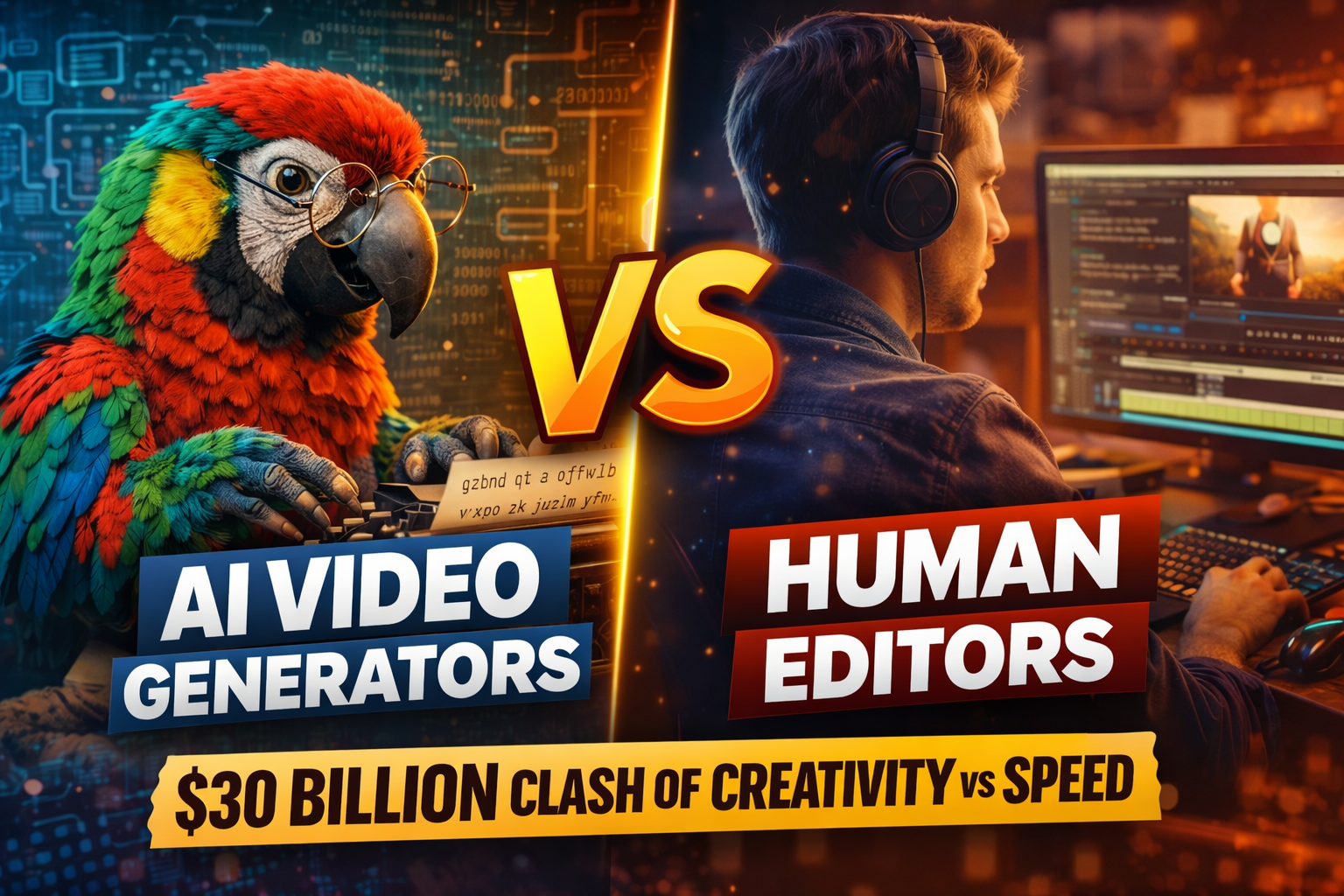
The video production landscape is currently experiencing its most significant tectonic shift since the transition from analog tape to Non-Linear Editing (NLE) software. On one side of the ring, we have AI video generators and AI-assisted tools that promise to turn text into 4K footage in under sixty seconds. On the other side, we have the Human Editor—a craftsman with a timeline, a trackpad, and two decades of accumulated creative scars.AI Video Generators vs. Human Editors: The $30 Billion Clash of Creativity vs. Speed
As we move through 2024 and into 2025, the debate is no longer “if” AI will replace editing, but “where” the line is drawn. For content creators, marketing directors, and post-production houses, choosing between the two is not about picking a winner; it is about understanding the specific weight class each competitor fights in.
This article is a deep dive into the raw economics, the creative psychology, and the technical limitations of both entities. We are leaving the generic “pros and cons” lists behind. Instead, we are analyzing this battle through the lens of ROI, creative nuance, and industry survival.
Part 1: Defining the Contenders
Before we judge the fight, we must understand the physiology of the fighters.
The AI Video Generator: The Stochastic Parrot
Modern AI video generators (Runway Gen-2/Gen-3, Pika, Kling, and the upcoming Sora) operate on diffusion models. They have been trained on millions of hours of footage to statistically guess what pixel should come next. They do not “understand” a brief in the human sense; they recognize patterns.

- Core Strength: Speed and non-linearity. An AI can generate 100 variations of “a blue car driving through a cyberpunk city at night” in the time it takes a human to locate the stock footage folder.
- Core Weakness: It has no memory of the footage it created five minutes ago. It has no ego, but it also has no emotional connection to the project.
The Human Editor: The Interpretive Artist
The human editor (often a motion graphic artist, colorist, and sound designer rolled into one) uses tools like Premiere Pro, DaVinci Resolve, or Final Cut. Their workflow is intentional. Every cut, every J-cut, and every color grade is a decision based on narrative psychology.
- Core Strength: Contextual empathy. An editor knows that a 2-frame flash frame of a face can induce subconscious unease in a horror trailer, or that holding on a reaction shot for an extra half-second can make a million-dollar commercial go viral.
- Core Weakness: Biological limitations (sleep, burnout, processing speed) and billing rates.
Part 2: The 5 Rounds of Technical and Creative Judgment
To truly SEO optimize this comparison, we must look at specific metrics: Speed, Cost, Creativity, Technical Mastery, and Scalability.
Round 1: Speed & Turnaround (Winner: AI)
If the metric is “ugly but done,” AI wins by knockout.
The AI Workflow:
A social media manager needs a 15-second background loop of “abstract golden data flowing through fiber optic cables.” With a tool like Pika or Runway, this takes 90 seconds. No render queue, no export settings, no media management.
The Human Workflow:
The human editor must either shoot this (requiring lights, a set, and a macro lens) or license it from Getty/Storyblocks. Even with pre-existing assets, cutting a mood-based loop takes roughly 30–60 minutes including color correction.
The Verdict: For hyper-speed trend jacking (TikTok trends lasting 48 hours) or for creating A/B test variants at scale, human hands are simply too slow. However, speed is useless if the output is wrong.
Round 2: Cost Efficiency & Hidden Fees (Winner: Human – Long Term)
At face value, AI is cheap. A Runway subscription is $15–$50/month. A human editor costs $500–$1,500 per video. However, we must account for iteration tax.
The AI Hidden Cost:
AI generation is a slot machine. To get one usable 5-second clip of a “CEO walking confidently,” you might generate 40 attempts. The fingers will be wrong. The logo on the shirt will morph into an Eldritch horror. You pay for all 40 attempts, either in compute credits or subscription tiers.
The Human Hidden Cost:
Humans are expensive upfront. But a senior editor delivers a usable first draft 90% of the time. There is no “compute waste.” Furthermore, a human manages the legal risk. AI models currently face lawsuits regarding copyright infringement (SAI v. Stability AI, Getty v. Stability). If you use AI commercially, you risk your IP being contested. A human editing licensed stock footage or original footage provides a clean chain of title.
The Verdict: AI wins the “first dollar” cost. Human editors win the “last dollar” cost and legal safety.
Round 3: Creative Problem Solving & Nuance (Winner: Human)
This is the non-negotiable gap.
The Human Intuition Factor:
Imagine a brief: “We need the audience to cry here.”
- The AI: Looks for visual tags—rain, sad faces, grey scale.
- The Human: Cuts from a wide shot of a couple arguing to an extreme close-up of a single tear hitting a wedding ring. The human applies a slight power window in DaVinci Resolve to darken the background, forcing the viewer’s eye to the tear. They then sidechain compress the music to duck under the sound of the tear hitting the metal.
AI cannot invent technique; it can only remix existing technique. Editing is not just about joining clips; it is about manipulating time and space to mimic human emotion. This is the “Uncanny Valley” of video editing. AI videos often feel floaty and dreamlike because the AI lacks the aggressive, intentional rhythm that defines premium content.
The Prompt Ceiling:
There is a concept called the “Prompt Ceiling.” You can write a prompt like “make this sadder,” but the AI doesn’t know that adding a 23% teal tint to the shadows and lifting the blacks by 5 IRE units creates a specific melancholic film stock look (Kodak Vision3 500T). A human editor does.
Round 4: Technical Mastery & Fidelity (Winner: Human)
Let’s look at the raw export.
AI Artifacts:
Despite advances in Sora and Kling, AI generated video struggles with:
- Physics: Objects don’t obey gravity correctly. Liquids behave weirdly.
- Consistency: Character walk into a doorframe and emerge with a different hairstyle.
- Typography: AI cannot render specific fonts or logos reliably.
- High Motion: Fast action sequences degrade into mush.
Human Technical Output:
A human editor outputs ProRes 4444 or DNxHR. They output in specific color spaces (Rec. 709 for broadcast, Rec. 2020 for HDR). They can do object removal with masks that actually track the movement of the actor. They can stabilize footage that was shot on a shaky iPhone using Warp Stabilizer without introducing the “jelly wobble.”
The Verdict:
If you need broadcast standards, theatrical release, or high-end corporate work where the CEO’s watch must display the correct time, AI is currently unusable. Human technical precision remains the gold standard.
Round 5: Scalability & Personalization (Winner: AI)
This is where the market is shifting fastest.
Dynamic Creative Optimization (DCO):
If you are running Facebook/Instagram ads for an e-commerce brand, you need 500 variations of a video. Different hooks, different accents, different product colors.
- Human: Would require an army of junior editors. This costs hundreds of thousands of dollars.
- AI: Can generative fill these variations. AI can take one master talking head video and lip-sync it into Spanish, Japanese, and Hindi with perfect mouth movement (HeyGen, Rask.ai).
The Verdict:
For 1:1 personalization (every viewer sees a slightly different ad tailored to their browsing history), AI is the only viable solution. Humans cannot compete with generative volume.
Part 3: The Silent Revolution – AI as the “Junior Editor”
The biggest mistake in the “AI vs Human” debate is framing it as a war. In reality, successful post-production houses are adopting a Cyborg Model.
Think of AI not as the Oscar-winning editor, but as the highly efficient, slightly erratic intern.
The New Hybrid Workflow:
- Ideation (Human): The Creative Director writes the script and storyboard.
- Asset Generation (AI): Instead of spending $50k on a stock footage license, the team generates 80% of the B-roll using generative AI (landscapes, transitions, abstract textures). This is cheap and limitless.
- Assembly (AI + Human): The editor uses AI tools within Premiere Pro (Adobe Sensei) or DaVinci Resolve to auto-transcribe the footage, auto-reframe for vertical/horizontal crops, and remove silences.
- The Cut (Human): The editor takes the rough AI-generated assets and the real footage. They apply the human rhythm. They fix the AI physics errors. They color match the AI clips to the live-action clips so the lighting looks consistent.
Why this works:
This model respects the intention of the creator while leveraging the grunt work of the machine. The human editor becomes the “Art Director of Pixels.” They stop spending 4 hours cutting green screen backgrounds out (AI does it in 2 clicks) and start spending 4 hours on color theory and pacing.
Part 4: Niche Warfare – Who Should Hire Whom?
To truly optimize this article for search intent, we must segment the market. Different industries have different winners.
1. The High-End Agency (Winner: Human + AI Assisted)
Scenario: Producing a Super Bowl commercial or a luxury fashion film.
Why: The nuance of brand safety is paramount. A luxury brand cannot afford an AI glitch that gives their handbag six zippers. The Human Editor is the guardian of brand equity. They may use AI for background extension or de-aging actors, but the final sign-off is human.
2. The SaaS Explainer Video (Winner: AI or Low-Tier Human)
Scenario: A 60-second whiteboard animation explaining cloud computing.
Why: This is commoditized content. It doesn’t need to win Cannes Lions; it needs to convert. Many companies are switching to AI avatars and AI voiceovers for this. However, the strategy of where to place the call-to-action button still requires human marketing psychology.
3. The News & Documentary (Winner: Human)
Scenario: War reporting, investigative journalism.
Why: Ethics. AI cannot verify sources. AI cannot look at raw footage of a protest and decide which angles to use to accurately represent the scale without inciting panic. Human editorial judgment is the cornerstone of journalism. Using generative AI in this space is currently viewed as highly unethical unless explicitly labeled as reenactment.
4. YouTube Long-Form (Winner: Human)
Scenario: A video essayist like Hbomberguy or a commentary channel.
Why: YouTube retention is brutal. You need to hook the viewer in the first 7 seconds. AI does not understand comedic timing. It does not understand the “pause” before a punchline. Human editors who specialize in YouTube are currently commanding rates of $1,500+ per video because they understand the specific rhythm of the platform.
Part 5: The Economic Reality – Job Displacement vs. Job Evolution
Let’s address the elephant in the room. Will Human Editors become extinct?
The Extinction Myth:
When the camera was invented, painters did not go extinct. Painters evolved. Photography killed realistic portraiture as a necessity, but it elevated painting into expressionism (Picasso, Warhol). The same is happening here.
Jobs that are disappearing:
- The Sub-clip Creator: The junior role of watching 10 hours of footage and logging timecodes. AI does this instantly.
- The Generic Stock Editor: Cutting together stock footage of “people shaking hands.” The CEO can now do this themselves with Canva/Clipchamp.
Jobs that are booming:
- The Prompt Art Director: Agencies are hiring “Generative AI Directors.” This is a human who understands lighting terminology, lens terminology (focal length, f-stop), and composition. They don’t code; they command the AI in its own language.
- The Deep Fixer: As companies rush to use AI, they generate thousands of videos with subtle errors. Human editors with After Effects skills are being hired specifically to “fix the AI”—to paint out the sixth finger, to stabilize the morphing face.
Part 6: The Future Forecast (2025-2027)
Prediction 1: The Death of the “Blank Page”
The most stressful part of editing is the blank timeline. In 2 years, an editor will never start from scratch. They will feed a script into a proprietary AI, get a rough cut in the brand’s style guide (learned from previous videos), and then sculpt it. This cuts production time by 70%.
Prediction 2: AI Training becomes a Human Specialty
AI models are stupid. They need high-quality data to learn. The highest-paid editors in 2026 will not be the ones cutting videos; they will be the ones cutting training sets for major AI companies. They will curate the perfect footage to teach the AI what “cinematic lighting” actually looks like.
Prediction 3: The Rise of the Local Model
Currently, AI video generation happens in the cloud (privacy risk). Major studios refuse to upload unreleased footage to public servers. We will see a surge in local AI generation (running models on local RTX 6000 GPUs). This will require human IT/editors who understand both codecs and neural networks.
Part 7: The Verdict – It’s Not a Competition; It’s a Symbiosis
To summarize this 3000-word analysis for the SEO skimmers:
Choose AI Video Generators when:
- You need quantity over quality (1000 ad variants).
- You have zero budget but need a visual placeholder.
- You need to visualize a concept instantly for a client pitch.
- You lack access to a physical film set or specific locations.
Choose Human Editors when:
- The project carries the weight of a brand legacy.
- Emotional manipulation (horror, romance, drama) is required.
- You are dealing with sensitive human stories.
- You need to output in specific broadcast/cinema technical specs.
- You want the video to be timeless, not just timely.
The Final Takeaway:
The human editor is not dying; they are being upgraded. The value of the editor is shifting from button pusher to decision maker. Anyone can push a button to generate a video of a cat in a spaceship. Not everyone knows why that cat should be looking camera-left to match the eyeline of the host.
In the battle of AI vs Human Editors, the human doesn’t win by competing on the machine’s terms (speed). The human wins by doubling down on the one thing the machine will never possess: the experience of being human, and the desire to communicate that experience to others.