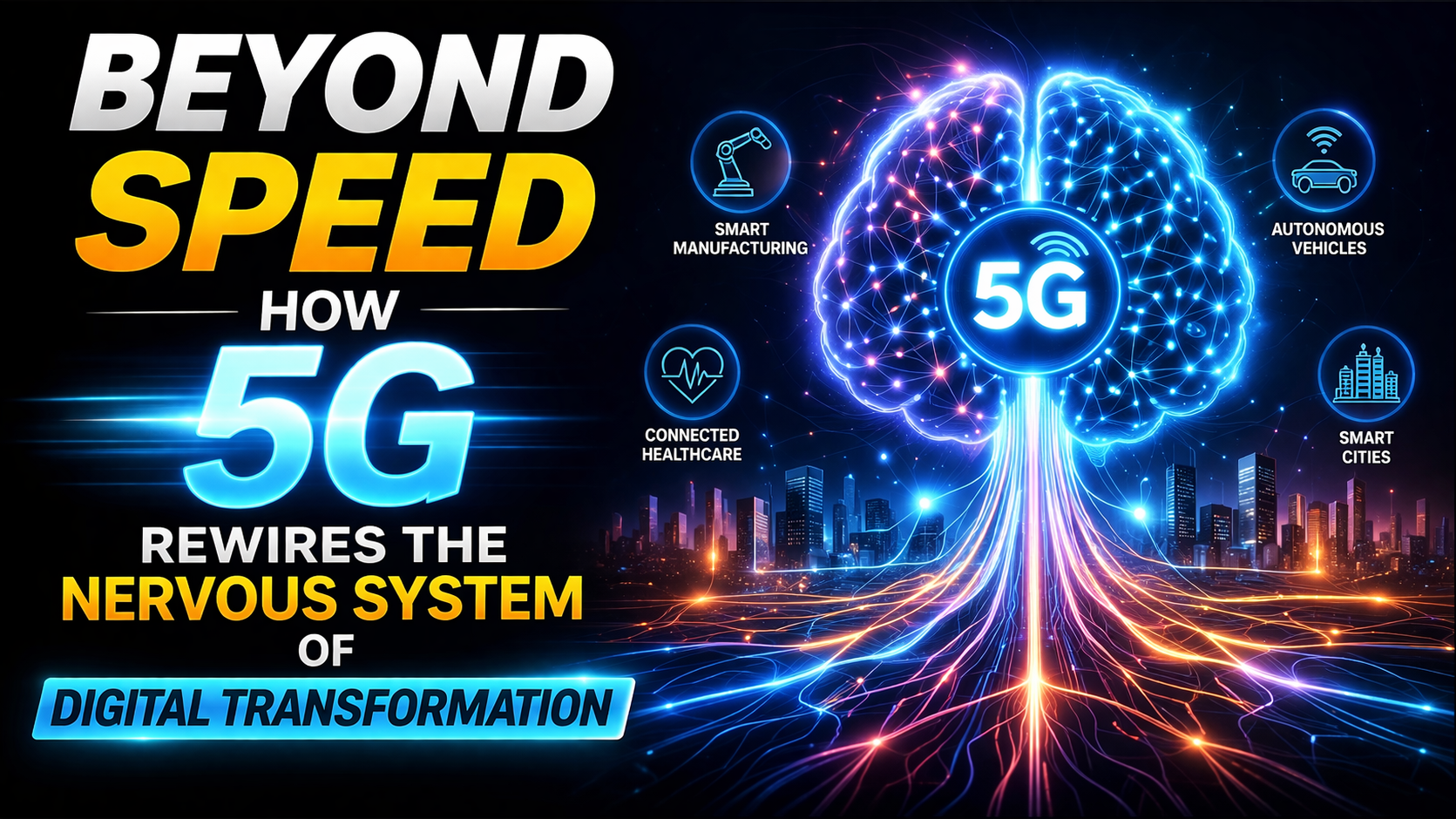
Beyond Speed How 5G Rewires the Nervous System of Digital Transformation For the better part of the last decade, “digital transformation” has been the corporate world’s North Star. It has meant moving spreadsheets to the cloud, putting customer data into CRMs, and holding Zoom calls instead of boardroom meetings. We have digitized documents, automated workflows, and talked endlessly about agility. But let’s be honest with ourselves: most of what we’ve called digital transformation so far has been a migration of existing processes onto faster horses. We built better interfaces, but the underlying reality of how machines, humans, and data interact remained largely tethered to the same physical limitations: latency, bandwidth bottlenecks, and the tyranny of the cable.
Enter 5G. Not the marketing slogan. Not the slightly faster download speed for your Netflix queue. The real 5G. The one that operates in the messy, physical, unpredictable world of factories, ports, farms, and emergency rooms. The impact of 5G on digital transformation is not incremental. It is foundational. It shifts the locus of intelligence from centralized clouds to the very edge of action. It transforms connectivity from a utility into an orchestrator of reality. If previous generations of wireless tech made information mobile, 5G makes action mobile. And that changes everything.
The Latency Lie We All Believed
To understand the true impact, we have to first unlearn what we think we know about speed. For years, the digital transformation narrative has been obsessed with throughput—how many gigabytes per second can we push? 5G delivers that, sure. But the real revolution hides in a number most executives ignore: one millisecond.
Latency is the pause between command and execution. It is the time it takes for a sensor in a factory to tell a robotic arm to stop before it crushes a worker. It is the gap between a surgeon’s hand moving and a scalpel 500 miles away responding. On 4G, that latency is around 30 to 50 milliseconds. On Wi-Fi 6, in ideal conditions, you might get down to 10 or 15. On 5G Ultra-Reliable Low Latency Communication (URLLC), we are talking about 1 millisecond—end to end.
That number, 1ms, is the threshold where the physical world and the digital world become indistinguishable. When latency drops below the human nervous system’s reaction time (around 250ms for visual stimulus), the difference between being “there” and “here” evaporates. Digital transformation up until now has been asynchronous—you type, the cloud thinks, the result appears. With 5G, transformation becomes synchronous. Machines no longer need to ask permission from a faraway server. They can react, adjust, and collaborate in real-time, in the same breath as the physics they are trying to control.
This isn’t about faster video calls. This is about closing the loop between data and action so tightly that the digital twin and the physical asset become one and the same. When you achieve that, every industry reorients itself.
The Factory Floor Stops Being a Cage
Consider manufacturing, the original crucible of industrial transformation. For the past twenty years, factories have been littered with sensors, cameras, and programmable logic controllers (PLCs). But almost all of them are wired. Not because engineers love cable trays and conduits, but because wireless was too unreliable, too slow, too jittery. Every time a factory manager tried to cut a cable, they introduced a point of failure. So the factory floor remained a cage of copper and fiber, rigid and expensive to reconfigure.
5G breaks those chains. A factory equipped with a private 5G network (a localized, dedicated slice of spectrum) can reconfigure its entire production line overnight, not over months. Need to move a vision inspection system to a different station? Unplug it. Roll it over. It connects automatically to the 5G network with the same latency and reliability as if it were hardwired. Need to add ten new autonomous mobile robots (AMRs) for a holiday rush? They join the network and start coordinating collisions at millisecond intervals without saturating the airwaves.
But the deeper impact is on quality control. Today, most quality inspections happen at the end of the line. A part is made, then inspected, then either passed or scrapped. That’s reactive. With 5G, you can place high-resolution cameras and AI inference engines at every single station. As a component is machined, a 4K video stream feeds into an edge server on the factory floor—not some distant cloud—and within 2 milliseconds, an algorithm decides if a cutting tool is dulling. It sends a command back to the machine tool to adjust feed rates in real time. The defect never happens. You aren’t inspecting for quality; you are producing quality through a continuous digital feedback loop.
This is digital transformation not as a project, but as a material property of the production process. And it is only possible when the network has the deterministic performance that 5G provides. The factory transforms from a place where things are made to a place where things learn how to be made better, every single cycle.
The Edge Becomes the New Cloud
For the last decade, cloud computing has been the engine of transformation. Push everything up to AWS, Azure, or Google. Run massive analytics. Send the results back down. This worked brilliantly for batch processes: monthly reports, customer segmentation, inventory forecasting. But it fails miserably for real-time physical systems. You cannot send a self-driving car’s steering decisions up to a cloud 200 miles away. By the time the answer comes back, the car is in a ditch.
5G forces a re-architecture of digital transformation. It doesn’t kill the cloud; it elevates the edge. Because 5G can move enormous amounts of data with almost no delay, it becomes economically and technically viable to distribute computing power everywhere: inside streetlights, on factory robots, inside hospital MRI machines, on agricultural sprayers.
This is where the real impact lives. A 5G network is not just a pipe; it is a distributed operating system for the physical world. It allows data to be processed exactly where it is generated, with the ability to escalate only the interesting, anomalous, or high-value insights to the central cloud for long-term learning.
Take a wind farm in the North Sea. Today, each turbine generates terabytes of vibration, temperature, and power output data. Sending all of that to shore via satellite or microwave is impossible. So most of it is discarded. With 5G, each turbine can have a local edge server. The turbine’s sensors stream continuously over 5G to that edge server, which runs a model that knows what “normal” looks like. The moment a bearing begins a sub-audible vibration pattern that precedes failure by three weeks, the edge server flags it. It sends a single kilobyte alert to the cloud: “Turbine 7, bearing replacement needed by May 12.” The rest of the data stays local and is deleted.
The digital transformation here is not about collecting more data. It is about turning data into judgment at the source. 5G enables a world where intelligence is not centralized but ubiquitous. The cloud becomes the brain’s long-term memory, but the edge—powered by 5G—becomes the reflexes. And in a competitive landscape, reflexes win.
The Forklift Driver Becomes a Myth
Walk into any warehouse or distribution center today. What do you see? Humans driving forklifts, scanning barcodes, pushing carts. These are not low-skill jobs, but they are jobs built around information friction. The driver has to stop, find the right pallet, scan a label, wait for the warehouse management system to confirm, then move. Each pause is a micro-failure of connectivity.
5G, combined with autonomous mobile robots (AMRs) and augmented reality (AR), transforms this space into a symphony of coordinated motion. Not in some sci-fi future. Now. A 5G-enabled AMR doesn’t need Wi-Fi handoffs every thirty feet. It maintains a continuous, low-latency connection to a fleet management edge server that knows the position of every other robot, every human, and every pallet in real time, with centimeter precision using network-based location services.
But the deeper transformation is the human-machine interface. Give a warehouse worker a set of 5G-connected AR glasses. They don’t need to stop to scan. The glasses recognize every package they look at through computer vision, streamed to an edge server that returns, within milliseconds, the destination, weight, and handling instructions overlaid directly on the worker’s field of view. A worker can pick, sort, and pack without ever putting down a scanner. Productivity doesn’t increase by 10% or 20%. It doubles. Triples. Because the worker’s hands are always moving, and their brain is always focused on the exception, not the routine.
This is the kind of transformation that changes labor markets. It doesn’t necessarily eliminate jobs; it eliminates the drudgery within jobs. But it also demands new skills. The warehouse of 2028 won’t need fifty forklift drivers. It will need five “flow coordinators” who monitor the 5G network health, five AR-assisted pickers, and a swarm of AMRs. The digital transformation enabled by 5G is not automation; it is orchestration. And orchestration requires a network that can conduct without latency.
Healthcare Leaves the Hospital
No industry is more burdened by physical constraints than healthcare. The patient has to travel to the MRI. The specialist has to travel to the patient. The ambulance has to bring the stroke victim to the neurosurgeon. Every mile traveled is a mile of risk, delay, and cost.
5G doesn’t cure diseases. But it untethers healthcare from the hospital campus. And that is a profound digital transformation of the entire care model.
Consider a stroke patient in a rural community. Today, the local ER might have a CT scanner but no radiologist trained to read it for thrombectomy eligibility. The patient waits for images to be transferred (often slowly, over VPNs or satellite links) to a regional stroke center. Minutes become hours. Brain cells die. With 5G, the CT scanner can stream the full DICOM image set in seconds to a remote neurosurgeon’s tablet. But more importantly, that neurosurgeon can now guide a local physician through an emergency procedure using haptic feedback and AR.
A 5G network with URLLC can transmit the hand movements of a specialist 200 miles away to a robotic instrument in the rural ER. The latency is 2 milliseconds. The human hand cannot perceive that delay. To the local physician watching an AR overlay, it looks like the specialist is right there, pointing, making incisions, cauterizing. The patient gets stroke care without a helicopter ride. That is digital transformation that saves lives, not just spreadsheet rows.
And outside the hospital, the transformation continues. A patient with congestive heart failure goes home wearing a 5G-enabled patch that monitors thoracic impedance, heart rate variability, and oxygen saturation continuously, not just during a 15-minute office visit. The patch streams to an edge server at the patient’s home—a small device the size of a router. That edge server runs a model that has learned the patient’s unique baseline. The moment the fluid retention pattern that precedes hospitalization begins, the edge server alerts the patient’s nurse via a standard text message, but also sends a dense packet of the preceding hour’s waveforms for confirmation. The nurse calls the patient: “Increase your diuretic by 5mg today.” The hospitalization is avoided.
This is not telemedicine. Telemedicine is a video call. This is continuous, autonomous, predictive care. And it only works when the network can support dozens of high-fidelity medical sensors in a single home, streaming simultaneously, with the reliability of a hospital-grade wired connection. That is 5G.
The City That Actually Responds
Smart cities have been a joke for a decade. We put some sensors in parking spaces and a few cameras on light poles, called it “smart,” and then watched as the data rotted in silos. The problem was never the sensors. It was the network. Cities are messy, noisy, congested environments. Wi-Fi doesn’t cover the streets. 4G gets overloaded at rush hour. And no one wants to trench fiber to every traffic light and trash can.
5G changes the urban calculus. A single 5G small cell on a light pole can cover a city block, support a million devices per square kilometer, and provide deterministic latency for safety-critical applications. Now the smart city stops being a PowerPoint slide and becomes a nervous system.
Traffic lights talk to each other over 5G, not through a central server downtown that crashed three years ago. An ambulance with a 5G modem transmits its route to every traffic light along the corridor. The lights don’t just turn green; they coordinate to create a rolling green wave that clears intersections 10 seconds before the ambulance arrives. The ambulance shaves four minutes off a response time. In cardiac arrest, those four minutes are the difference between walking out and leaving in a bag.
But the deeper transformation is environmental. A city with 5G-enabled air quality sensors on every bus and taxi can map pollution at street level, not at the one government monitor in the park. Those sensors stream to an edge server at the transit authority, which runs a dispersion model. When a diesel truck idles outside an elementary school, the system doesn’t just log it. It sends an automatic alert to the school principal and to the fleet manager. The driver gets a notification on their in-cab tablet: “Please move to designated staging area.” The system closes the loop. Data leads to action within seconds, not weeks.
This is what digital transformation looks like when it escapes the screen and enters the asphalt. It is mundane, invisible, and relentless. And it requires a network that can handle the density, mobility, and reliability of an entire city in motion. Wi-Fi cannot do that. 4G cannot do that. 5G can.
The Hard Truths Nobody Wants to Admit
For all the promise, the impact of 5G on digital transformation will be uneven, frustrating, and expensive. We are already seeing the first wave of disillusionment. Carriers rolled out “5G” that was really just repackaged 4G with better marketing. True URLLC requires standalone 5G architecture, which is still being deployed. The millimeter wave spectrum that delivers multi-gigabit speeds also stops at a wet leaf. And the devices—the sensors, the robots, the AR glasses—are still in the early, expensive phase.
Any honest assessment of 5G’s impact must acknowledge that the transformation it enables is not automatic. You cannot just buy a 5G router and become transformed. You have to re-engineer your processes, your data architecture, and your security model. A 5G network is a software-defined network. It runs on servers and switches. It can be reconfigured in minutes, but it can also be misconfigured in seconds. The same low latency that enables remote surgery also enables a hacker to cause chaos if your network slicing is not properly isolated.
Furthermore, the organizational change required is staggering. Most companies have a telecom team that buys circuits from carriers, an IT team that manages Wi-Fi, and an OT (operational technology) team that runs wired industrial networks. 5G smashes these silos. It is a wireless network that offers carrier-grade reliability. Who owns it? Who secures it? Who troubleshoots it when the latency spikes to 10ms? These are not technical questions. They are political and cultural. And they are the real barriers to transformation.
The organizations that will win are not those with the fastest 5G. They are those that understand that 5G is not a faster pipe. It is a new class of operational capability. They will build teams that combine RF engineers, cloud architects, data scientists, and process engineers. They will start not with the technology but with the physical bottleneck: the cable that cannot be cut, the latency that makes a robot unsafe, the bandwidth that forces them to discard valuable sensor data. They will deploy private 5G networks in specific, high-value zones—a factory cell, a hospital wing, a port terminal—and learn.
The Bottom Line
Digital transformation has always promised to bridge the gap between the world of bits and the world of atoms. For the past twenty years, we have done a good job with the bits. We have moved data, optimized algorithms, built beautiful dashboards. But the atoms—the physical stuff of manufacturing, logistics, healthcare, and cities—have remained stubbornly resistant. They have resisted because the network was always the weak link. It was too slow, too unreliable, too centralized.
5G is the first wireless technology designed from the ground up for the physical world. Its low latency makes remote control possible. Its high density makes ubiquitous sensing feasible. Its edge computing capabilities make real-time intelligence distributed. Its network slicing allows a single physical network to behave like dozens of dedicated, guaranteed-performance networks.
The impact on digital transformation is therefore not that we will do the same things faster. It is that we will do entirely new things. We will orchestrate fleets of robots that never collide. We will perform surgery across continents. We will predict bridge failures before the cracks show. We will build cities that breathe and respond.
But none of this is automatic. The technology is ready. The question is whether our organizations, our skills, and our imaginations are ready to use it not as a faster connection, but as a new way to close the loop between seeing and doing. That is the real transformation. And it starts at one millisecond.