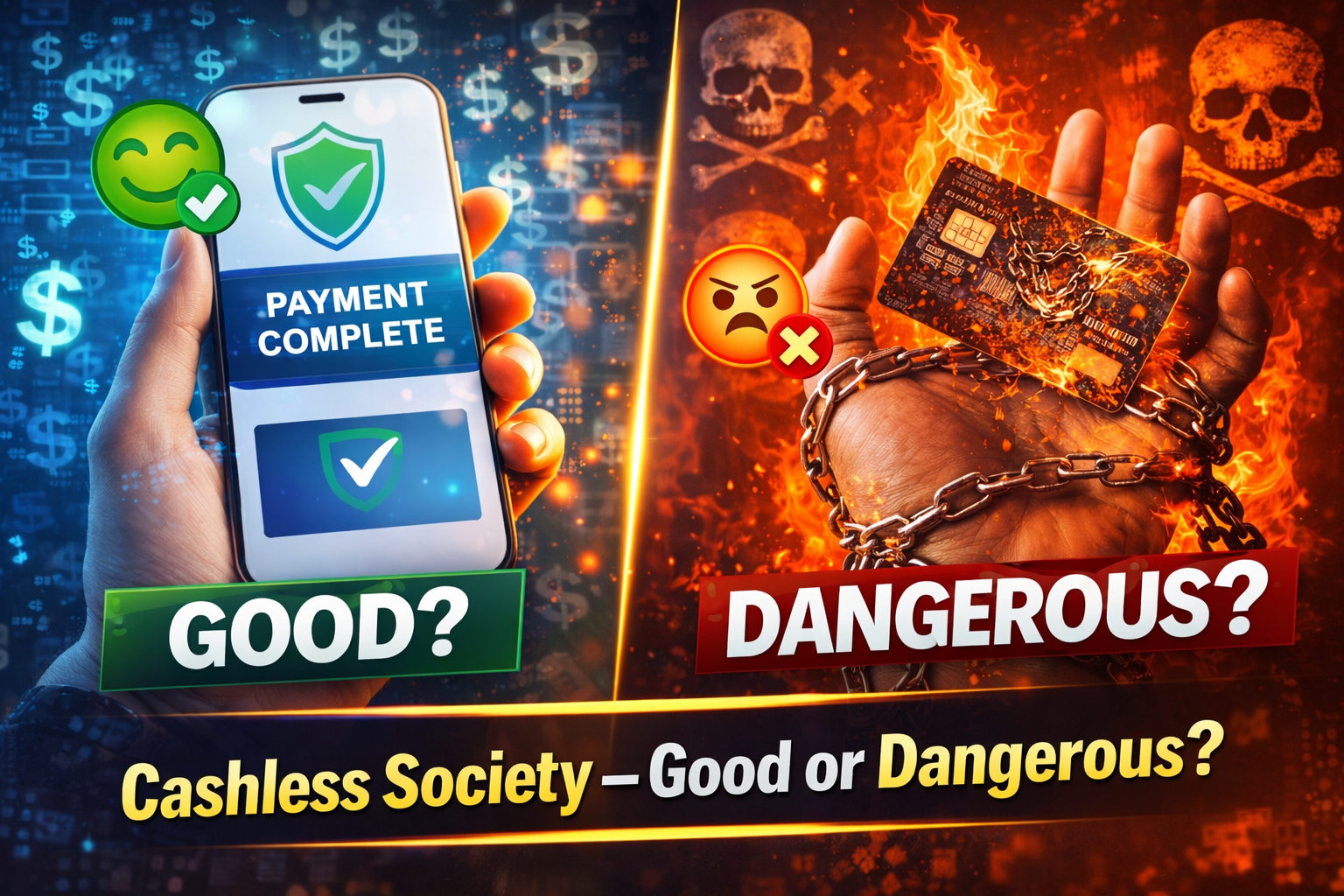
We are currently living through the fastest mass extinction of physical currency in human history. In 2010, cash accounted for over 60% of global point-of-sale transactions. By 2024, in economies like the UK, Sweden, and China, that figure has cratered to the low teens. The rise is so steep that it no longer feels like a trend; it feels like an inevitability.Cashless Society — Good or Dangerous?
But is it? The phrase “Cashless Society” evokes two radically different utopias depending on who you ask.
To a Silicon Valley technocrat, it is a frictionless paradise: no waiting for change, no bank runs, no tax evasion, and programmable money that can stimulate the economy with the click of a button. To a civil rights advocate, it is a digital cage: a world where every loaf of bread is tracked, every donation is surveilled, and the government holds the kill switch to your financial life.
This article is not here to comfort you. It is here to map the battlefield. We will examine the cashless society through the lens of freedom vs. efficiency, privacy vs. security, and inclusion vs. modernization.
Part 1: The Great Uncoupling — What We Actually Mean by “Cashless”
Before we judge the morality of the cashless society, we must define its architecture. A cashless society is not merely “not using paper money.” It is the complete digitization of value transfer, enforced by the elimination of anonymous, bearer-based currency.
There are two distinct models emerging:
1. The Private Model (The West): Dominated by Visa, Mastercard, PayPal, and Block. Transactions run through corporate rails. The government can access the data, but usually via subpoena. This is the “oligopoly” model.
2. The State Model (CBDCs): Central Bank Digital Currencies (China’s e-CNY, Nigeria’s e-Naira, and pilot programs in Europe). Here, the state issues digital cash directly to citizens, cutting out commercial banks. This money is programmable. It can expire. It can be restricted to specific geographies.
The Nuance: When someone says “cash is freedom,” they are usually defending the anonymity of the physical banknote. When someone says “cash is obsolete,” they are usually frustrated with the friction of handling physical change.
Understanding the difference between CBDC surveillance and Visa processing fees is critical to having an intelligent debate.
Part 2: The Case for the Cashless Society — Why “Good” Has Momentum
The “Good” argument is not propaganda; it is rooted in genuine, observable improvements to quality of life and macroeconomic stability.
1. The Annihilation of Friction
Consider the opportunity cost of cash. A business owner closing up shop at 9 PM does not want to count a draw of $50 bills, drive to the night deposit box, and pray they aren’t robbed. The consumer doesn’t want to stand at a vending machine that rejects their crumpled dollar bill.
The Efficiency Dividend:
The Peterson Institute for International Economics estimates that a shift to digital payments saves economies roughly 1% of GDP annually in “transaction costs”—the printing, storing, securing, and transporting of physical currency. In a country like the US, that is over $200 billion a year of productive capacity unshackled.
2. The Tax Base & The Social Contract
This is the uncomfortable truth that privacy advocates rarely address: Cash fuels the shadow economy.
In Italy, prior to digital payment mandates, tax evasion via cash-in-hand transactions was estimated at nearly 20% of GDP. That is not just “stick it to the man” behavior; that is underfunded schools, potholed roads, and crumbling hospitals. When transactions are digital, they are visible. Visibility allows for fair taxation.
The Argument: If you are operating a legitimate business and paying your fair share, a cashless society does not hurt you. It hurts your competitor who is undercutting you by not charging sales tax or paying their employees off the books.
3. Financial Inclusion (The Paradox)
It sounds counterintuitive: “How does eliminating cash help the poor? The poor use cash!”
The Unbanked Trap:
Holding cash is expensive. To cash a paycheck, an unbanked worker in the US pays check-cashing fees (often 3-5%). To pay a utility bill in cash, they must travel to a payment center, losing a half-day of wages. They cannot build credit history because their rent payments are invisible to the banking system.
A properly designed cashless system (like India’s UPI or Brazil’s Pix) drops the marginal cost of a transaction to zero. It allows a street vendor to accept payment from a tourist without needing a $200 Square terminal—just a QR code printed on cardboard. In India, UPI pulled 300 million citizens into the formal economy in under five years.
The Nuance: The good version of a cashless society includes free public infrastructure, not rent-seeking private toll roads.
4. Crime & Public Safety
It is difficult to launder money when the money leaves a digital fingerprint. It is difficult to pay a kidnapper ransom in Bitcoin when the blockchain is traceable (and stablecoins are often frozen). It is difficult to bribe a customs official with a Venmo transfer.
While sophisticated criminals will always find alternatives (art, real estate, barter), the street-level economy of illicit drugs, human trafficking, and petty corruption relies on the anonymity of the $100 bill. The US Secret Service notes that the majority of counterfeit currency operations are now tied to narcotrafficking networks that require physical cash for settlement. Drying up the cash supply starves the beast.
Part 3: The Case Against — Why “Dangerous” is Not Paranoia
If the case for cashless is efficiency, the case against is asymmetry of power. It is the fear that the infrastructure we rely on for survival is owned by entities that do not have our best interests at heart.
1. The Weaponization of Access
The Freedom Convoy Incident (2022):
In Canada, truckers protesting vaccine mandates had their bank accounts frozen, their donations halted, and their insurance policies canceled—not by criminal conviction, but by administrative order. The government did not need to prove guilt in court; they simply pressured payment processors to blacklist the donors.
The Precedent:
If the financial system can be weaponized against political dissent in a G7 nation, what happens when the system is total? If you have no cash, you cannot buy food to sustain a protest. You cannot pay for legal defense. You are financially neutered without due process.
The Counterargument: Proponents argue this is a feature, not a bug—that “hate speech” or “misinformation” should be financially deplatformed. The danger is that the definition of “hate” shifts with the party in power.
2. Privacy as a Casualty
Cash is the only truly private transaction between two consenting adults. No bank knows you bought a birthday gift for your spouse. No algorithm knows you donated $20 to a controversial politician. No data broker knows you visited a therapist.
The Surveillance Capitalism Layer:
In a cashless society, your spending habits are the product. Visa knows if you ate at McDonald’s or a salad bar. They know if you bought condoms or baby formula. This data is sold, traded, and used to profile your insurance risk, your creditworthiness, and even your political leanings.
The Intimacy Gap:
There is a psychological weight to knowing that every choice is observed. It creates a chilling effect on civil liberties. You might not buy a book about anarchism if you know the state can see the receipt.
3. The Fragility of the Digital Rails
Cash works when the power is out. Cash works when the internet is down. Cash works during a hurricane, a solar flare, or a cyberattack.
The Single Point of Failure:
In 2021, a software update at Cloudflare knocked out large swaths of European payment terminals for an hour. In 2023, a ransomware attack against MGM Resorts left Las Vegas casinos and hotels unable to process credit cards for days.
The Black Swan Risk:
A nation that is 100% cashless is one sophisticated cyberattack away from civilizational stasis. No fuel pumps. No grocery checkouts. No medicine purchases. Cash is the analog backup to a fragile digital grid.
4. The Technological Apartheid
While India’s UPI is hailed as an inclusion success, it also created a two-tiered society. The urban, smartphone-literate youth thrive. The rural elderly, the visually impaired, and those who cannot navigate a 4-inch screen are left behind.
The Unseen Poor:
Not everyone has a smartphone. Not everyone has a stable 4G signal. Not everyone has a bank account that won’t be drained by monthly maintenance fees. Forcing these populations into digital rails is not inclusion; it is coercion. It forces them to pay the “tech tax” or be excluded from commerce entirely.
Part 4: The Middle Ground — The Nordic Paradox
If we look at the nations closest to being cashless—Sweden, Norway, Finland—we see a pattern that contradicts both the utopian and dystopian narratives.
The Reality:
Sweden has vastly reduced cash usage, yet it has not banned cash. The Riksbank (Sweden’s central bank) has mandated that banks must provide some cash services. They recognize that for a segment of the population (the elderly, the rural), cash is a lifeline.
The Synthesis:
The healthiest model is not “cashless.” It is “cash-lite.” It is a society that defaults to digital for convenience and scale but preserves the option of anonymity and physical settlement.
Why This Matters:
Legislating the elimination of cash is where danger lies. Legislating the infrastructure for digital payments (interoperability, no surcharges, consumer protection) is where good governance lies.
Part 5: The Geopolitical Chessboard
The cashless debate is no longer a domestic policy issue; it is a weapon of statecraft.
China’s e-CNY:
China is not building a digital yuan to make shopping easier. They are building it to break the dominance of the SWIFT system and the US dollar. By creating a digital currency that operates on its own rails, China can offer Russia, Iran, and other sanctioned nations a way to trade without American oversight.
The Dollar’s Exorbitant Privilege:
The US has resisted a true CBDC largely because the physical dollar is already the world’s reserve currency. But if the world moves to digital state currencies, the anonymity of the US $100 bill becomes a global safe haven. Ironically, the demand for physical US currency is rising outside the US, even as it declines domestically. Foreigners hoard Benjamins as a hedge against their own governments’ digital surveillance.
Part 6: The Psychological Cost — The “Wallet as Leash”
We must address the intangible. There is a dignity to cash that is rarely discussed in economic journals.
The Dignity of Settlement:
When you hand a $20 bill to a plumber, the transaction is complete. There is no third party. There is no “pending” status. There is no risk of the payment being clawed back because the plumber’s political views fell out of favor with a payment processor.
The Generational Divide:
Younger generations view cash as dirty, inconvenient, and useless. Older generations view cash as tangible, real, and final. This is not Luddism; it is a different relationship with value. For someone who lived through hyperinflation or bank failures, a note in the mattress is freedom. A balance on a screen is a promise that can be broken.
Part 7: The Verdict — Neither Good Nor Evil, But a Question of Rights
To frame the cashless society as “Good” or “Dangerous” is to ask the wrong question. The correct question is: Who holds the power, and what are the checks on that power?
Cashless is Good when:
- It is built on open, public, interoperable infrastructure (like UPI or Pix).
- It includes strong privacy laws that prevent the sale of transaction data.
- It maintains a physical backup for times of crisis.
- It is a choice, not a mandate.
Cashless is Dangerous when:
- It is controlled by a single corporate oligopoly that extracts rent on every transaction.
- It is programmable money that allows the state to restrict what you can buy and when.
- It is the only option, forcing the vulnerable to conform to technology they cannot afford or understand.
- It lacks judicial oversight, allowing administrative freezing of assets without trial.
The Bottom Line:
We are moving toward a digital financial system. That momentum is unstoppable. The question is whether we arrive there as empowered citizens with rights and privacy, or as managed users with privileges that can be revoked.
Cash is not perfect. It enables crime, it is inefficient, and it excludes the digitally connected. But it is neutral. It does not judge. It does not remember.
The fight for cash is not a fight against progress. It is a fight for the right to exist, transact, and think—occasionally—outside the watchful eye of the ledger.