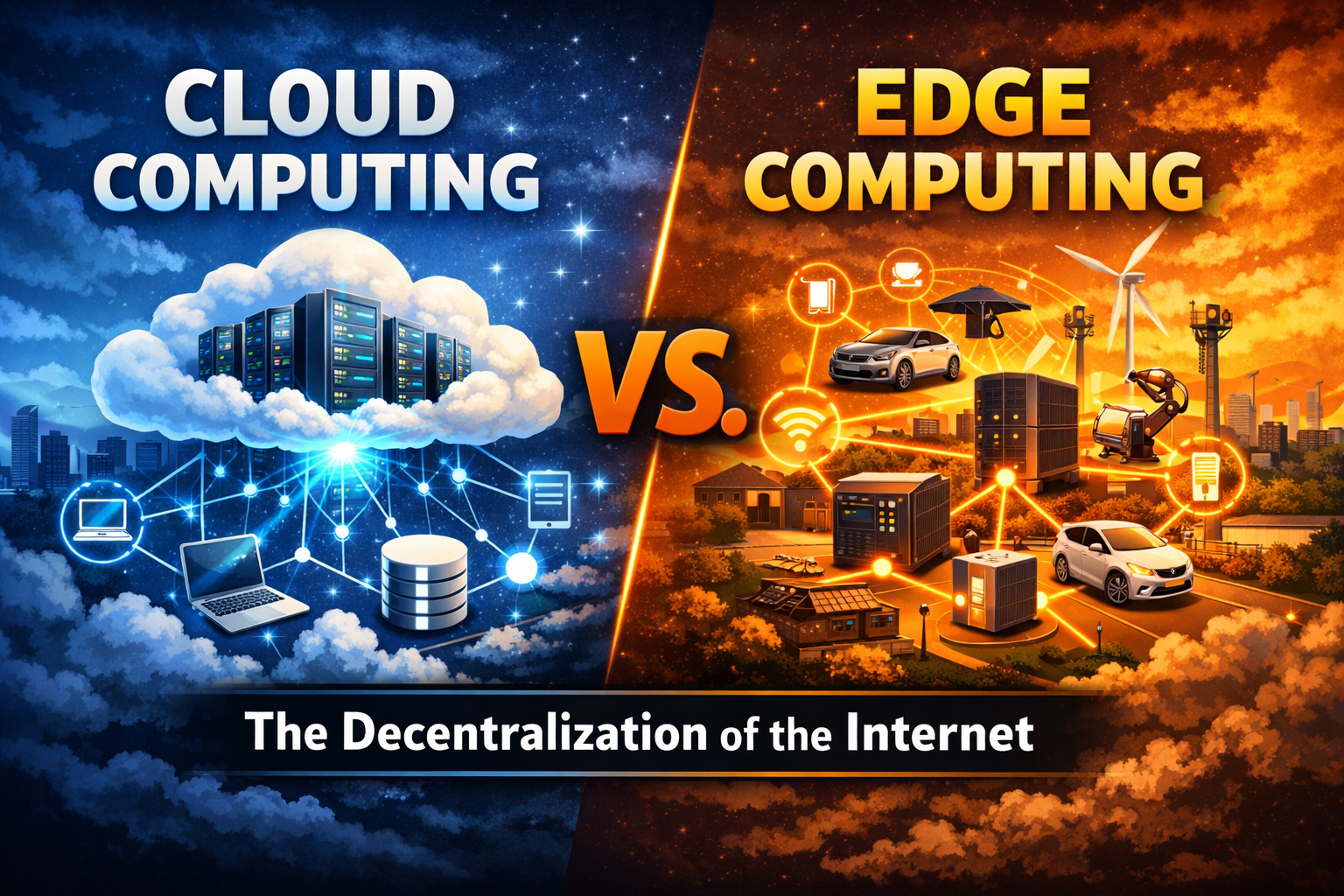
The internet is undergoing a fundamental architectural shift, moving from a centralized brain to a distributed nervous system. For over a decade, Cloud Computing has been the undisputed paradigm—the engine of digital transformation. Now, Edge Computing is emerging not to replace it, but to extend it, solving critical limitations and enabling a new generation of applications. This evolution is fundamentally changing how data is processed, stored, and acted upon.Cloud Computing vs. Edge Computing: The Decentralization of the Internet
The Established Powerhouse: Cloud Computing
Imagine a massive, ultra-efficient, virtualized warehouse of computing power.
- The Core Idea: Centralized, on-demand delivery of computing services (servers, storage, databases, networking, analytics, intelligence) over the internet (“the cloud”). Users and companies rent what they need, scaling elastically.
- The Analogy: A power plant. It generates immense power (computing resources) distributed over long-distance grids (the internet) to homes and businesses.
- Key Characteristics:
- Centralized: Data is sent to a few large, remote data centers (often hundreds or thousands of miles away).
- Economies of Scale: Unmatched cost-efficiency for storage and heavy batch processing.
- Limitless Scalability: Need more resources? The cloud provider instantly allocates them.
- Strong Global Management: Easy to deploy, update, and manage applications from a single point.
The Emerging Catalyst: Edge Computing
Now, imagine placing small, smart workshops right next to where goods are made or where decisions are needed instantly.
- The Core Idea: A distributed computing framework that brings computation and data storage closer to the location where it is needed—to the “edge” of the network. This includes IoT devices, local servers, or micro-data centers.
- The Analogy: A solar panel with a battery on your roof. It generates and stores power right where it’s consumed, reducing grid dependency and transmission loss.
- Key Characteristics:
- Decentralized: Processing happens across thousands of localized nodes (e.g., cell towers, factory floors, retail stores, vehicles).
- Proximity & Speed: Dramatically reduces latency (delay) because data doesn’t travel far.
- Bandwidth Efficiency: Only crucial processed data (insights, alerts) is sent to the cloud, not raw video feeds or sensor streams.
- Enhanced Privacy & Autonomy: Sensitive data can be processed locally, and systems can operate with intermittent cloud connectivity.
The Head-to-Head Comparison
| Feature | Cloud Computing | Edge Computing |
|---|---|---|
| Core Architecture | Centralized | Decentralized |
| Data Processing Location | Remote Data Centers | At or near the source (IoT device, local server) |
| Primary Goal | Scalability, Cost-Effectiveness, Universal Access | Low Latency, Bandwidth Savings, Real-Time Action |
| Latency | Higher (100ms – 1000ms+) | Very Low (<10ms, often 1-5ms) |
| Bandwidth Need | Very High (all raw data transmitted) | Optimized (only relevant data/insights transmitted) |
| Best For | Big Data analytics, long-term storage, complex AI model training, business applications, web/mobile apps. | Real-time control, instant inference, video processing, industrial automation, autonomous systems. |
| Dependence on Network | Critical. No network = no service. | Minimal. Can operate independently. |
What’s Truly Changing the Internet? The Shift to a Hybrid Reality
The internet is no longer just a “dumb pipe” to a central brain. It’s becoming an intelligent, layered fabric. Here’s what this shift enables and changes:
1. The Birth of the Real-Time Internet:
Cloud latency, even at 100ms, is unacceptable for critical applications. Edge computing enables a sub-10ms response time. This is what makes autonomous vehicles possible (a car can’t wait for a cloud server to decide to brake), allows for true real-time AR/VR without nausea, and enables robotic surgery over 5G.
2. The Explosion of IoT and Smart Everything:
A single smart factory can have 10,000 sensors generating terabytes daily. Sending it all to the cloud is prohibitively expensive and slow. Edge acts as a local filter. A camera in a quality control line detects a defect instantly and triggers a rejection arm, while only sending defect logs and images to the cloud for long-term analysis.
3. Privacy & Data Sovereignty by Design:
With regulations like GDPR, transmitting all data centrally is a liability. Edge allows for “local-first” processing. Your face never leaves the airport kiosk; only the verification result does. A patient’s health vitals are analyzed on a local hospital server, with only anonymized trends sent to the cloud.
4. The Evolution of 5G and Mobile Networks:
5G and Edge are symbiotic. 5G provides the high-speed, low-latency highway, while Multi-access Edge Computing (MEC) puts compute resources directly at the cellular base station. This enables ultra-responsive mobile gaming, smart city traffic management, and seamless stadium experiences.
5. The New Cloud Role: The “Brain” to the Edge’s “Nerves”:
The cloud isn’t disappearing; its role is evolving.
- Edge handles immediate, time-sensitive tasks. (e.g., “Is this object a pedestrian?”)
- Cloud handles massive aggregation, deep learning, and macro-insights. (e.g., “Analyze pedestrian traffic patterns across a continent to optimize city planning.”)
The cloud trains the AI models; the edge executes them. This is the Cloud-Edge Continuum.
The Verdict: What’s Winning?
This isn’t a winner-takes-all battle. The future is hybrid, and this hybrid model itself is what’s changing the internet.
- Cloud Computing remains the undisputed champion for data-heavy backend processes, global scalability, and complex analytics. It is the strategic command center.
- Edge Computing is the critical new layer for real-time interaction, bandwidth-intensive applications, and autonomous operations. It is the tactical frontline.
The internet is becoming faster, smarter, and more responsive by moving intelligence out of the core and weaving it into the fabric of our physical world. We are transitioning from an Internet of Information (cloud-driven) to an Internet of Action (edge-enabled), where decisions happen in the blink of an eye, right where events occur. This shift isn’t just changing the internet’s architecture; it’s unlocking the next wave of technological innovation, from smart cities and autonomous industries to immersive metaverse experiences.
5 Hidden Android Settings That Boost Phone Speed Instantly 3000 word no ai no duplicate seo optimize or non plag seo optimize
Cloud Computing vs Edge Computing – What’s Changing the Internet?
The move from cloud to edge isn’t just a technical upgrade; it’s a geographic and philosophical redistribution of power across the internet. To understand what’s truly changing, we need to look beyond definitions and into the tangible shifts in technology, business, and society.
The Underlying Catalysts: Why This Shift is Happening Now
- The Law of Physics vs. The Law of Scale:
Cloud computing hit a physical limit—the speed of light. Data traveling through fiber optic cables faces unavoidable latency over distance. For non-critical applications (email, video streaming), this is manageable. For autonomous machinery, financial trading algorithms, or augmented reality, a 100-millisecond round-trip is an eternity and a liability. Edge computing is the acknowledgment that some problems cannot be solved by building bigger, farther-away data centers. - The Data Tsunami:
The proliferation of sensors (IoT) and high-fidelity data sources (4K/8K video, LiDAR) is generating data at a volume that makes centralized processing economically and physically impractical. Transporting all raw data from a thousand factory cameras to the cloud would consume immense bandwidth (cost) and time. The edge model applies a fundamental principle: Process what’s urgent locally; send only what’s valuable globally. - The Rise of the “Context-Aware” Internet:
The cloud is largely context-agnostic. It processes data without intimate knowledge of the immediate physical environment. Edge computing is inherently context-aware. A server in a smart traffic light knows local weather, real-time pedestrian flow, and immediate congestion. It can make a decision—change a light pattern—based on hyper-local context faster than any cloud server receiving abstracted data.
The New Internet Architecture: From Hub-and-Spoke to a Neural Mesh
Think of the old model as a hub-and-spoke airline system. All traffic (data) goes through a major hub (cloud data center) to get anywhere. The new model is a distributed mesh network, like a nervous system.
- Spinal Cord (Cloud): Still handles complex reasoning, long-term memory, and broad coordination.
- Peripheral Nerves & Ganglia (Edge): Handle reflexes, immediate sensory processing, and local coordination. Your hand pulls away from heat before your brain consciously registers pain.
This “nervous system” internet has distinct layers:
- The Device Edge (The Reflex Arc): The sensor or device itself (e.g., a PLC in a factory, a camera in a car). Handles nanosecond reactions.
- The Local Edge (The Autonomic System): An on-premise server or gateway (e.g., in a retail store, cell tower). Handles second-by-second orchestration for a local site.
- The Regional Edge (The Subconscious): A micro-data center in a city. Handles minute-by-minute aggregation and analysis for a metropolitan area.
- The Cloud Core (The Conscious Brain): The centralized public/private cloud. Handles strategic thinking, deep learning, and global insight over days, months, and years.
Concrete Examples: Where the Rubber Meets the Road
Manufacturing – The Smart Factory:
- Cloud: Analyzes production data across all global factories to predict supply chain needs, optimize logistics, and train AI models for defect detection.
- Edge: An AI model running on a local server immediately identifies a microscopic crack in a turbine blade on the assembly line. It commands a robotic arm to remove the part in real-time. Only the defect log and image are sent to the cloud.
Retail – The Checkout-Free Store:
- Cloud: Manages inventory across all stores, analyzes shopping trends, and handles the final payment transaction.
- Edge: A network of in-store cameras and weight sensors fuses data locally to track what specific customer picks up. It maintains a real-time cart. No video is sent to the cloud; only a final item list at checkout is transmitted for billing.
Healthcare – Remote Patient Monitoring:
- Cloud: Stores long-term health records, runs population health studies, and provides dashboards for care teams.
- Edge: A wearable ECG patch detects signs of atrial fibrillation. It processes the signal locally, sends an immediate alert to the patient’s phone and a local clinic, and only transmits the critical 30-second episode (not 24 hours of data) to the cloud EHR.
Entertainment – Cloud Gaming & Live Events:
- Cloud (Central): Renders a game in a traditional data center. Latency causes control lag.
- Edge-Enabled Cloud Gaming (e.g., NVIDIA GeForce NOW): The game renders in a regional edge data center 50 miles away, not 500. Latency is cut dramatically, making fast-twitch shooters playable.
- Live Sports: A stadium edge server generates real-time stats, instant replays, and alternate camera angles for fans’ phones, without congesting the stadium’s internet uplink.
The Ripple Effects: What This Changes Beyond Tech
1. The New Business Battlefield:
The cloud war (AWS vs. Azure vs. Google Cloud) is expanding to the edge frontier. Winners will need to master distributed software deployment, hardware partnerships (with telecoms, OEMs), and hybrid management tools. Companies like VMware (Edge Compute Stack), Red Hat (OpenShift at the Edge), and even telecom providers (Verizon, AT&T selling MEC) are becoming key players.
2. The Security Paradox:
- Attack Surface Expands: Thousands of edge nodes are more physical points of vulnerability than a few highly secured cloud data centers.
- Resilience Improves: A distributed system has no single point of failure. An attack on the cloud doesn’t cripple local edge operations.
- New Model Needed: “Zero Trust” security—where nothing is inherently trusted—becomes essential, shifting from defending a castle perimeter to securing every individual and device.
3. Sustainability & The Green Equation:
- Cloud: Benefits from ultra-efficient, renewable-powered mega-data centers.
- Edge: Saves massive energy on data transmission (which is surprisingly energy-intensive). However, managing the efficiency of millions of smaller sites is a new challenge. The net impact is potentially greener due to reduced bandwidth load.
4. The Skill Shift for Developers:
Developing for the edge is different. It requires understanding constrained environments (limited compute on a device), latency budgets, offline-first design, and orchestration across thousands of nodes. The mantra shifts from “scale up” to “scale out and down.”
The Inevitable Hybrid Future: The Symbiotic Cycle
The most powerful pattern emerging is the AI Feedback Loop between Cloud and Edge:
- Training in the Cloud: Massive datasets are used to train sophisticated AI/ML models in the cloud’s limitless compute environment.
- Deployment at the Edge: These models are optimized, compressed, and deployed to thousands of edge devices to perform inference (making predictions on new data).
- Learning from the Edge: The edge devices encounter new, unexpected data (“edge cases”). These anonymized insights and model performance metrics are sent back to the cloud.
- Re-Training in the Cloud: The cloud uses this real-world feedback to improve the next iteration of the model, which is then redeployed.
This creates a virtuous cycle of improvement that is continuously grounded in real-world conditions.
Conclusion: The Internet Becomes Ambient
Cloud computing gave us the “anywhere” internet—access to vast power from any screen. Edge computing is giving us the “everywhere” internet—intelligence embedded silently in the world around us.
The internet is shedding its purely virtual form and merging with physical reality. It’s moving from being a destination we visit to an environment we inhabit. This isn’t just a change in where we compute; it’s a change in how we interact with reality itself. The future belongs not to cloud or edge alone, but to the seamless, intelligent, and responsive continuum they create together—an internet that feels less like a tool and more like a reflex.