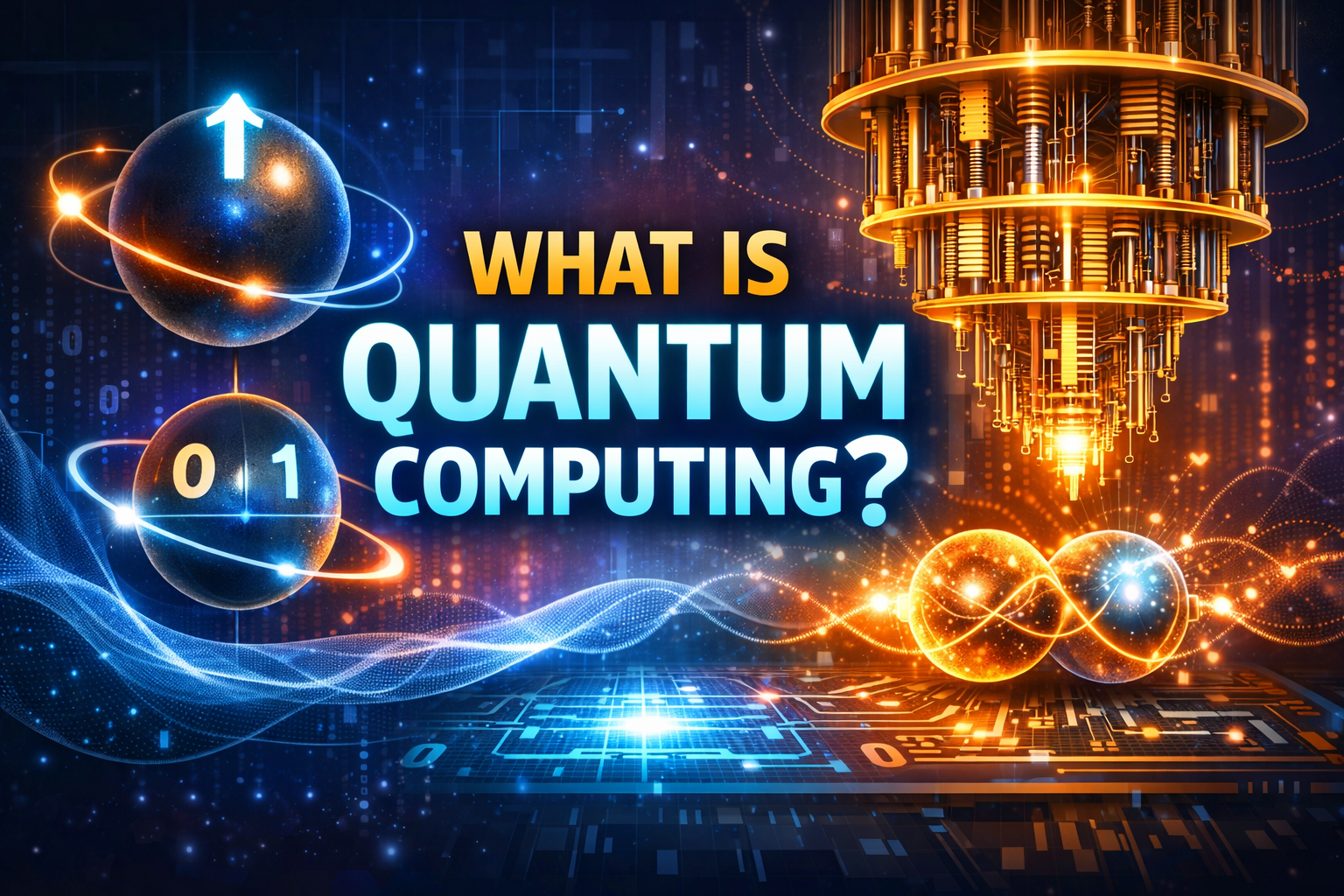
Imagine you’re in a vast library. A classical computer is like a supremely fast reader who can check one book at a time, racing through the shelves at billions of books per second. A quantum computer, however, is like someone who can stand in the middle of the library and read What is Quantum Computing? A Simple Guide to the Next Tech Revolution
all the books at once, finding connections and answers hidden in the combined information. This isn’t just about speed; it’s about a fundamentally different way of processing information.
Quantum computing is no longer just a physicist’s dream—it’s a rapidly emerging technology that promises to solve problems deemed impossible for today’s computers. But what exactly is it? Let’s break it down, step by step, in plain language.
The Problem with “Normal” Computers: Bits and Limits
First, we need to understand our current computers. They run on bits. A bit is the smallest unit of information, like a tiny light switch that can only be in one position: ON (represented by a 1) or OFF (represented by a 0). Every email, photo, video, and calculation on your phone or laptop is, at its core, a vast, intricate tapestry of millions of these 1s and 0s.
Classical computers are phenomenal at following clear, sequential instructions—like calculating your taxes, rendering a video game, or browsing the internet. But they hit a wall with certain types of problems. Why?
Because they have to check possibilities one at a time. Think of a maze. A classical computer tries one path, hits a dead end, backs up, and tries the next. For a complex maze with millions of paths, this takes an immense amount of time.
Some real-world problems look like impossibly complex mazes:
- Drug Discovery: Simulating a single molecule to find a new medicine requires modeling how every atom interacts with every other atom. A classical computer struggles because the number of interactions explodes exponentially.
- Optimization: Finding the most efficient route for hundreds of delivery trucks, or the optimal configuration for a financial portfolio, involves sifting through a universe of possible combinations.
- Cryptography: Much of our online security relies on the fact that it would take a classical computer thousands of years to factorize extremely large numbers (finding the prime numbers that multiply to create them).
This is where quantum computing enters, offering a new set of rules written by the strange and powerful laws of quantum mechanics.
The Quantum Leap: It’s All About Qubits
The heart of a quantum computer is the quantum bit, or qubit (pronounced cue-bit).
If a classical bit is a light switch, a qubit is a spinning coin. While it’s in the air, the coin isn’t just “heads” or “tails”—it’s in a fuzzy, probabilistic state of being both heads and tails at the same time. Only when you catch it (measure it) does it “collapse” into one definite state.
This ability to be in multiple states at once is called superposition. It’s the first core principle of quantum mechanics that quantum computing harnesses.
A qubit in superposition can be a 0, a 1, or any probabilistic blend of both. This means 2 qubits can represent 4 possibilities (00, 01, 10, 11) simultaneously. 3 qubits can represent 8 states. The power grows exponentially: 300 qubits could, in theory, represent more simultaneous states than there are atoms in the known universe.
This is the source of the “parallel processing” magic. A quantum computer doesn’t just try one path in the maze at a time; it can, in a sense, explore many paths at once.
Quantum Weirdness: The Power of Connection
Superposition is mind-bending, but the real engine of quantum computing’s power is a phenomenon so strange Albert Einstein called it “spooky action at a distance”: entanglement.
When two qubits become entangled, they form a deep, intimate connection. Their fates are linked, no matter how far apart they are. If you measure one entangled qubit and find it’s a 0, you instantly know its partner is a 1 (or vice-versa, depending on the type of entanglement). They don’t just correlate; they function as a single, unified system.
This allows qubits to work in a profoundly coordinated way. Operations on one qubit can instantly influence its entangled partner, creating a rich, interconnected computational space. This is what allows quantum algorithms to solve problems in a holistic way, finding patterns and solutions across the entire landscape of possibilities, rather than plodding through them one by one.
How Does a Quantum Computer Actually Work?
Building and running a quantum computer is one of the greatest engineering challenges of our time.
1. Building a Qubit: You can’t buy a quantum processor at your local electronics store. Qubits are incredibly fragile. They can be made from various materials:
- Superconducting loops: Tiny, chilled circuits that carry current in two directions at once (a quantum state). This is the approach used by companies like Google and IBM.
- Trapped ions: Single atoms suspended in a vacuum and manipulated with lasers.
- Photons: Particles of light.
- Quantum dots: Nanoscale semiconductor particles.
2. The Big Chill: To maintain superposition and entanglement, qubits must be almost perfectly isolated from their environment. Any interaction with heat, vibration, or stray electromagnetic waves causes decoherence—the qubit “collapses” into a regular, boring bit. To prevent this, quantum processors are housed in massive, multi-layer refrigerators called dilution refrigerators that cool them to within a fraction of a degree above absolute zero (-273°C), colder than outer space.
3. Programming It: You don’t program a quantum computer with Python or Java in the traditional way. You use quantum algorithms—specialized sets of instructions that leverage superposition and entanglement. These algorithms are like blueprints for a choreographed dance of the qubits.
4. The Quantum Dance (Gates & Circuits): Programmers use quantum logic gates to manipulate qubits. These gates flip, swap, and entangle qubits, creating complex, multi-qubit states. A sequence of gates forms a quantum circuit, which is the actual program.
5. Getting the Answer: After the quantum circuit runs, you measure the qubits. This causes their delicate quantum states to collapse into classical 1s and 0s. Here’s the catch: because the result is probabilistic, you often have to run the same circuit thousands of times to see a pattern emerge in the results. The correct answer appears with the highest probability.
What Can We Actually Do With It? (The Quantum Toolkit)
Quantum computers won’t replace your laptop. They won’t make your spreadsheet faster or improve your video calls. They are specialized tools for specific, monumental tasks.
1. Simulation of Nature: This is perhaps the “killer app.” Chemistry, materials science, and biology are quantum mechanical at their core. A quantum computer can simulate molecules, atoms, and subatomic particles as they truly are, leading to:
- Revolutionary new materials: Room-temperature superconductors, ultra-efficient batteries, and lighter, stronger alloys for aerospace.
- Breakthrough drugs: By accurately simulating protein folding and molecular interactions, we could design life-saving medicines in years instead of decades.
- Better fertilizers: Optimizing the Haber-Bosch process for ammonia production (which currently consumes 2% of the world’s energy) could dramatically reduce global energy use.
2. Optimization: Finding the best solution from a near-infinite set of possibilities.
- Logistics: Drastically improving global supply chains, airline schedules, and delivery routes, saving fuel and time.
- Finance: Building better risk models and optimizing complex trading portfolios.
- Machine Learning: Potentially accelerating the training of certain AI models and discovering more efficient neural network architectures.
3. Cryptography: This is a double-edged sword.
- The Threat: A large-scale quantum computer could break the widely used RSA encryption that secures the internet, banks, and government secrets. This is the “Q-Day” security agencies worry about.
- The Solution: Quantum Cryptography and Post-Quantum Cryptography are being developed to create new, quantum-proof encryption methods. Furthermore, Quantum Key Distribution (QKD) uses the principles of quantum mechanics to create theoretically unhackable communication channels.
4. Searching Large Datasets: Grover’s quantum algorithm can search an unsorted database quadratically faster than a classical computer. For a database of 1 trillion items, a classical computer might need 1 trillion checks; a quantum computer might only need about 1 million.
The Challenges: Why Aren’t We All Using Quantum Computers Yet?
The potential is staggering, but the road is hard. We are in the Noisy Intermediate-Scale Quantum (NISQ) era. Current machines have 50-1000 qubits, but they are “noisy”—prone to errors from decoherence and imperfect gates.
- Error Correction: A single, perfect “logical qubit” might require thousands of error-prone “physical qubits” to correct errors in real-time. We are still far from the millions of stable qubits needed for most groundbreaking applications.
- Scalability: Adding more qubits while maintaining their quality and connectivity is a monumental engineering challenge.
- Algorithm Development: We need more clever, practical quantum algorithms that can deliver a clear advantage on near-term, noisy machines.
The Quantum Landscape: Who’s Building It?
This isn’t just academic research. A global race is underway:
- Tech Giants: Google (achieved “quantum supremacy” with a specific task in 2019), IBM (offers cloud access to its quantum processors via IBM Quantum), Microsoft (developing a topological qubit approach), and Amazon (Braket cloud service).
- Startups: Rigetti Computing, IonQ (trapped ions), and PsiQuantum (aiming to build a large-scale photonic quantum computer).
- Governments: The U.S., China, and the EU are investing billions in national quantum initiatives, recognizing its strategic importance for economy and security.
Looking Ahead: The Quantum Future
The journey to a full-scale, fault-tolerant quantum computer will likely take a decade or more. In the near term, we’ll see quantum advantage—quantum computers solving a useful, real-world problem faster than any classical computer, even if just for a niche application.
The future will likely involve hybrid computing: complex problems will be broken down, with quantum processors handling the core, exponentially difficult parts (like simulating a molecule), and classical supercomputers handling the rest, working in tandem.
Conclusion: A New Way of Thinking
Quantum computing is more than a new type of machine; it represents a fundamental shift in how we approach problem-solving. It teaches us to think in terms of probabilities, entanglement, and exploring many possibilities at once. While the technology is still in its infancy, its potential to reshape industries, spark scientific revolutions, and tackle some of humanity’s greatest challenges is undeniable.
It won’t happen overnight, and the hype must be tempered with patience for the immense technical hurdles. But the race is on, and the library of possibilities is waiting to be read—all at once.
Frequently Asked Questions (FAQ)
Q: When will I have a quantum computer on my desk?
A: Almost certainly never. Quantum computers require extreme, laboratory-like conditions to function. You will access their power via the cloud, much like you use massive data centers today without seeing them.
Q: Will quantum computers break Bitcoin and the internet?
A: Bitcoin’s cryptography is theoretically vulnerable, but the community is aware and can transition to quantum-resistant algorithms. For general internet encryption (like RSA), the transition is a massive global undertaking that has already begun to prepare for “Q-Day.”
Q: Can quantum computers predict the future or create true AI?
A: No. They are powerful calculators within the laws of physics. They won’t magically predict stock markets or become conscious. They will, however, be incredible tools that could accelerate certain aspects of AI research.
Q: Is quantum computing real or just theory?
A: It is very real. While the full-scale vision is still theoretical, functional quantum processors with dozens to hundreds of qubits exist today. You can run experiments on some of them via the cloud right now.
Q: How can I learn more about quantum computing?
A: Many universities offer online courses. Companies like IBM have extensive educational resources. Start with concepts like linear algebra and quantum mechanics basics, and explore quantum programming frameworks like Qiskit (IBM) or Cirq (Google). The journey begins by embracing the weird and wonderful rules of the quantum world.