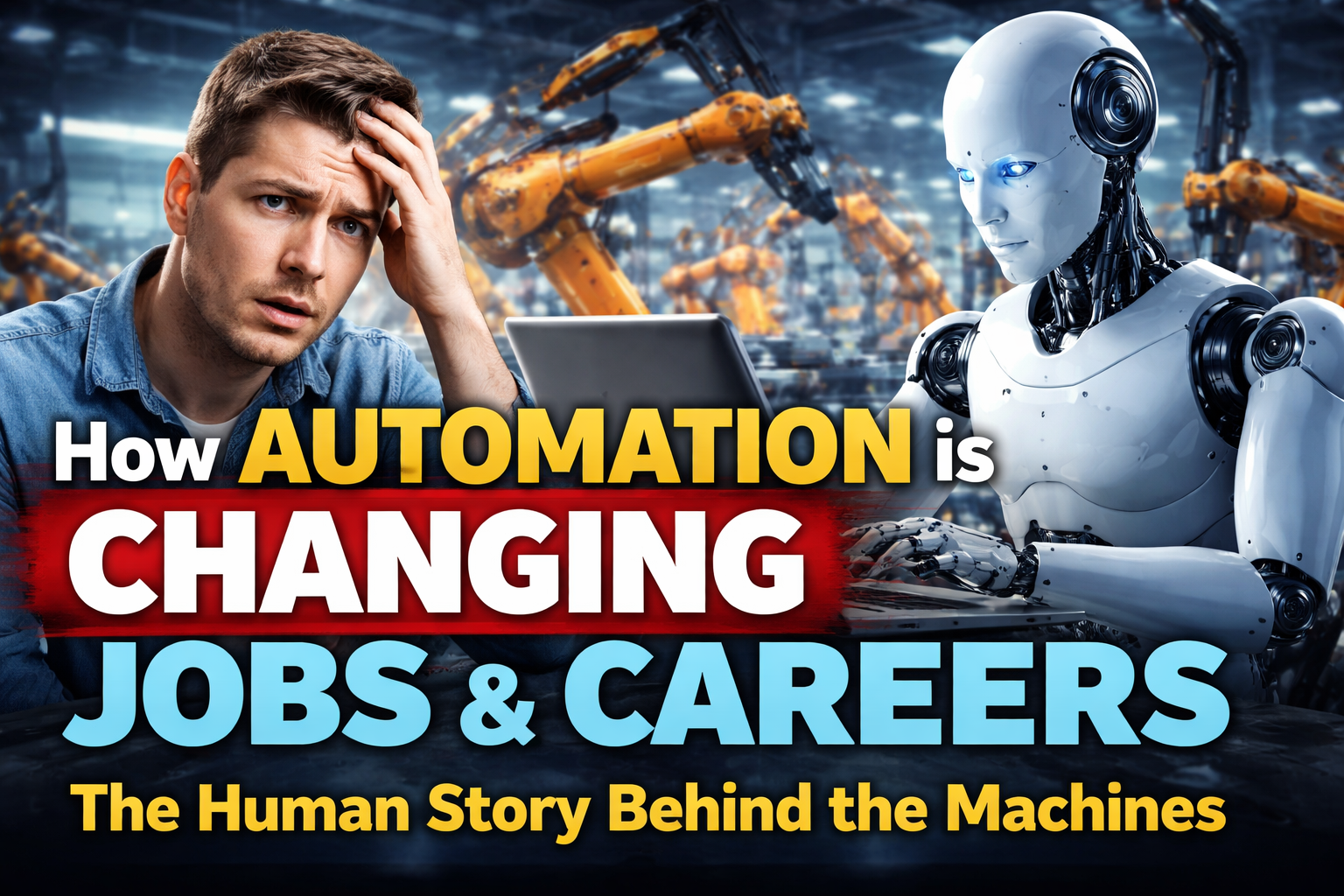
How Automation is Changing Jobs & Careers The Human Story Behind the Machines Walk into any grocery store today and you’ll see them: the self-checkout kiosks. Six glowing screens where four cashiers used to stand. Walk into a modern warehouse and you’ll hear them: the quiet whir of autonomous robots gliding across polished concrete floors, carrying shelves of products to a human picker who stands in one spot all day instead of walking fifteen miles. Walk into a law firm and you’ll find them: algorithms that review thousands of documents in seconds, work that once took a team of junior associates an entire weekend.
This is automation. And it is neither the apocalypse nor the utopia that the headlines promise. It is something far more interesting, far more uncomfortable, and far more human than that.
The story of automation changing jobs is not really a story about machines at all. It is a story about people waking up on Monday mornings and wondering if the skills they spent twenty years perfecting still matter. It is about a factory worker in Ohio who now manages a team of collaborative robots and discovers that his ability to troubleshoot mechanical problems is more valuable than his ability to weld. It is about a radiologist who realizes that AI can spot a tumor better than she can, but that no machine has ever figured out how to tell a sixty-year-old man that he has six months to live.
This is the real story. And it is happening right now, faster than most of us want to admit.
The Quiet Erosion of Repetition
Let us begin by clearing up a common misunderstanding. Automation is not primarily about robots walking into offices and handing people pink slips. That dramatic image belongs in movies. What automation actually does is far more subtle and, in some ways, more devastating. Automation erodes jobs from the inside before it eliminates them from the outside.
Consider the accountant. Fifteen years ago, a staff accountant at a mid-sized firm spent her days doing what accountants had always done: sorting receipts, entering figures, reconciling statements, hunting for discrepancies. These tasks were repetitive, yes, but they were also the training ground. They taught young accountants how the numbers worked, where mistakes hid, and what the story behind the spreadsheet actually meant.
Then came the software. First QuickBooks, then more sophisticated platforms, and now AI-powered systems that can process an entire company’s expenses in minutes. The repetitive tasks disappeared. The accountant who used to spend three days on data entry now spends three hours. This sounds like progress. And in many ways, it is. But here is what we do not talk about: that same accountant now has to find something else to do for the remaining twenty-nine hours of her week. If she cannot, or if her firm decides that one accountant with software can do the work of three without software, then the erosion becomes elimination.
The Bureau of Labor Statistics calls this “occupational decline.” Workers call it looking over their shoulder for ten years.
This pattern repeats across every industry. The legal researcher who no longer needs to read case law because AI summarizes it instantly. The customer service representative who only handles the angry customers because chatbots answer the easy questions. The journalist who writes five articles a day instead of two because AI generates the earnings reports and sports scores, leaving only the investigative pieces for human hands.
Here is what automation actually changes: it removes the bottom rungs of the career ladder. The entry-level jobs that once taught people how an industry works are the very jobs most susceptible to automation. And when those rungs disappear, the question becomes not “how do we retrain workers” but rather “how do young people enter a profession when the traditional apprenticeship has been automated away?”
The Skills That Survive
If you spend enough time talking to economists and technologists about automation, you will eventually hear a phrase that has become something of a mantra: “automation does not eliminate jobs, it eliminates tasks.” This is true. But it is also a bit like saying that removing all the flour from a bakery does not eliminate bread, it just eliminates a key ingredient.
Still, the task-based view of automation offers something valuable. It forces us to ask a more precise question: which tasks resist automation?
The answer is revealing itself in real time across industries. The tasks that survive are the ones that require three distinctly human capabilities: judgment in the face of ambiguity, empathy in the face of suffering, and creativity in the face of constraint.
Let me give you concrete examples.
A bank loan officer used to spend most of her time gathering and verifying financial information. This was tedious work, but it was work. Automation now handles that instantly. The loan officer’s job has not disappeared, but it has transformed. She now spends her days doing something completely different: meeting with small business owners who have been rejected by the algorithm. The machine says no based on credit scores and income statements. But the human loan officer looks at the pizza shop owner whose revenue dipped for six months because of road construction, or the landscaper who has terrible credit but has never missed a payment on his equipment lease. She makes a judgment call. She decides whether the algorithm missed something.
That judgment call is not a task that can be automated. Not because it is too complex, but because it involves weighing factors that cannot be quantified. How do you measure a person’s determination? How do you calculate the value of a reputation built over twenty years in a small town? You cannot. And so the bank keeps the loan officer, not because she processes information faster than a computer, but because she processes information differently.
The same dynamic plays out in medicine. Radiologists feared that AI would make them obsolete when algorithms proved better at detecting certain cancers from imaging scans. But here is what actually happened: the radiologist who used to spend hours hunting for tiny nodules now spends that time talking to patients and consulting with oncologists. The machine finds the tumor faster. The human decides how to talk about it, how to weigh treatment options against a patient’s values and fears, and how to coordinate care across a dozen specialists. The technical task was automated. The human task was amplified.
This is the pattern that nobody predicted five years ago. Automation does not necessarily replace humans. It forces humans to become more human. It strips away the mechanical parts of work and leaves behind the emotional, the creative, and the judgment-based parts. For some workers, this is liberation. For others, it is a nightmare, because they spent their entire careers mastering the mechanical parts.
The Geography of Disruption
Walk through any small town in the American Midwest or the English Midlands or the German Ruhr Valley, and you will see the ghost of the industrial age. Empty factories. Boarded-up storefronts. A main street where every other building is a dollar store or a pawn shop or a church. These places were not destroyed by automation alone. Globalization and trade policy played enormous roles. But automation has been the slow, steady, and relentless force that finished what free trade agreements started.
Here is a fact that should give us pause: the places most vulnerable to automation are not the ones with the most robots. They are the ones with the most routine jobs. And routine jobs concentrate in specific places. The manufacturing town where everyone worked on the assembly line. The insurance city where thousands of people processed claims. The call center hub where young workers answered the same questions eight hours a day.
Automation does not care about geography. An algorithm that processes insurance claims works as well in Hartford as it does in Hyderabad. A chatbot that handles customer service requests serves a company just as effectively whether the servers are in Iowa or Ireland. This means that when automation comes for a particular type of job, it comes for all of those jobs everywhere at once. There is no relocation strategy. There is no “move to where the jobs are,” because the jobs are disappearing from everywhere simultaneously.
This is fundamentally different from previous technological shifts. When farm automation displaced agricultural workers in the early twentieth century, those workers moved to cities and found factory jobs. When factory automation displaced manufacturing workers in the late twentieth century, those workers moved to suburbs and found service jobs. But when service automation displaces administrative and clerical workers in the twenty-first century, where do they go? What is the next frontier?
The uncomfortable answer is that we do not know yet. The jobs that are growing fastest in automated economies are the ones that require high levels of social intelligence, creative problem-solving, and physical dexterity in unpredictable environments. Registered nurses. Software developers. Physical therapists. Sales managers. These are not jobs that someone can pick up with a six-week training course. They require years of education or apprenticeship. And they are not evenly distributed across the country. A displaced factory worker in rural Pennsylvania cannot simply become a software developer in Silicon Valley. The geography does not work. The economics do not work. The human reality does not work.
The Generation Gap
Spend an afternoon in any workplace that spans multiple generations, and you will witness a strange and often painful drama. The fifty-five-year-old accountant who refuses to learn the new expense reporting software. The forty-year-old warehouse manager who secretly loves the new robots because his knees hurt from twenty years of walking. The twenty-five-year-old marketing associate who has no idea how to write a persuasive email because she has always used AI to draft everything.
Automation is changing jobs differently for each generation. And this is the part of the story that never makes it into the economic models.
For older workers, automation often feels like betrayal. They played by the rules. They worked hard. They built careers around skills that took decades to master. And now they are being told that those skills are obsolete. The resistance to learning new technology is not always laziness or fear. Sometimes it is grief. The manual machinist who refuses to learn CNC programming is not just being stubborn. He is mourning the craft he loved, the feel of the handwheel, the sound of the cutter biting into steel. The algorithm that generates perfectly optimized toolpaths may be more efficient, but it will never give him that feeling.
For mid-career workers, automation is often exhausting. They are the ones caught in between. They know enough about the new technology to be dangerous but not enough to be comfortable. They are expected to train younger workers while also keeping up with their own workloads. They watch as entry-level positions disappear, which means they take on more of the grunt work that automation was supposed to eliminate. They are too senior to be protected by junior status and too junior to be protected by executive status. They are the squeezed middle of the automated workplace.
For younger workers, automation presents a completely different set of challenges. They have never known a world without powerful algorithms. They use AI as naturally as their parents used spreadsheets and their grandparents used typewriters. But this fluency comes with its own costs. Many young professionals are discovering that relying too heavily on automation has atrophied their fundamental skills. The young lawyer who uses AI to draft briefs may struggle to argue a case from first principles when the technology fails. The young designer who uses generative AI to create images may never develop the hand skills that make great designers truly great.
Every generation faces its own version of this problem. But the speed of change today is unprecedented. A skill that is valuable at twenty-five may be automated by thirty. A career path that looks promising at thirty may vanish by forty. The idea of learning one trade and practicing it for forty years until retirement is not just outdated. It is incomprehensible to anyone under thirty-five.
The Hidden Job Creation
It would be dishonest to write an article about automation without acknowledging the other side of the ledger. Automation does destroy jobs. But it also creates them. The question is whether it creates enough, and whether the new jobs are accessible to the workers who lost the old ones.
The jobs that automation creates are often invisible. Nobody makes a headline about the new position for “robot maintenance technician” or “AI training data specialist” or “automation workflow coordinator.” But these jobs are real, and they are multiplying. Every automated system needs humans to build it, train it, maintain it, and override it when it fails. A self-checkout machine still needs someone to fix the receipt paper and clear the error messages. An AI-powered customer service chatbot still needs someone to review the conversations it mishandles and update its responses. A warehouse full of autonomous robots still needs someone to sweep the floors so the robots do not get confused by stray pieces of cardboard.
These are not the high-tech glamour jobs that politicians talk about when they promise to retrain displaced workers. But they are real jobs with real paychecks. And they have an interesting property: they are often more interesting than the jobs they replaced. The cashier who now troubleshoots self-checkout machines has more autonomy and variety in her day. The data entry clerk who now reviews AI outputs has more intellectual engagement. The warehouse worker who now manages a fleet of robots has more responsibility and higher pay.
This is the optimistic view. And there is truth in it. But the optimistic view depends entirely on whether displaced workers can actually get these new jobs. The cashier who becomes a self-checkout attendant needs minimal retraining. But the assembly line worker who wants to become a robot maintenance technician needs significant technical education. The legal secretary who wants to become an AI training specialist needs to understand how natural language processing works. The gap between the old job and the new job is not always bridgeable with a two-week training course.
The Psychological Toll
Here is something that economists rarely discuss when they write about automation: the psychological experience of watching your job change beyond recognition while you are still in it.
The term “deskilling” appears in academic papers. But what it feels like is different. It feels like showing up to work one day and realizing that the thing you were best at no longer matters. The junior lawyer who prided herself on her meticulous document review suddenly finds that an algorithm does it better and faster. The customer service representative who built his reputation on patient, thorough explanations suddenly finds that most customers prefer the instant response of a chatbot. The journalist who spent years cultivating sources and developing a distinctive voice suddenly finds that her editor wants more listicles because they perform better with AI-generated search traffic.
This is not just frustrating. It is disorienting. Work is not just how we make money. It is how many of us define ourselves. It is where we find purpose, community, and identity. When automation strips away the meaningful parts of a job and leaves only the administrative scraps, it does more than reduce productivity. It reduces humanity.
I have spoken to dozens of workers who have been through this process. The common theme is not anger or fear, although both are present. The common theme is exhaustion. The constant need to learn new systems. The endless meetings about “digital transformation.” The pressure to “upskill” during evenings and weekends after a full day of work. The knowledge that no matter how much you learn, the technology will change again next year.
This is the hidden cost of automation. And it falls disproportionately on the workers who are least equipped to bear it. The single mother working two jobs does not have time to take an online course in data analytics. The fifty-eight-year-old with arthritis in his hands cannot become a robot maintenance technician. The high school graduate who never had the opportunity for college cannot compete for the new jobs that require credentials he cannot afford.
What Comes Next
Predicting the future of automation is a fool’s errand. The technology changes too quickly, and human beings adapt in ways that no model can capture. But a few things seem reasonably clear.
First, the era of the routine cognitive job is ending. Anything that involves processing standardized information according to predictable rules will be automated. This includes vast swaths of accounting, law, medicine, finance, journalism, and customer service. The jobs that survive will be the ones that require genuine judgment, creativity, or human connection.
Second, the transition is going to be painful for millions of people. The skills that automation eliminates are not trivial. They are the skills that built the middle class. Processing insurance claims is not glamorous work, but it put food on the table for hundreds of thousands of families. Writing basic code is not creative work, but it launched countless careers in technology. Answering customer service calls is not fulfilling work, but it provided a foothold for young people entering the workforce. When these jobs disappear, something real is lost.
Third, the solution is not going to come from technology alone. Retraining programs have a disappointing track record. Universal basic income is politically difficult and philosophically problematic. Protectionism would slow innovation without saving jobs. There is no magic bullet. There is only hard, messy, political work: rebuilding education systems to emphasize adaptability over specific skills, creating safety nets that support workers through transitions rather than trapping them in unemployment, and having honest conversations about what we owe each other in an economy where work is no longer guaranteed.
The story of automation is still being written. And despite the doom and gloom, there is reason for hope. Human beings have survived every technological revolution so far. We have adapted. We have found new kinds of work that the old generations could not have imagined. The farmer’s daughter became a factory worker. The factory worker’s son became a software developer. The software developer’s daughter will become something we cannot yet name.
Automation is changing jobs and careers. That is undeniable. But what it is changing them into is still up to us. The machines are powerful. They are getting more powerful every day. But they are not in charge. We are. And the choices we make today, about education, about training, about social support, about what we value in work and in each other, will determine whether automation becomes a tool of liberation or a tool of displacement.