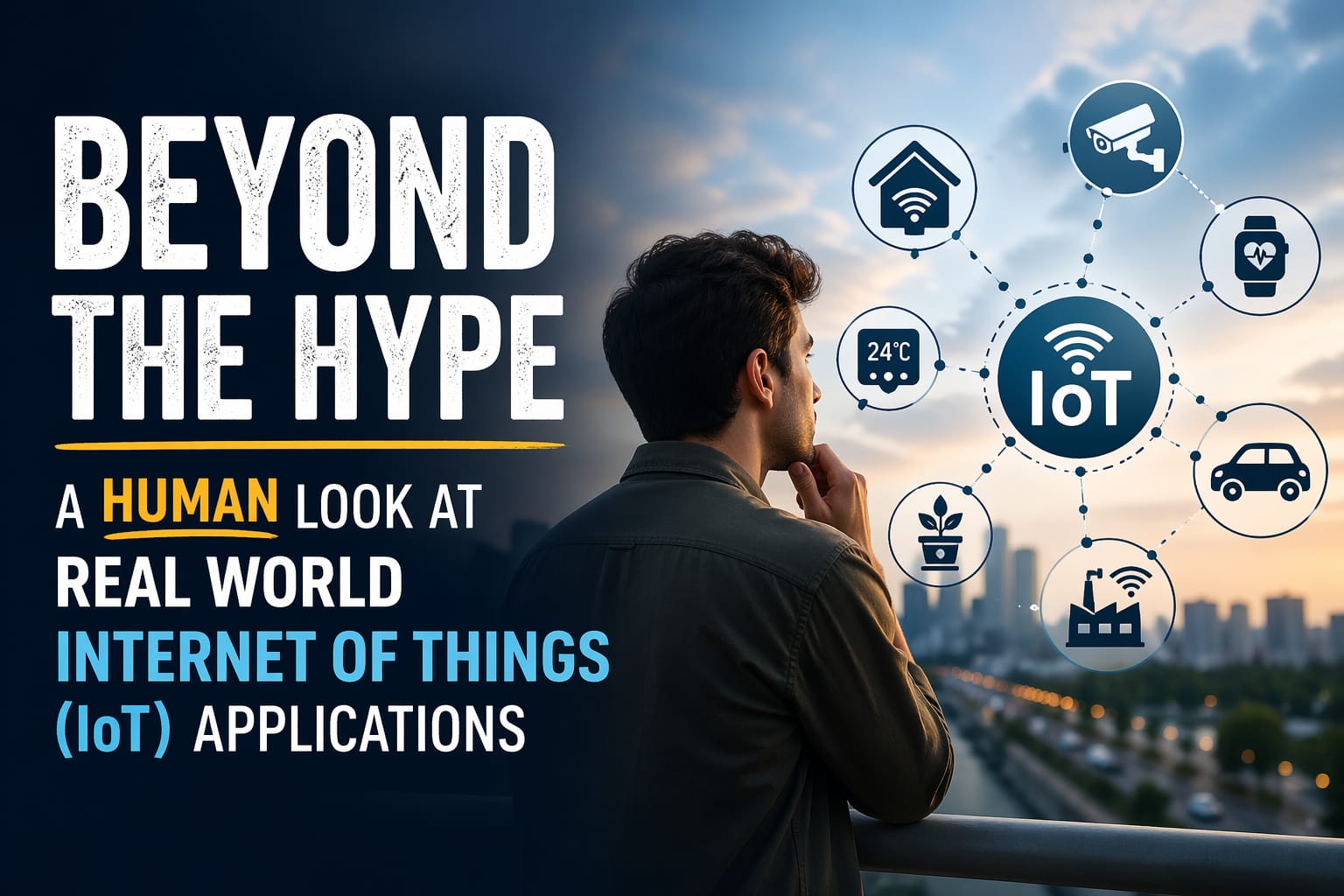
Beyond the Hype A Human Look at Real World Internet of Things (IoT) Applications Let’s be honest for a second. When most people hear “Internet of Things,” they either picture a fridge that tweets when you’re out of milk (which nobody asked for) or they get a vague sense of anxiety about their toaster being hacked. The tech world has done a fantastic job of making IoT sound either like a miracle or a menace, depending on who’s selling what.
But after spending years watching this space evolve, I’ve come to see IoT differently. It’s not about smart coffee makers. It’s about dumb objects getting a tiny dose of situational awareness. It’s about giving a bridge the ability to tell us it’s tired before it breaks. It’s about helping a farmer in a drought-stricken region use only the water each plant actually needs. The real magic of IoT isn’t in the gadgets—it’s in the quiet, invisible ways it’s starting to solve very old, very human problems.
Let’s step away from the PowerPoint slides and the vendor demos. Let’s talk about where IoT applications are actually making a difference, where they’re failing, and what it feels like to live with them.
The Quiet Revolution in Healthcare From Reactive to Predictive
The most profound IoT applications aren’t the flashy ones. They’re the ones that fade into the background of someone’s life. Nowhere is this truer than in healthcare.
Wearables That Actually Matter
Forget step counting for a moment. That’s old news. The real shift is happening with continuous monitoring devices that don’t require a patient to be tethered to a hospital bed. I talked to a nurse in rural Oklahoma last year who manages a population of elderly heart failure patients. Before IoT, her job was reactive—she’d get a call when someone was already in crisis, short of breath, their body retaining fluid. Now? Her patients wear a small patch that measures thoracic fluid levels, activity, and heart sounds. The device sends a daily “score” to her tablet.
She told me, “I can call someone and say, ‘Hey, your numbers are trending the wrong way. Can you come in today?’ instead of waiting for the ambulance.” That’s not science fiction. That’s a grandma staying in her own home for six more months. That’s an emergency room visit avoided. That’s IoT doing what it does best: turning raw data into a gentle nudge before disaster strikes.
The Inhaler That Knows About Air Quality
Then there’s respiratory care. I have a friend whose son has severe asthma. They live in a city with unpredictable air quality—sometimes it’s fine, sometimes industrial particulates drift over from the port. They recently started using a smart inhaler. It’s just an ordinary rescue inhaler with a small sensor attached. But here’s the clever part: the app cross-references the time and location of every puff with local air quality data, pollen counts, and weather patterns.
After a few weeks, they noticed a pattern. His son wasn’t using the inhaler because of exercise or illness. He was using it every time the air pressure dropped sharply before a storm. Now they know to pre-treat with maintenance medication on those days. The inhaler didn’t cure asthma. It just helped a family see a pattern they would have otherwise missed. That’s the human scale of IoT.
The challenges here are real, though. Battery life matters when you’re dealing with a sick person who can’t remember to charge another device. Data privacy is a massive, unresolved conversation—who owns that breathing pattern data? The patient? The hospital? The insurance company? We’re still figuring that out, and frankly, we’re not doing it fast enough.
The Industrial Side Where IoT Pays the Bills
If consumer IoT is still finding its footing, industrial IoT (often called IIoT) is already pulling its weight. Industry doesn’t care about cool factor. Industry cares about uptime, efficiency, and not having to shut down a production line for three days because a single motor bearing failed.
Predictive Maintenance: Listening to Machines Complain
The classic example is still the best one: vibration sensors on motors and pumps. But let’s make it real. A food processing plant I visited makes everything from soup to salad dressings. They have hundreds of motors running conveyor belts, mixers, and pumps. Before IoT, maintenance was either “run it until it breaks” (chaotic and expensive) or “replace everything on a fixed schedule” (wasteful and still not foolproof).
Now they have wireless puck-sized sensors bolted to each motor. These sensors measure vibration, temperature, and magnetic flux. An electrician showed me his phone. “This motor here,” he said, pointing to a graph, “started singing a different tune three days ago. The vibration signature shifted in the high-frequency range. That tells me a bearing cage is starting to fail. I can swap that bearing next Tuesday during our planned two-hour sanitation window. If I ignore it, that bearing seizes in two weeks, the motor burns out, and the entire sauce line stops for eight hours.”
That eight hours of downtime? About $120,000 in lost production. The sensor? Eighty dollars. The math is simple. This is why IIoT isn’t a trend—it’s a toolkit for survival in competitive manufacturing.
The Sneaky Genius of Cold Chain Monitoring
Another industrial application that never gets enough credit is cold chain monitoring. Every time you eat a berry in January or get a vaccine that actually works, you’ve benefited from IoT. But the reality is grittier. Trucks carry perishable goods across continents. A refrigerator case in a warehouse fails at 2 AM. A freezer door in a pharmacy gets left slightly ajar.
IoT sensors with cellular or satellite connectivity now ride along with everything from chemotherapy drugs to ice cream. They log temperature every five minutes. If the temperature drifts outside the safe range, the system doesn’t just log it—it sends an alert. A logistics manager gets a text: “Trailer 447, rear zone, temperature 47°F for 12 minutes at 3:14 AM.” Now they know exactly which pallet of flu vaccines might be compromised. They can quarantine just that pallet instead of throwing away an entire truckload.
This matters more than most people realize. The World Health Organization estimates that up to 50% of vaccines are wasted globally each year, largely due to temperature control issues. IoT won’t fix all of that—infrastructure and poverty are bigger problems—but it’s a start.
Agriculture Growing Food in the Information Age
Farming is older than civilization, but it’s also becoming one of the most data-intensive industries on Earth. And no, I’m not talking about robots milking cows (though that exists). I’m talking about the quiet, incremental changes that add up to something remarkable.
Soil Sensors and the End of Guesswork
A third-generation corn and soybean farmer in Nebraska told me something that stuck: “My grandpa farmed by the almanac. My dad farmed by the weather channel. I farm by a dashboard on my phone.” He has soil moisture sensors buried at three different depths across his fields. These solar-powered nodes report back every hour. He also has a small weather station on his highest ground.
Before IoT, he irrigated on a schedule—every three days, run the center pivot for twelve hours. He knew he was overwatering some areas and underwatering others, but what could he do? Now he opens an app and sees a color-coded map of his fields. Red means dry. Blue means wet. Yellow means just right. He can tell his irrigation system to water only the red zones, at variable rates, for exactly as long as needed.
He estimates he’s cut water use by 25% while increasing yield on his drier ground by 15%. In a region where water rights are increasingly contested, that’s not just efficiency. That’s survival.
Livestock Tracking That’s Actually Humane
The livestock side is even more interesting—and more controversial. Ear tags with GPS and accelerometers are now common on cattle ranches in Australia, Brazil, and the American West. But here’s what the marketing materials don’t tell you: these tags do more than track location. They measure movement patterns. A cow that’s lying down too much or not walking to water might be sick. A heifer that’s suddenly spending all her time alone in a corner might be about to give birth.
Ranchers get alerts. They can check on that specific animal instead of riding out to inspect the whole herd. That’s less stress on the animals, less diesel burned in a truck, and fewer calves lost to a difficult birth that went unnoticed.
The pushback is legitimate, though. These systems cost money. A tag might be $50 plus a monthly data fee. That’s fine for a 500-head operation but impossible for a subsistence farmer in sub-Saharan Africa. And there’s the question of what happens to all that behavioral data. Does a meat processor get to see which animals were lazy? Does that affect pricing? We’re opening ethical questions faster than we’re answering them.
Smart Cities The Messy, Unsexy Reality
Every few years, some tech company unveils a “smart city” concept video full of flying cars and reactive pavement. That’s not how this works. Real smart city IoT is boring, incremental, and often invisible. It’s also where some of the most practical applications live.
Parking and Traffic: Lowering the Temperature of Daily Frustration
Consider parking. In a mid-sized city like Boulder, Colorado, or Ann Arbor, Michigan, drivers spend an average of 15 to 20 minutes looking for parking per trip. That adds up to millions of hours of wasted time and tons of unnecessary emissions. Some cities have started embedding magnetic sensors into individual parking spaces. These sensors detect when a car is present and relay that information to a mobile app.
It sounds trivial. But when you’re late for a doctor’s appointment, circling the same block for the fourth time, knowing exactly which spaces are open is a small miracle. The city benefits, too—less circling means less congestion, fewer near-misses with pedestrians, and lower emissions. The sensors are cheap, they run on batteries that last five years, and they install in fifteen minutes with a core drill. That’s the kind of IoT I can get behind: low drama, high utility.
Trash Cans That Ask to Be Emptied
Here’s another one you’ve probably never thought about: waste management. Most cities empty trash cans on a fixed schedule. But not all cans fill at the same rate. A can in a busy tourist plaza might need emptying twice a day. A can in a residential cul-de-sac might need it once a week. Without data, the city just guesses—and often guesses wrong.
IoT-enabled trash cans have a fill-level sensor. When the can reaches 80% full, it sends a message to the route optimization system. The garbage truck driver gets an updated route that morning, skipping the empty cans and hitting the full ones. One city that deployed this—I think it was Barcelona, but don’t quote me—reduced waste collection costs by 20% and cut the number of trucks on the road by a third. Fewer trucks means less noise, less diesel exhaust, less wear on the streets.
The challenge? These systems require coordination across multiple city departments that often don’t talk to each other. The IT department buys the sensors. Public works manages the cans. The fleet department runs the trucks. Getting them all in the same room is harder than the technology.
The Dark Side Where IoT Goes Wrong
I’d be doing you a disservice if I painted a picture of universal success. IoT fails constantly. It fails in ways that are instructive.
The Security Hangover
Remember the Mirai botnet attack in 2016? Hackers took over hundreds of thousands of insecure IoT devices—security cameras, DVRs, baby monitors—and used them to launch a massive denial-of-service attack that took down Twitter, Netflix, and much of the internet. The devices were compromised because they had default passwords like “admin” and “password123” that users never changed.
Six years later, this is still a problem. I recently bought a “smart” plug from a major online retailer. The setup process never asked me to change the default password. The manufacturer’s website had no firmware updates. This thing is a ticking time bomb on my home network. Most consumers have no idea. They just want to turn their lamp on with their voice.
The industry has no excuse for this. Secure device provisioning isn’t hard. It just costs money and takes time, and too many manufacturers are racing to the bottom on price. Until consumers start caring—or regulators start demanding—we’re going to keep seeing IoT botnets.
The Data Graveyard Problem
Here’s a less dramatic but more common failure: the data graveyard. A company installs thousands of sensors. For the first few months, everyone is excited. They look at the dashboards. They find a few insights. Then the novelty wears off. The person who understood the system leaves. The cloud subscription auto-renews. But nobody looks at the data anymore. The sensors keep chirping away, sending information into a void.
I’ve seen this happen in a smart building, a greenhouse, and a small factory. The problem isn’t the technology. The problem is organizational. IoT generates data continuously, passively, without effort. That’s the blessing and the curse. It’s too easy to collect data and too hard to turn it into action. Most organizations lack the discipline to review IoT data regularly and the authority to act on it. So they end up with an expensive system that does nothing.
The solution isn’t more AI. It’s a human being whose job includes looking at the dashboard every Tuesday at 10 AM and making one decision based on what they see. That’s not glamorous. But it works.
Where We Go From Here
I’m often asked if IoT is overhyped. The answer is yes and no. The consumer vision of a fully automated home where everything talks to everything else? That’s mostly hype. It’s expensive, it’s fragile, and honestly, do you really want your blinds and your toaster collaborating without you?
But the industrial, agricultural, and civic applications? Those are real. They’re saving money, saving water, saving time, and in healthcare, saving lives. They’re just not very exciting to watch. A soil sensor doesn’t have a screen. A vibration monitor doesn’t have an app with cute animations. They just sit there, doing their quiet job, making the world slightly more efficient.
The next five years will be about consolidation, not innovation. We have the sensors. We have the connectivity. What we need are better batteries, simpler security, and most of all, better ways to turn data into action without requiring a data science degree. We need systems that fail gracefully, that don’t demand constant attention, that respect privacy by design rather than as an afterthought.
And we need to remember that the goal of IoT isn’t to make everything smart. It’s to make the right things smart enough. A bridge doesn’t need to tweet. It just needs to tell an engineer when a crack appears. A refrigerator doesn’t need to order milk. It just needs to run efficiently and keep food cold. The best IoT applications are the ones you never notice until they save you from something you didn’t see coming.
2 thoughts on “Beyond the Hype A Human Look at Real World Internet of Things (IoT) Applications”