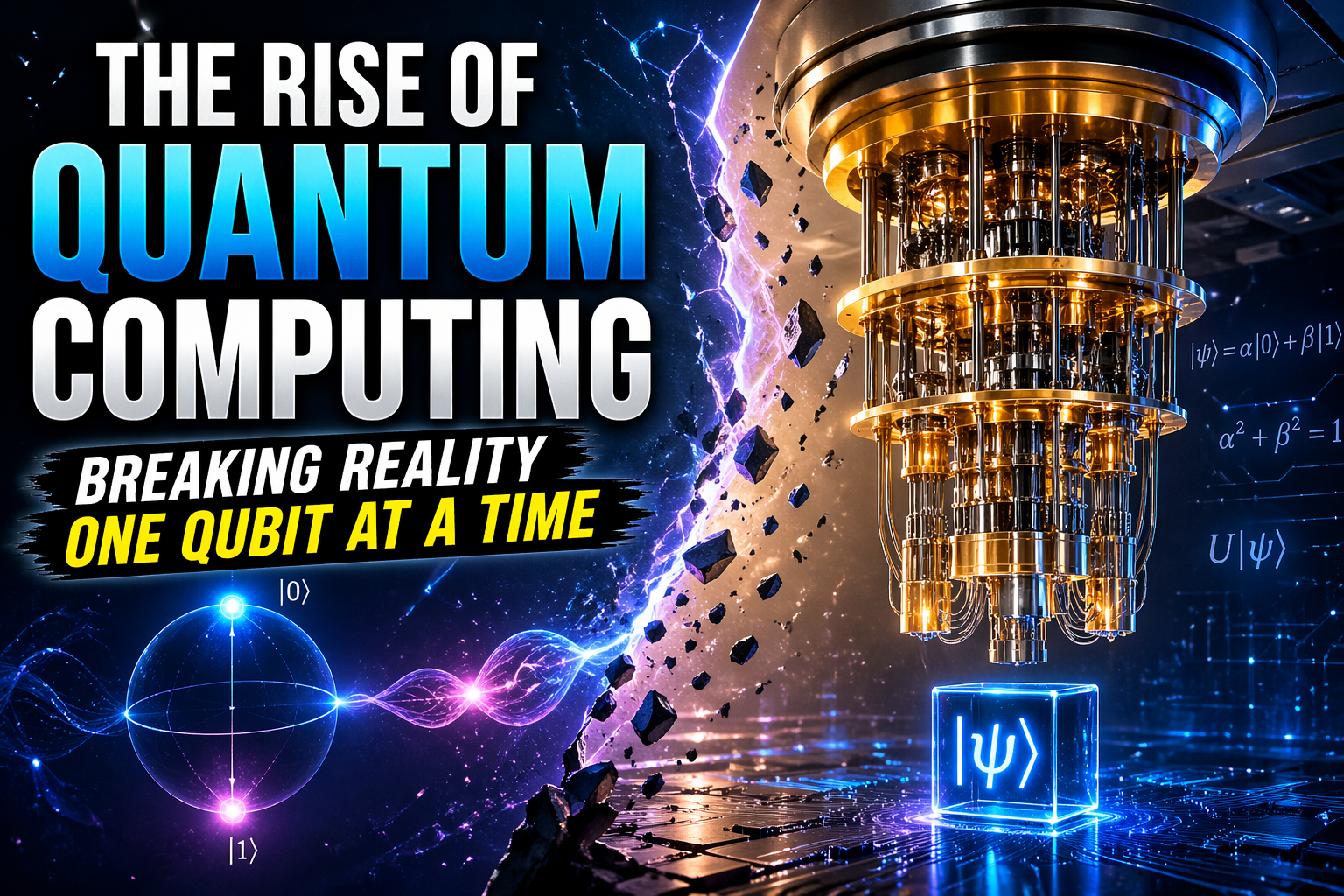
The Rise of Quantum Computing Breaking Reality One Qubit at a Time Let me tell you something that sounds insane. For the last seventy years, every single computer you have ever touched—the phone in your pocket, the laptop on your desk, the massive servers running Google searches—they all think in binary. Zero or one. On or off. Yes or no. That’s it. Two pathetic little states. And somehow, we built an entire civilization on that binary backbone. The internet, social media, financial markets, artificial intelligence, weather forecasting, encrypted government secrets—all of it running on a language of just two words.
Then along come the quantum physicists and say, “That’s cute, but what if a bit could be both zero and one at the same time?”
And everyone laughed. Until they stopped laughing.
The Weird Place Where This Story Begins
The year is 1981. MIT. A small conference room filled with the kind of brilliant, disheveled men who don’t own umbrellas because thinking about rain feels inefficient. Richard Feynman stands up—the same Feynman who helped build the atomic bomb, who played bongos in strip clubs, who cracked safes at Los Alamos just to prove he could. He looks at the room full of computer scientists and says something that most of them dismiss as theoretical nonsense.
“Nature isn’t classical, dammit. And if you want to simulate nature, you’d better build a computer that works like nature.”
What he meant was this. Physics at the smallest level—the level of electrons and photons and atoms—doesn’t follow the clean rules of zeros and ones. An electron doesn’t have a single position. It has a cloud of probabilities. It exists everywhere it could exist until you measure it. That’s not philosophy. That’s experimental fact, confirmed a hundred thousand times in hundred thousand labs.
Feynman’s point was brutal and simple. If you try to simulate a quantum system using a classical computer, you fail immediately. A single quantum particle interacting with thirty other quantum particles generates a mathematical problem so large that every computer on Earth working together for the age of the universe couldn’t solve it. The numbers explode exponentially. Classical computers choke and die.
Feynman said the only thing that can simulate quantum physics is quantum physics itself. You need a computer built from quantum parts to calculate quantum problems.
That was the seed. It took twenty years to germinate.
What Actually Makes Quantum Computers Different
You need to understand superposition and entanglement, but everyone explains these badly, so let me try a different way.
Think about a maze. A classical computer solves a maze by trying one path, hitting a dead end, backing up, trying another. It’s methodical. It’s patient. It’s also stupidly inefficient when the maze has billions of branches. A quantum computer doesn’t pick a path. It takes every path simultaneously. Not metaphorically. Physically. Because of superposition, the quantum bits—qubits—exist in multiple states at once. When you start a quantum computation, you don’t input a single number. You input a wave of possibilities, all interfering with each other like ripples in a pond.
Then comes entanglement, which even Einstein called “spooky action at a distance” because he couldn’t accept it. Two entangled particles share a single quantum state. Measure one, and the other instantly collapses to match, even if it’s on the other side of the galaxy. No signal passes between them. No time elapses. It simply happens. Most physicists have stopped being disturbed by this and now just shrug and build machines using it.
Entanglement means that qubits don’t act like independent bits. They act like a single system with exponentially more information capacity than the sum of its parts. Ten classical bits give you ten possible states. Ten entangled qubits give you 1,024 possible states all existing at once. Thirty qubits give you a billion states simultaneously. Fifty qubits give you a quadrillion states. Three hundred qubits give you more states than there are atoms in the known universe.
This is the weapon. This is why everyone from Google to the Chinese government to every major intelligence agency on Earth is pouring billions into quantum computing.
The Long, Humiliating Road to Actual Machines
For decades, quantum computers existed only on chalkboards and in grad students’ nightmares. Building one requires isolating a handful of particles from the entire universe—every vibration, every photon of stray heat, every stray magnetic field will destroy a quantum state in microseconds. This destruction is called decoherence, and it’s the single greatest enemy of quantum computing.
The first serious attempts were pathetic. A single qubit that stayed coherent for a nanosecond. Two qubits that couldn’t talk to each other without collapsing. Three qubits that produced more errors than calculations. The field moved forward at the speed of continental drift. Most of the original researchers retired or died before seeing anything that looked like a computer.
Then came 2019. Google’s Sycamore processor. Fifty-three qubits. The team set it on a specific calculation—proving that a random number generator was truly random, something classical computers struggle with. Sycamore completed the calculation in 200 seconds. Google estimated that the world’s most powerful classical supercomputer, Summit at Oak Ridge National Laboratory, would take 10,000 years to do the same thing.
Google called this “quantum supremacy.” IBM immediately disputed the claim, arguing that a clever classical algorithm could match Sycamore in about two and a half days, not ten thousand years. The debate got ugly. Academic food fights erupted in prestigious journals. But everyone agreed on one thing: a quantum computer had finally outperformed a classical computer on a real task, even if that task was carefully chosen to favor quantum hardware.
That was the crack in the dam. Sycamore proved the physics worked. Now it was an engineering problem.
The Insane Engineering Challenges Nobody Talks About
Here’s what quantum computing articles don’t tell you. The processors live inside dilution refrigerators that cool them to temperatures colder than deep space. We’re talking 15 millikelvin. That’s 0.015 degrees above absolute zero. At that temperature, atoms barely move. Electrical resistance disappears. The normal rules of electronics stop applying.
The wiring is a nightmare. Every control signal to the quantum processor has to travel through specially filtered, superconducting lines. The vibrations from a person walking across the lab floor can inject enough energy to kill a calculation. The Earth’s magnetic field has to be canceled out with precise shielding. Cosmic rays—actual particles from space—occasionally blast through the lab and flip a qubit for no reason.
And the errors. Dear God, the errors. Qubits are fragile. They fail constantly. A classical computer bit flips maybe once every billion billion operations. A qubit flips once every thousand operations if you’re good. To run a useful calculation, you need error correction, which means using many physical qubits to create one logical qubit. Current estimates suggest you need about one thousand physical qubits to create one reliable logical qubit.
This is why Sycamore’s fifty-three qubits is a toy. A real quantum computer—one that can break encryption or discover new drugs or model complex molecules—probably needs millions of physical qubits. We are nowhere close. We are at the Kitty Hawk stage, watching a wooden glider stay airborne for twelve seconds, and people are asking when we’ll have commercial flights to Tokyo.
Who Is Building These Things and How Much Are They Spending
The usual suspects are fighting the usual war. Google, IBM, Microsoft, Amazon, Intel, Hewlett Packard Enterprise—all have major quantum programs. But the real heavy lifting is happening in surprising places.
IonQ, a spinout from the University of Maryland, uses trapped ions instead of superconducting circuits. Individual atoms levitated in electromagnetic fields, manipulated with lasers. Different approach, same goal. They went public in 2021 and now trade on the New York Stock Exchange. Their machines are already accessible through the major cloud providers.
PsiQuantum took a billion dollars from backers including BlackRock and the Singaporean government to build a photonic quantum computer using particles of light. No extreme cooling required. Photons don’t interact with each other much, which is both the advantage (less decoherence) and the disadvantage (harder to make them compute).
Quantinuum, a merger of Honeywell’s quantum division and Cambridge Quantum, claims to have the highest-fidelity qubits in the industry. They sell access to their machines by the minute, like supercomputer time in the 1990s.
Then there’s China. The Chinese government listed quantum computing as a strategic priority in its thirteenth five-year plan. They have built a quantum research campus larger than anything in the West. Their photonic quantum computer, Jiuzhang, performed a calculation in 200 seconds that would take a classical supercomputer 2.5 billion years. That’s not a typo. Billion with a B. The West has not matched this result. China also launched the world’s first quantum communications satellite, Micius, which demonstrated entanglement distribution over 1,200 kilometers. The National Security Agency does not sleep well thinking about this.
The Encryption Apocalypse That Keeps Cryptographers Awake
Here is the part that genuinely frightens people who understand the stakes.
Almost all of the encryption protecting the modern world relies on a mathematical trick. Multiplying two large prime numbers is easy. Factoring the product back into those primes is extremely hard. Your bank login, your medical records, your private messages, government secrets, military communications—all of it protected by the assumption that factoring large numbers takes too long to be practical.
Shor’s algorithm, developed by Peter Shor at Bell Labs in 1994, can factor numbers exponentially faster on a quantum computer than any known classical method. A sufficiently large quantum computer running Shor’s algorithm could break RSA-2048 encryption in hours instead of heat-death-of-the-universe timeline.
How large is sufficiently large? Estimates vary, but most experts think you need about twenty million physical qubits. Current record is around one thousand. So we are not there yet. But the trajectory matters. If progress continues at the current pace—and it has been accelerating, not slowing—we hit twenty million qubits sometime between 2030 and 2040.
This creates a horrible problem. Encrypted data is being harvested right now by intelligence agencies with the assumption that they can decrypt it later. It’s called “harvest now, decrypt later.” Your encrypted messages from today might be readable by any government with a quantum computer in twelve years. There is no way to secure past data. Once a quantum computer arrives, every secret ever encrypted with RSA or ECC becomes an open book.
The National Institute of Standards and Technology has been running a competition since 2016 to develop quantum-resistant encryption algorithms. They announced the final selections in 2024. These algorithms don’t rely on factoring. They use different mathematical problems that seem equally hard for quantum and classical computers. But deploying these new standards across the entire global internet will take decades, and the transition has barely started.
Where Quantum Computing Actually Works Today
Most of what you read about quantum computing is hype. Venture capitalists need exits. Universities need grants. Companies need stock prices to go up. So the press releases scream about curing cancer and solving climate change and breaking all encryption. The reality is more modest and more interesting.
Right now, the only real commercial applications are in quantum simulation. Chemical and pharmaceutical companies use current quantum computers to model molecular interactions. Classical computers are terrible at this. A caffeine molecule has about 160 electrons. Modeling the interactions between all of them requires tracking an astronomical number of possibilities. Quantum computers, being quantum themselves, handle this naturally.
Daimler and Volkswagen have used quantum computers to model the molecular structure of new battery materials. JPMorgan Chase has run quantum algorithms for portfolio optimization and option pricing. BP and ExxonMobil are exploring quantum chemistry for carbon capture and catalyst design. These are not replacing classical computers. They are running alongside them, handling specific sub-problems that classical computers choke on.
Quantum machine learning is also emerging. Certain types of pattern recognition and classification problems map naturally to quantum circuits. Google has demonstrated quantum-assisted recommendation algorithms. But this is early days. Most of these hybrid algorithms run on a few qubits and produce results that classical algorithms could match with more cleverness.
The honest truth, the one that quantum computing researchers whisper at conferences after a few drinks, is that we don’t actually know what this technology will be good for. Every major computing breakthrough revealed its killer applications only after the hardware existed. The internet was built for military and academic file sharing, not cat videos and e-commerce. The iPhone launched with no App Store, just whatever web apps Steve Jobs felt like approving. We don’t know what quantum computing will do because we don’t yet have the machines to experiment with.
The Cultural Shift Happening Right Now
Something strange is occurring in physics departments and computer science buildings around the world. The quantum computing people are no longer the weird ones. They are the popular ones. Undergraduate enrollment in quantum information science courses has exploded. Every major university now offers quantum computing degrees. High school students are learning to write quantum circuits in Qiskit, IBM’s open-source quantum development framework.
The old guard—the ones who spent thirty years proving quantum mechanics from first principles, who fought to keep the field alive when funding was nonexistent and the physics establishment laughed at them—they are retiring now. They watch the new generation build machines that look like science fiction props, and they don’t quite know what to feel. Pride, certainly. But also a kind of vertigo. The thing that lived in their equations and their daydreams is becoming real, and reality is always messier than theory.
The hardest problem now isn’t physics. It’s programming. Classical programming teaches you to think sequentially—do this, then this, then this. Quantum programming requires thinking in parallel waves of probability, in amplitudes and phases, in interference patterns. Most computer scientists cannot make this jump. Their intuitions are exactly wrong for quantum systems. The best quantum programmers today are often physicists who learned to code, not coders who learned quantum mechanics.
This is changing slowly. New programming languages like Q#, Qiskit, and Cirq are building higher-level abstractions. You don’t need to understand spinors and Hilbert spaces to write a quantum program anymore, any more than you need to understand transistor physics to write Python. But we are years away from quantum programming being accessible to average developers.
Where We Actually Stand Right Now
Let me level with you. Quantum computing today is where classical computing was in 1955. The hardware exists but is unreliable, expensive, and requires constant babysitting from PhDs. The software ecosystem is primitive. The killer applications are theoretical. Most people who work in the field have never seen a real quantum computer in person—they just program simulators running on classical machines, pretending the decoherence isn’t there.
But 1955 was only twenty-two years before the Apple II brought computing to regular people. Twenty-two years before Steve Jobs and Steve Wozniak sold a machine that your parents could actually use. The first commercially available quantum computer that solves problems classical machines cannot touch will probably arrive before 2040. That machine will cost millions of dollars and fill a room. But it will start something.
And here is the thing that keeps me awake at night, the thing that makes this worth three thousand words of your time. Classical computing gave us the internet, artificial intelligence, genetic sequencing, climate modeling, and financial derivatives. It also gave us surveillance capitalism, algorithmic radicalization, cyber warfare, and the complete destruction of privacy. Every transformative technology cuts both ways.
Quantum computing will be no different. It will unlock materials that can capture carbon directly from the air, drugs that target diseases with molecular precision, optimization algorithms that could make supply chains and power grids radically more efficient. It will also break the cryptographic foundation of the global economy, render current surveillance systems omnipotent, and create a divide between nations and corporations that have quantum capability and those that don’t.
The rise of quantum computing is not a story about physics. It is a story about power. About which problems we choose to solve and which we choose to ignore. About who gets access to the future and who gets left behind.
The machines are coming. They are smaller every year, more stable, more capable. Somewhere in a lab right now, a grad student is running an experiment that will become a footnote in a textbook twenty years from now, a footnote about the day everything changed. That student probably doesn’t know it yet. The best ones never do.
But the rest of us get to watch. And worry. And maybe, if we are paying attention, prepare. Because the quantum future is not arriving next century. It is arriving now, one fragile qubit at a time, and it will not ask for our permission.