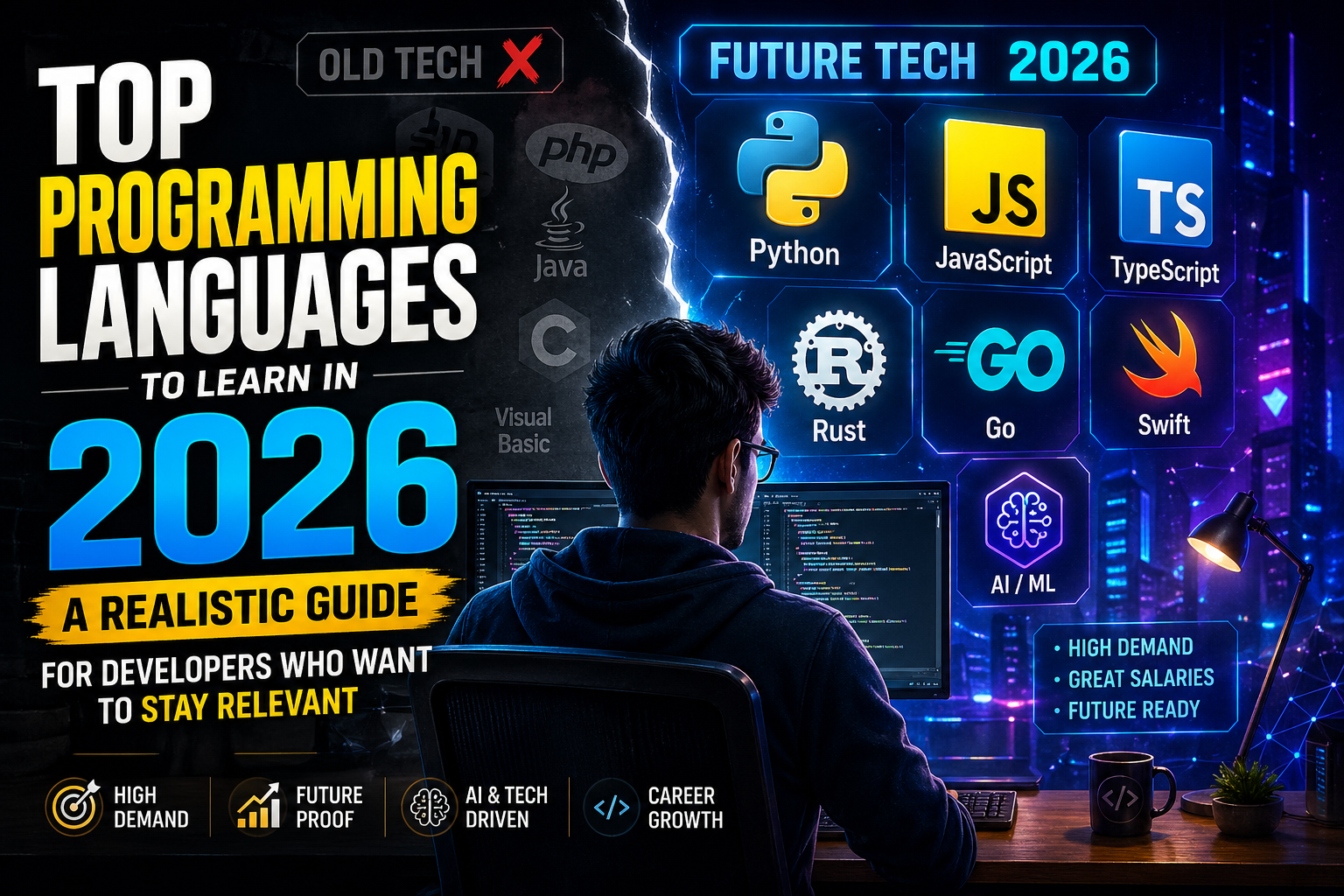
Top Programming Languages to Learn in 2026 A Realistic Guide for Developers Who Want to Stay Relevant Let me tell you something straight up – if you’re still asking “which programming language should I learn” in 2026, you’re probably overthinking it. But since you’re here, I’ll give you the unfiltered truth about what’s actually worth your time this year, not some recycled list from 2023 that some content mill churned out.
I’ve been writing code since before “full stack” was a buzzword, and I’ve watched languages rise, fall, and occasionally rise again from the dead (looking at you, COBOL during the pandemic). So here’s what I’m seeing heading into 2026.
The Elephant in the Room AI Coding Assistants Changed Everything
Before I dive into specific languages, we need to talk about the 800-pound gorilla in the room. GitHub Copilot, Cursor, and all the other AI coding tools aren’t going anywhere. In fact, by 2026, not using AI assistance while coding feels like handwriting a letter instead of typing an email – technically possible, but why would you?
Here’s the thing though – AI hasn’t made learning programming languages obsolete. It’s actually made it more important to understand what you’re doing. I’ve watched junior developers crutch on AI to generate code they don’t understand, then spend three days debugging something a human would have spotted in ten minutes. The language you learn matters less than ever, but knowing how to think in that language matters more than ever.
With that off my chest, let’s get into the real list.
Python – Still the Workhorse, But With Complications
Python isn’t going anywhere in 2026, but I need to be honest about its growing pains. The language that became synonymous with “easy to learn” has stretched itself thin across data science, web development, DevOps, and AI. And that stretch is starting to show.
The good news first – Python’s ecosystem for machine learning and data work is untouchable. PyTorch, TensorFlow, LangChain, Hugging Face – these libraries have become so deeply embedded that even if something technically better came along tomorrow, the migration would take years. If you want to work in AI or data science, Python isn’t optional. It’s like learning Latin if you want to be a historian – you just have to do it.
But here’s what the bootcamps won’t tell you. Python’s performance limitations are becoming more painful in 2026 than they were five years ago. The “just throw more hardware at it” approach doesn’t work when you’re running on edge devices or trying to keep cloud costs under control. I’ve seen startups build their MVP in Python, get traction, then spend six months rewriting critical paths in Rust or Go. That’s an expensive lesson.
The other problem is that “learning Python” in 2026 means a lot more than understanding loops and dictionaries. You need to know type hints (which have become standard in any serious codebase), async programming (because synchronous Python isn’t keeping up), and probably some familiarity with at least one of the new JIT compilers like Mojo or Cython if you’re doing performance work.
Who should learn Python in 2026? Anyone doing data science, AI, or academic work. Anyone writing glue code between systems. Anyone prototyping ideas quickly. Who probably shouldn’t? People building high-throughput backend services or real-time systems. There are better tools for those jobs now.
TypeScript – The Uncomfortable King of Frontend
I’ll be honest – I hated TypeScript when it first came out. It felt like taking the wild west freedom of JavaScript and putting it in a straightjacket. But ten years later, I get it. Actually, everyone gets it. By 2026, starting a new frontend project in plain JavaScript is considered mildly unprofessional.
TypeScript has won the frontend wars, but here’s the interesting part – it’s quietly winning backend wars too. Bun and Deno both use TypeScript natively now, and Node.js support keeps getting better. The line between “frontend language” and “backend language” has blurred so much that I know teams running TypeScript on the backend for production workloads handling millions of requests.
What makes TypeScript particularly valuable in 2026 is how well it works with AI coding tools. Static types give AI assistants way better context about what your code should do. I’ve noticed that Copilot makes way fewer nonsense suggestions in TypeScript than in plain JavaScript. The types act like guardrails that keep both you and the AI from doing stupid things.
The framework situation around TypeScript has also stabilized. React is still everywhere in 2026, but it’s no longer the default assumption. Vue and Svelte have solid market share, and the React versus everything else debate has settled into “use what your team knows” rather than evangelism. What matters is that all of them work great with TypeScript.
If you want to build anything with a user interface in 2026 – web, mobile with React Native, desktop with Tauri or Electron – you need TypeScript. It’s not the most fun language to learn. It’s not the most elegant. But it’s the language that pays the bills for frontend developers.
Go – The Boring Choice That Keeps Winning
Go is like that coworker who shows up on time, does their work without drama, and never asks for recognition. It’s boring as hell, and that’s exactly why it’s thriving in 2026.
Every time a new language comes out promising revolutionary features, thousands of developers go try it, realize they don’t actually need those features, and come back to Go. The language hasn’t changed much in years, and that’s intentional. The Go team explicitly prioritizes stability over new features.
So why learn Go in 2026? Because cloud infrastructure runs on it. Docker, Kubernetes, Terraform, Prometheus – all written in Go. Every major cloud provider’s SDK has first-class Go support. When you need to write something that’s going to run as a microservice, handle decent concurrency, and not crash in weird ways, Go is the safe bet.
The learning curve for Go is interesting. You can learn the basics in a weekend – there just aren’t that many language features. But writing idiomatic Go takes time. Newcomers often write Go code that looks like Java or Python, and it works, but it feels wrong to experienced Gophers. The patterns around error handling, goroutines, and interfaces are simple but specific.
Go’s weaknesses haven’t really improved. The generics implementation, while better than nothing, still feels bolted on. Package management, which used to be a complete disaster, is now just slightly awkward. And if you need to do anything with heavy abstractions or functional programming patterns, you’ll be fighting the language the wh
Who should learn Go? Backend developers working on cloud services, DevOps engineers, anyone writing CLI tools. Who shouldn’t? People doing data science, frontend work, or anything requiring complex generic abstractions.
Rust – The Hard Language That’s Actually Worth It
I’m going to be straight with you about Rust. It’s hard. Not “oh this is different from what I’m used to” hard. Genuinely, makes-you-want-to-throw-your-laptop-across-the-room hard. The borrow checker has broken the spirits of developers who’ve been coding for fifteen years.
But here’s the thing about 2026 – Rust is in places you wouldn’t expect. The Linux kernel accepts Rust drivers now. Android has Rust in its core. Major tech companies are rewriting security-critical infrastructure in Rust because memory safety vulnerabilities (use-after-free, buffer overflows, double frees) basically don’t happen in safe Rust.
The Windows kernel is getting Rust support. The Chromium project has Rust components. Even the White House published a report recommending memory-safe languages, and everyone reading between the lines knows that means “stop writing new C and C++ code.”
The job market for Rust in 2026 is weird. There aren’t as many Rust jobs as Python or TypeScript jobs, but the Rust jobs that exist pay very well and tend to be on interesting problems. You’re not writing another CRUD app in Rust. You’re writing databases, game engines, embedded systems, cryptocurrency infrastructure (some of which isn’t a scam, surprisingly), or high-performance network services.
Learning Rust in 2026 is easier than it was a few years ago, mostly because the error messages have gotten incredibly good. The compiler doesn’t just tell you what’s wrong – it tells you how to fix it and explains why. The documentation ecosystem has matured too. But it’s still going to take you months of consistent practice before you feel productive.
The real value of learning Rust isn’t just the language itself. Learning Rust teaches you how memory actually works in a way that Python and JavaScript never will. You’ll understand pointers, stack versus heap, ownership patterns, and lifetimes. That knowledge makes you a better programmer in any language, even if you never ship Rust to production.
Zig – The Language Nobody Saw Coming
If you haven’t heard of Zig yet, you will by the end of 2026. It’s positioned as a C replacement rather than a Rust alternative, and that distinction matters. Zig doesn’t have the safety guarantees of Rust. It doesn’t have the abstractions of Go. What it has is complete control with less headache than C.
Zig’s killer feature is compilation. The build system is built into the language, and it’s actually good – you can cross-compile for any target without messing around with toolchains. The compile times are absurdly fast. And the error handling model (errors are just values) is simple and elegant.
The Zig community in 2026 is still small but passionate. You’ll find Zig being used in game development, audio processing, operating system components, and WebAssembly. Bun (the JavaScript runtime) is written in Zig, which gave the language a huge credibility boost.
Should you learn Zig? If you write C or C++ for a living, yes, absolutely. If you’re a systems programmer who finds Rust too restrictive, Zig offers a compelling alternative. For everyone else? Probably not yet. The ecosystem is too small, the job market is almost nonexistent, and the language is still evolving.
Swift and Kotlin – Platform Languages That Survived
Remember when everyone said “write once, run anywhere” would kill platform-specific languages? That prediction didn’t age well. Swift and Kotlin are both doing fine in 2026, but for different reasons.
Swift escaped the iOS bubble more than anyone expected. Server-side Swift (with Vapor and Hummingbird) is a niche but growing. Swift on the server has some genuine advantages – it’s fast, memory safe, and the concurrency model is actually really nice. But the bigger story is Swift’s cross-platform capabilities. You can write iOS, macOS, watchOS, tvOS, and now server code in the same language. For Apple ecosystem developers, that’s powerful.
Kotlin similarly escaped Android. Kotlin Multiplatform lets you share code between Android, iOS, desktop, and web. Jetpack Compose and SwiftUI have both matured to the point where building native UIs feels almost pleasant. If you’re building a mobile app from scratch in 2026, you’re either using Kotlin Multiplatform or React Native, with Flutter having lost the momentum battle.
The problem with both Swift and Kotlin is that they lock you into ecosystems. Swift outside Apple platforms is possible but not pleasant. Kotlin outside JVM-based infrastructure loses most of its advantages. If you know you want to work in those ecosystems, learn them. If you’re trying to keep options open, TypeScript or Go are safer bets.
Mojo – The Wild Card for AI
Mojo is fascinating because it’s the first new systems programming language designed specifically for AI hardware. It’s basically Python syntax (so it feels familiar) with the performance of Rust or C. The idea is that you can write your model code in what looks like Python, but it compiles down to something that runs efficiently on GPUs and the even weirder AI accelerators that are showing up everywhere.
In 2026, Mojo is still early. The company behind it (Modular) is well-funded, and the language shows genuine promise. But learning Mojo in 2026 is a bet. You’re betting that it becomes the standard for AI infrastructure work. If you’re right, you’ll have skills that are rare and valuable. If you’re wrong, you’ve learned a language that mostly teaches concepts you could have learned from Rust or Python anyway.
The Honorable Mentions
Elixir still exists and still has the happiest community in programming. It’s great for fault-tolerant systems. The job market is tiny but loyal.
Julia is the language that data scientists wish Python was. It’s faster, it handles math better, and it has great tooling. But the ecosystem still lags far behind Python, and that gap hasn’t closed as fast as people predicted.
C# continues its slow, steady growth. Microsoft’s open-source push has made .NET relevant again, and C# is a genuinely good language. It’s not exciting, but it’s solid and the job market is large.
SQL isn’t going anywhere. Every developer should know SQL. Not ORM-level SQL, actual SQL. You don’t need to be a DBA, but if you can’t write a window function or understand what a query planner does, you’re leaving value on the table.
So What Should You Actually Learn?
Here’s my honest advice after watching this industry for too many years.
If you’re new to programming, start with Python. Not because it’s the best language, but because it removes the most friction from the learning process. You don’t need to understand memory management or type systems or build tooling. You just need to think about problems and solve them. After six months of Python, you’ll know enough to make your own decisions about what to learn next.
If you want a job in 2026, learn TypeScript and one of Go or Python. That combination gives you the most options. TypeScript for anything with a UI, and Go or Python for backend work. That covers probably 80% of programming jobs out there.
If you want to work on really interesting problems and don’t mind a steep learning curve, learn Rust. The jobs are harder to find but more rewarding. You’ll work on infrastructure, performance-critical systems, or security-sensitive code.
If you’re already employed and happy, learn enough of the other languages to understand what they’re good for. You don’t need to become an expert. But you should understand why a Go developer would choose concurrency over inheritance, or why a Rust developer would fight the borrow checker instead of using garbage collection.
The worst thing you can do in 2026 is try to learn “the best language” because no such thing exists. Every language is a set of tradeoffs. Python trades performance for expressiveness. Rust trades simplicity for safety. Go trades flexibility for practicality. TypeScript trades dynamism for maintainability.
2 thoughts on “Top Programming Languages to Learn in 2026 A Realistic Guide for Developers Who Want to Stay Relevant”