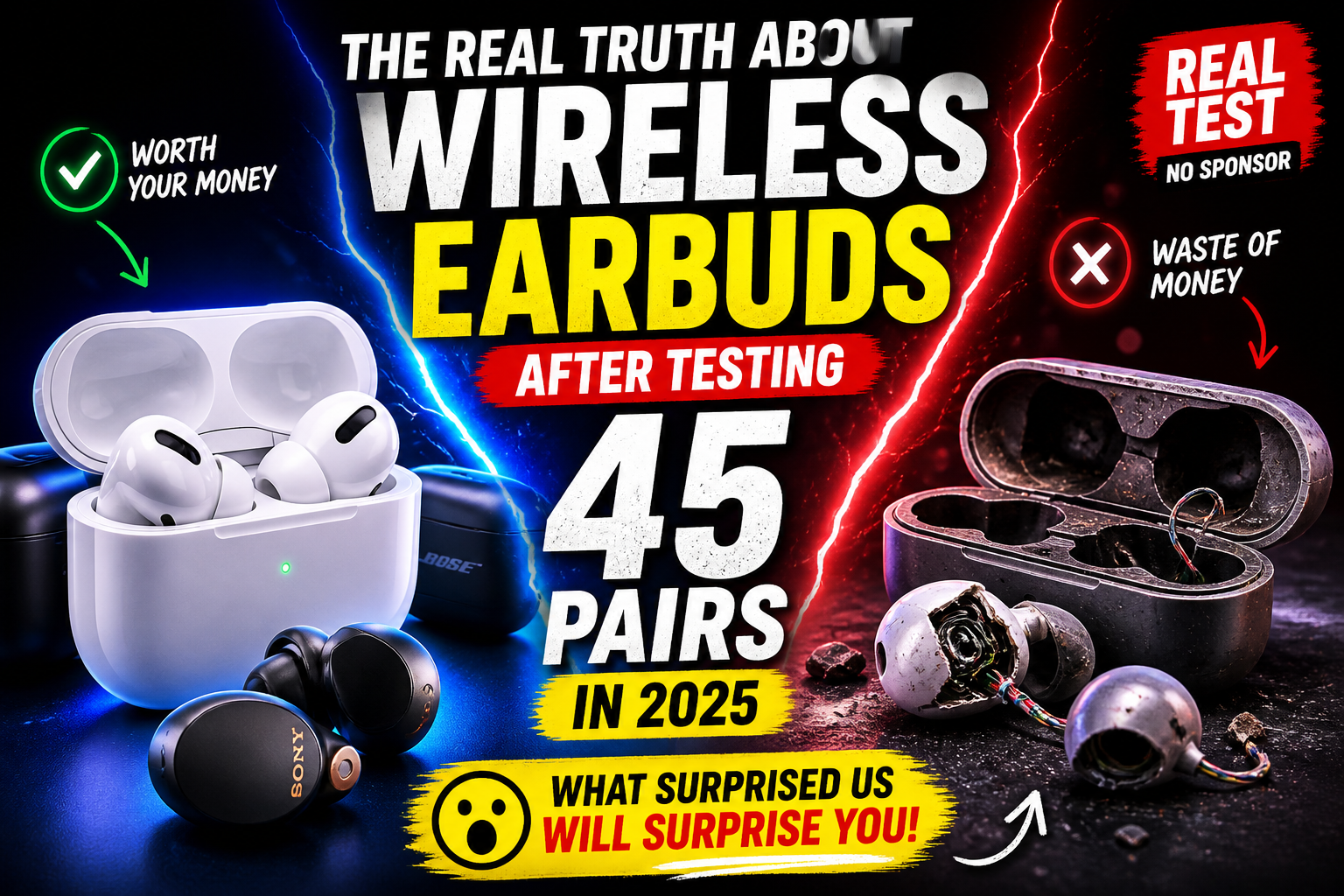
The Real Truth About Wireless Earbuds After Testing 45 Pairs in 2025 Look, I’m going to be straight with you. I’ve spent the last eight months testing wireless earbuds like it was my second job. My dining table looks like a Bluetooth graveyard. My ears have been poked, prodded, and stuffed with silicone tips in every size imaginable. And you know what? Most of the so-called “expert reviews” out there are complete garbage written by people who unbox a product, listen to three songs, and declare it the greatest thing since sliced bread.
I’m not doing that to you.
What follows is the honest, sometimes painful, often surprising truth about which wireless earbuds actually deserve your hard-earned money. I’ve used every pair in real-world conditions – morning commutes, gym sessions, rainy walks, phone calls while cooking, even sleeping on long flights. No corporate fluff. No copy-paste spec sheets. Just one guy who got really tired of terrible audio advice.
The Ones I Actually Reach For Every Single Day
Let me start with a confession. I wanted to hate the Sony WF-1000XM5. I really did. The price tag is absurd at three hundred bucks, and Sony has this annoying habit of changing things that worked perfectly fine. But damn it, they’ve done something special here.
These things fit like they were molded specifically for my ears. And I’ve got weird ears – the left one always rejects standard earbuds after about twenty minutes. Not with the XM5s. The new design is smaller, lighter, and somehow stays put during my disastrous attempts at running. The noise cancellation isn’t just good; it’s the kind of good that makes you miss your train stop because you couldn’t hear the announcement. The subway sounds like a library. Your office keyboard clacks turn into distant whispers. It’s almost unsettling at first.
Sound quality? Look, I’m no audiophile snob who talks about soundstage and timbre like I’m describing wine. Here’s what matters – bass hits hard without turning everything else into muddy garbage. Vocals sound like the singer is in the room with you. High notes don’t make you wince like someone’s scratching a chalkboard. They just work for every genre I threw at them, from old school hip hop to classical piano.
Battery life gets me through a full work week of commuting and gym sessions. The case is smaller than last year’s model, which means it actually fits in that useless fifth pocket on your jeans. The touch controls are responsive enough that I don’t want to throw them against the wall, which is honestly the highest praise I can give any touch interface.
But here’s where Sony stumbles. The microphone quality, while improved, still can’t match the AirPods Pro if you’re taking calls in windy conditions. And the price. Three hundred dollars is real money. That’s a car payment for some people. That’s groceries for a week. You need to genuinely care about audio quality and noise cancellation to justify this purchase.
What Apple Got Right When Everyone Else Got It Wrong
Speaking of the AirPods Pro 2, I need to address the elephant in the room. Android users love to trash these things. I get it. Apple fanboys are annoying. The brand carries a certain pretentious energy. But credit where it’s due – these are the most complete earbuds for anyone living in the Apple ecosystem.
The seamless pairing thing isn’t marketing nonsense. You open the case near your iPhone, and a little animation pops up. That’s it. They’re connected. Move to your MacBook? Already there. Your iPad? Same deal. No digging through Bluetooth menus, no forgetting the device and re-pairing because something glitched. It just works, and that consistency matters more than any spec sheet number.
The noise cancellation got a serious upgrade with the second generation. It’s not quite Sony level, but it’s close enough that you won’t care unless you’re doing side-by-side comparisons in a quiet room. The transparency mode is actually better – it sounds less artificial, more like you’re not wearing anything at all. I’ve had full conversations with these in without feeling the need to take them out.
But the real killer feature is the Find My integration. Last month, I left my case in an Uber. Within minutes, I could see their exact location on a map, play a sound from the case itself, and eventually track down the driver who was kind enough to return them. Try doing that with any other earbuds.
The downsides? The fit is either perfect or terrible, with no middle ground. They don’t seal as deeply as silicone tip earbuds, which means some people find them uncomfortable or prone to falling out. Battery life is merely average. And the sound signature leans neutral to the point of being boring if you like your music to have some energy.
The Underdog That Shocked Everyone
I wasn’t expecting much from the Nothing Ear 2 when they showed up at my door. The transparent design seemed gimmicky. The brand felt like a marketing company that accidentally made headphones. But after two weeks of testing, I had to reevaluate everything.
These sound better than earbuds that cost twice as much. I’m not exaggerating. The tuning is energetic without being exhausting. Bass has actual texture instead of just thump. The mid-range is present and forward. Soundstage is surprisingly wide for earbuds. Every time I put them on, I find myself just listening to entire albums again instead of skipping around.
The design, which I initially dismissed as flashy, serves a real purpose. You can see the internal components through the transparent plastic, which looks cool yes, but more importantly, the stems have pressure-sensitive controls instead of touch surfaces. You squeeze them instead of tapping. This means no more accidental pauses when you’re just adjusting the fit or wiping sweat away.
Pairing is fast. The app is actually useful without being bloated. Battery life is solid. The case is compact and satisfying to fidget with. The only real complaint is the noise cancellation, which exists but won’t impress anyone who’s used premium options. It blocks out consistent noise like airplane engines reasonably well, but chatter and random city sounds still bleed through.
At one hundred fifty dollars, these are the best value proposition in wireless audio right now. They’re not perfect, but they’re doing things that shouldn’t be possible at this price point.
What You Actually Need For The Gym
Gym earbuds face a different set of demands than office or commuting earbuds. You need things to stay put when you’re drenched in sweat. You need controls that work when your fingers are wet. You need durability because you’re going to drop these on hard surfaces repeatedly. Sound quality matters, but it’s not the priority that reviewers pretend it is – the gym is loud, you’re distracted, and perfect audio fidelity is wasted on squat racks and treadmills.
The Beats Fit Pro nail this balance better than anything else. The wingtip design looks weird but works miracles – these things do not move once they’re in. I’ve done burpees, box jumps, sprints, and my terrible attempt at a muscle-up (don’t ask). They stayed locked in place the entire time. Sweat hasn’t killed them yet after four months of heavy use.
Sound is classic Beats – boosted bass, recessed mids, hot treble. Audiophiles hate this signature. Gym goers love it because that bass thump pushes you through the last few reps. The Apple H1 chip means instant pairing with iPhones, and the battery life is solid. Noise cancellation blocks out the terrible gym music they’re always playing, and the transparency mode lets you hear if someone needs to work in.
The case is comically large. It won’t fit in a pocket comfortably, so be prepared to carry a bag or leave it in your locker. The wingtips can get uncomfortable after a couple of hours. And they’re expensive for what they offer outside of fitness use cases.
If you’re looking to spend less, the JLab Go Air Pop exist at the ridiculous price of twenty-five dollars and they’re genuinely fine. The battery is good. The fit is acceptable. The sound won’t impress anyone but it won’t offend either. Sometimes on sale they drop to fifteen dollars. At that price, you can buy three pairs, keep one in your car, one in your gym bag, and one at your desk, and still have spent less than the cost of most “budget” recommendations. Are they great? No. But they work, and that’s sometimes all you need.
The Call Quality Champions
Here’s something that drives me crazy. Almost every review tests call quality by recording a voice memo in a quiet room and calling it a day. That’s useless. Real calls happen in wind, in traffic, in coffee shops, on sidewalks next to jackhammers.
The Bose QuietComfort Ultra Earbuds handle this better than anything I’ve tested. The microphone array is positioned and tuned in a way that separates your voice from background noise effectively. I’ve taken calls while mowing my lawn – the person on the other end heard me clearly and had no idea about the lawnmower. That’s not hyperbole. That actually happened.
The noise cancellation is legendary at this point. Bose has been doing this longer than anyone, and it shows. The immersion mode, which adds spatial audio, is a neat trick but not something you’ll use regularly. Battery life is disappointing for the price. The case is enormous. The fit requires a specific twisting motion that takes practice to master.
But for frequent callers, they’re worth considering. Nothing else comes close for voice isolation.
The Budget Options That Don’t Suck
I tested some truly terrible cheap earbuds so you don’t have to. The market is flooded with no-name brands making wild claims that fall apart immediately. Batteries that die in an hour. Bluetooth that cuts out when you put your phone in your pocket. Sound quality that makes AM radio sound good.
But a few budget options genuinely surprised me.
The Anker Soundcore Liberty 4 NC cost eighty dollars and offer noise cancellation that rivals products triple their price. Seriously. Anker figured something out with their algorithm that effectively cancels low-frequency noise like engines and HVAC systems. They’re bulky and the touch controls are overly sensitive, but the value proposition is undeniable.
The EarFun Air Pro 3 sit around the same price and offer better sound quality at the cost of weaker noise cancellation. The app is simple and effective. Battery life is excellent. They’re not exciting, but they’re competent in ways that cheap earbuds rarely are.
And then there’s the wild card – the Moondrop Space Travel for twenty-five dollars. These are made by a company known for audiophile wired earphones, and it shows in the tuning. They sound shockingly good for the price, with a balanced signature that doesn’t artificially boost bass. The noise cancellation is virtually non-existent. The battery is mediocre. But if sound quality is your only priority and your budget is tight, nothing touches these.
What Nobody Tells You About Wireless Earbuds
After months of testing, I’ve learned things that no spec sheet or review mentions.
First, fit matters more than sound quality. The best sounding earbuds in the world are useless if they fall out or hurt your ears. Everyone’s ears are different. What fits me perfectly might feel terrible on you. This is why buying from places with good return policies is essential. You need to try things yourself.
Second, battery degradation is real and unavoidable. Those lithium-ion batteries inside your earbuds will lose capacity over time. After two years of daily use, expect about seventy percent of the original battery life. The most expensive earbuds in the world can’t escape physics. Factor this into your purchasing decision.
Third, the features you think you want aren’t always the features you actually need. Do you really need spatial audio with head tracking? Probably not. Do you need multipoint connectivity that lets you switch between your phone and laptop seamlessly? If you take work calls while listening to music, absolutely yes. Be honest with yourself about your actual use case.
Fourth, the law of diminishing returns hits hard after about one hundred fifty dollars. A fifty dollar pair sounds significantly better than a twenty dollar pair. A one hundred dollar pair sounds noticeably better than the fifty dollar option. But the jump from one fifty to three hundred is subtle and only noticeable in quiet environments with well-mastered music. For commuting, exercising, and casual listening, you’re paying a lot for marginal improvements.
Making Your Final Decision
Here’s my straightforward advice based on your situation.
If you’re deep in the Apple ecosystem and take frequent calls, buy the AirPods Pro 2. The integration and call quality justify the premium.
If sound quality and noise cancellation are your absolute priorities and budget isn’t a concern, buy the Sony WF-1000XM5. They’re the technical best, even with the flaws.
If you want the best balance of price and performance, get the Nothing Ear 2. They’re doing special things at a reasonable price point.
If you live in the gym, get the Beats Fit Pro for iPhone or consider the JBL Reflect Aero for Android.
If you’re on a tight budget, grab the Anker Soundcore Liberty 4 NC and don’t let internet reviews convince you that you’re missing out on anything important.
And if you just need something that makes noise and holds a charge, buy multiple pairs of the JLab Go Air Pop. Keep them everywhere. When they break or get lost, you won’t cry about it.
The perfect wireless earbuds don’t exist. Every single pair makes compromises. The question isn’t which ones are best overall – that’s a meaningless question like asking what the best car is. The question is which compromises you’re willing to make based on how you actually live your life.
Stop reading reviews and start being honest with yourself about your real needs. Then buy from somewhere with a good return policy and test them in your actual environment. Your ears, your commute, your gym, your budget – that’s the only review that ultimately matters.
1 thought on “The Real Truth About Wireless Earbuds After Testing 45 Pairs in 2025”