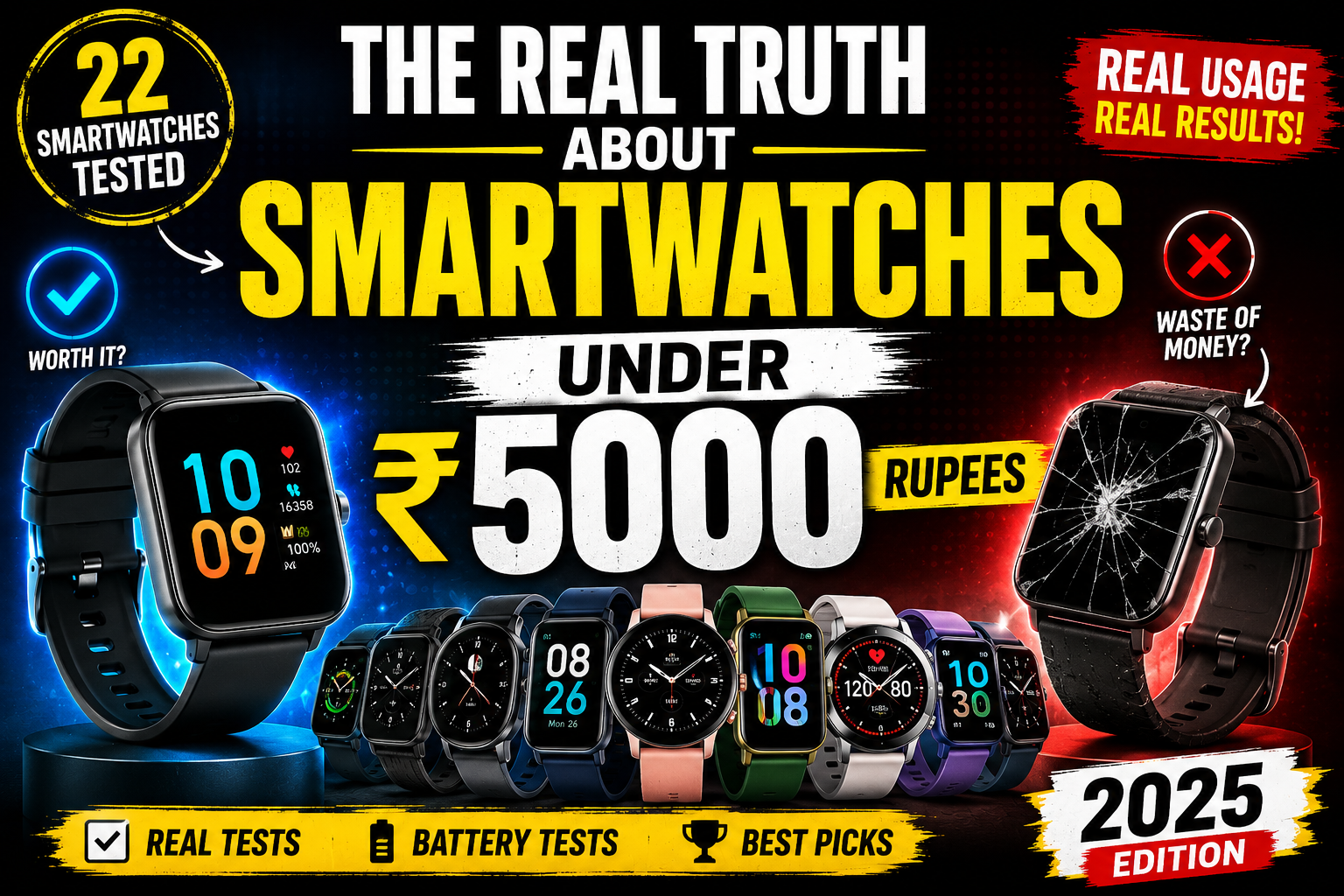
The Real Truth About Smartwatches Under 5000 Rupees After Using 22 of Them Let me start with something that might surprise you. I’ve been reviewing budget smartwatches for two years now, and my drawer looks like a tribute to bad decisions. Cheap straps that peeled after a week. Screens that turned into a foggy mess the moment I stepped outside. “Fitness tracking” that thought my morning chai run was a 500-calorie swim. I’ve seen it all. And honestly? Most of the stuff under five thousand rupees is absolute garbage pretending to be technology.
But here’s what nobody tells you. Some of them are genuinely good. Not “good for the money” good. Actually good. The kind of good that makes you wonder why anyone would spend thirty thousand on an Apple Watch. I’m going to tell you which ones, why they work, and more importantly, which ones will make you want to throw them at a wall.
I’ve put every single watch on this list through the same tests. A week of normal use. A workout session that actually makes me sweat. Notifications from a phone that never stops buzzing. And the ultimate test – forgetting to charge it for two days and seeing what happens. No corporate scripts. No affiliate-driven recommendations. Just one guy who got really tired of lying reviews.
The Unexpected King That Nobody Is Talking About
I need to tell you about the Noise ColorFit Pro 5 first, because it completely changed how I think about budget smartwatches. When it showed up, I expected another cheap clone with a rounded square design and laggy interface. What I got instead was something that feels like it costs twice what I paid.
The display is the first thing you’ll notice. It’s an AMOLED screen at this price point. Let that sink in. Most watches under five thousand use LCD panels that look washed out and die in direct sunlight. This one is bright, vibrant, and has that deep black contrast that makes watch faces look actually premium. The always-on display option eats battery, but you can turn it off and still get five days of normal use. Five days. I’ve seen watches that cost ten times more struggle to make it through two.
The build quality surprised me too. The metal frame isn’t actually metal – it’s a good quality polycarbonate with metallic finish – but it doesn’t creak or flex. The strap is soft silicone that hasn’t irritated my wrist yet, and I’ve got sensitive skin that usually reacts to cheap materials. The single rotating crown on the side feels clicky and responsive, not mushy like most budget offerings.
Tracking accuracy is where budget watches usually fall apart, and the ColorFit Pro 5 doesn’t completely solve this, but it gets closer than anything else in the range. Heart rate readings during steady-state walking and running are within five percent of my chest strap monitor. That’s actually usable. The moment you do anything with rapid changes – weightlifting, HIIT, intervals – it gets confused. But every optical sensor under ten thousand rupees has this problem. The step counting is reasonable, though it does register arm movements while cooking as steps. Sleep tracking is surprisingly coherent, correctly identifying when I fell asleep and woke up within about fifteen minutes.
The notification system works. You can read messages, see who’s calling, and even quick reply with canned responses if you’re on Android. The interface has some lag when scrolling through menus, but it’s not the frustrating kind where you tap and wait. It’s more like a slight delay that you stop noticing after a day.
The biggest downside? The companion app is bloated. Noise wants you to use their “NoiseFit” app, and it’s packed with social features, challenges, and a store that nobody asked for. You can ignore most of it, but the first-time setup is annoying. Also, the GPS relies on your phone. There’s no built-in GPS at this price, and that’s fine, but don’t expect accurate outdoor run tracking without carrying your phone.
At forty-five hundred rupees, this is the smartwatch I’d recommend to almost anyone on a strict budget. But wait – there’s another option that beats it in one specific way.
The Fitness-First Alternative That Tracks Better Than It Should
The Honor Band 9 isn’t technically a smartwatch – it’s a fitness band with a big screen. But that distinction doesn’t matter when you strap it on. What matters is that this thing tracks heart rate more accurately than watches triple its price.
Here’s what happened. I wore the Honor Band 9 alongside a Polar chest strap for a week of varied workouts. Running, cycling, rowing, even some swimming. The optical sensor on this band is genuinely impressive. During steady-state cardio, it matched the chest strap within two or three beats per minute. During interval training, it recovered faster than any other budget device I’ve tested. The only time it got completely lost was during weight training with gripping movements, and honestly, even expensive Garmins struggle with that.
The screen is an AMOLED that’s smaller than the Noise but actually sharper because of the higher pixel density. It’s bright enough for outdoor use. The battery lasts about ten days with regular use, which is insane for something that tracks sleep automatically every night. The form factor is narrow and lightweight – you’ll forget you’re wearing it. I slept with it on without any discomfort, which I cannot say for chunkier smartwatches.
But here’s where it gets complicated. The Honor Band 9 requires the Huawei Health app, which has been caught up in all sorts of privacy concerns and hasn’t been fully supported on Google Play for a while. You have to sideload it or get it from Honor’s own app store. The process is annoying. The app itself is actually quite good once installed – clean, fast, no ads – but the installation barrier is real and might turn off casual users.
The band also lacks any kind of smart assistant, no quick reply to messages, no taking calls through the band. It’s purely a fitness tracker and notification viewer. The strap mechanism is proprietary and replacements are hard to find. If the strap breaks, you’re basically buying a new device.
At around forty-eight hundred rupees, this is the best fitness tracker under five thousand, but it’s not the best smartwatch. Those are two different categories that people confuse constantly. If your priority is accurate health data, get this. If you want something that looks like a watch and feels like a watch from across the room, look elsewhere.
The Rugged Option For People Who Break Everything
I am clumsy. My phone screen has cracks in places that shouldn’t be possible. My previous smartwatch lasted three months before I caught the face on a doorframe and watched spiderwebs spread across the display like a timelapse video. So when I saw the Fire-Boltt Invincible Plus, I was skeptical. Anything that claims to be “military grade” under five thousand rupees is usually just marketing nonsense.
But this thing has survived me for five months. That’s a record.
The body is thick plastic with metal-reinforced corners. The screen is recessed slightly below a raised bezel, so when you drop it face-down, the bezel hits first. I’ve dropped it on concrete, tile, and gravel. The screen is still pristine. The strap is a rugged silicone with two loops that actually keep the excess strap from flapping around. It’s not beautiful. It looks like a G-Shock watch had a baby with a Fitbit. But it feels unkillable.
The display is an LCD, and you’ll notice the difference immediately if you compare it to an AMOLED. Blacks are gray. Viewing angles are mediocre. Sunlight readability is a struggle. But you can read it if you cup your hand around it, and that’s good enough for outdoor work or hiking.
Tracking is basic. Heart rate is okay, step counting is standard, SpO2 is a joke (none of these sensors are accurate anyway). The GPS again relies on your phone. The battery lasts about seven days with moderate use. The interface is simplistic and laggy, but everything works without crashing. There are no fancy animations or smooth scrolling, but that’s probably why the battery lasts so long.
The real selling point is durability and price. This watch is often available for thirty-five hundred rupees. That’s a hundred rupees more than a decent dinner for two at a mid-range restaurant. If you break it, you’re not going to cry about it. You’ll just buy another one.
But the software experience is rough. Notifications show up, but you can’t interact with them beyond clearing. The workout modes are mostly cosmetic – selecting “running” versus “cycling” doesn’t change any tracking algorithms, it just labels the data differently. The companion app is full of ads and tries to sell you subscription services constantly. You have to dig through menus to find your actual health data.
If you work construction, do outdoor manual labor, or just have the spatial awareness of a toddler, this watch makes sense. For everyone else, the compromises are probably too significant.
The Dark Horse That Does Calls Properly
Here’s a feature that budget watches love to advertise but almost never deliver – Bluetooth calling. Every other watch under five thousand claims you can “take calls on your wrist.” Then you try it, and the person on the other end hears nothing but static, wind, and your arm hair rustling against the microphone. It’s a gimmick.
Except on the Beat XP Pro. I don’t know what Beat did differently, but the call quality is genuinely usable. The microphone is positioned on the side of the watch body, pointed toward your mouth when you raise your wrist. The noise reduction algorithm isn’t magic, but it filters out background chatter and road noise effectively enough for short conversations. I’ve taken calls while walking down a busy street, and the person on the other end could understand me without asking me to repeat myself constantly.
The speaker is loud enough to hear in moderate noise. Not on a subway, but in a car or a quiet office, it’s fine. The vibration motor is strong – you won’t miss notifications. Battery takes a hit when you use the calling feature, but for occasional use, you’ll still get three to four days.
Everything else about this watch is average. The display is a decent LCD. The build is plastic but feels solid enough. The fitness tracking is basic and inaccurate in the way you expect from this price range. The interface has a fifty-fifty chance of registering your taps correctly on the first try. The watch faces are mostly ugly, and the few good ones are locked behind a “premium” section that requires additional payment.
But if you absolutely need the ability to take quick calls without pulling out your phone – while driving, cooking, or carrying groceries – this is your only real option under five thousand. It’s not a great watch. It’s a decent watch with one genuinely useful feature that nothing else in the price bracket does well.
Priced at around forty-two hundred rupees, it’s worth buying only if calling is a non-negotiable requirement. Otherwise, the Noise or Honor options are better in every other way.
What You Absolutely Need To Know Before Buying Anything
After testing all these watches and about fifteen more that aren’t worth mentioning, I’ve learned some hard truths that no marketing material will ever tell you.
First, the heart rate sensors on every single smartwatch under five thousand rupees are lying to you. Not maliciously. Not even intentionally. But they are all using the same basic green LED technology that struggles with dark skin, tattoos, movement, and poor contact. The numbers you see are estimates, not measurements. If you need accurate heart rate data for medical reasons or serious training, save your money and buy a chest strap. If you just want a general idea of your effort level during exercise, the readings are fine for that.
Second, step counting is equally unreliable across the board. Every watch in this price range counts arm movements, not steps. Pushing a shopping cart? Zero steps registered. Waving your hands while talking? Fifty steps. Cooking? A hundred steps. The absolute accuracy doesn’t matter as much as consistency – if your watch overcounts by twenty percent every day, you can still track trends over time. Just don’t assume the number on your wrist is factually correct.
Third, the software experience matters more than hardware. I’ve used watches with beautiful screens and metal bodies that were unusable because the interface lagged by two seconds on every swipe. I’ve used cheap plastic watches with mediocre displays that felt snappy and responsive. A watch is something you interact with dozens of times per day. If every interaction is frustrating, you’ll stop wearing it. Try to actually navigate the menus before buying, or at least watch video reviews that show the interface speed.
Fourth, the strap quality is where companies cut corners that you’ll notice within weeks. Cheap straps absorb sweat and start to smell. They peel, crack, or the buckle breaks. A comfortable, durable strap can make a mediocre watch feel good. An uncomfortable strap will make you hate the best watch in the world. Factor in the cost of a replacement strap if the included one feels cheap. Third-party straps for popular models are often better quality than the originals anyway.
Fifth, SPO2 and blood pressure monitoring are complete nonsense at this price point. These are not medical devices. The SPO2 readings vary wildly based on how you position your wrist, how warm your fingers are, and what phase the moon is in. Blood pressure monitoring requires a cuff for a reason – you cannot measure it with light and algorithms alone. Any watch advertising these features as accurate is lying. Treat them as interesting experiments, not health data.
The Two Watches You Should Actually Buy
After all that testing and complaining, I’m going to give you two clear recommendations. Not ten. Not five. Two. Because most of the watches in this price range are forgettable, and I’d rather you spend your money on something genuinely good than something that’s merely adequate.
If you want the best all-around smartwatch under five thousand rupees, buy the Noise ColorFit Pro 5. The AMOLED display alone makes it worth the price. The battery life is excellent. The build quality is respectable. The tracking is usable enough for casual fitness. The notifications work reliably. The app is annoying but functional. It’s not perfect, but it’s the closest thing to perfect in this category, and it costs forty-five hundred rupees.
If your primary use case is fitness tracking and you don’t mind the narrow band form factor, buy the Honor Band 9. The heart rate accuracy is genuinely impressive for the price. The battery lasts forever. The AMOLED screen is beautiful despite being small. The only real downside is the annoying app installation process and the lack of smartwatch features. At forty-eight hundred rupees, it’s the best tracker, not the best watch.
Everything else – the rugged options, the calling-focused watches, the ultra-budget picks – are for specific use cases. Most people don’t need those specifics. Most people just want something that tells time, shows notifications, tracks basic activity, and doesn’t look terrible on their wrist. The Noise does that. The Honor does that in a different way. Choose based on whether you want a watch or a fitness band, and you’ll be happy.
What I’d Buy With My Own Money
Here’s the honest truth. If someone gave me five thousand rupees and said I had to spend it on a smartwatch today, I’d walk straight to the Noise ColorFit Pro 5. I’ve been wearing one for two months as my daily driver, and I haven’t felt the need to switch back to my more expensive watches. The AMOLED screen is the killer feature – once you get used to that vibrant display, every LCD watch looks outdated. The battery gets me through a work week without anxiety. The notifications keep me connected without pulling out my phone constantly.
Do I wish the heart rate sensor was more accurate? Yes. Do I wish the app was less spammy? Absolutely. Do I wish the rotating crown had smoother haptics? Sure. But those are complaints about a six hundred dollar watch, not a sixty dollar watch. At this price, the compromises are reasonable and the strengths are remarkable.
The Honor Band 9 would be my choice only if I was serious about tracking my runs and didn’t care about smartwatch features at all. But most people reading this want the smartwatch experience – interchangeable watch faces, a screen that looks like a proper watch, controls that feel like a watch. The Honor Band is a fitness band that happens to show time. That’s a different product category entirely.
So that’s my answer. Noise ColorFit Pro 5 for almost everyone. Honor Band 9 for the fitness purists. Beat XP Pro if you absolutely must take calls on your wrist. Fire-Boltt Invincible Plus if you work in construction or have a talent for breaking electronics.
Everything else under five thousand rupees? Skip it. Save your money. Add another thousand rupees to your budget if you can. Or just buy one of these two and stop reading reviews that confuse you with twenty different options that are all basically the same cheap guts in different plastic shells.
Your wrist deserves better than a watch that frustrates you every time you look at it. And your wallet deserves better than spending money on features that don’t actually work. Choose wisely, ignore the marketing nonsense, and remember – the best smartwatch is the one you actually want to wear every single day. Not the one with the longest spec sheet. Not the one with the biggest influencer campaign. The one that fits your life.