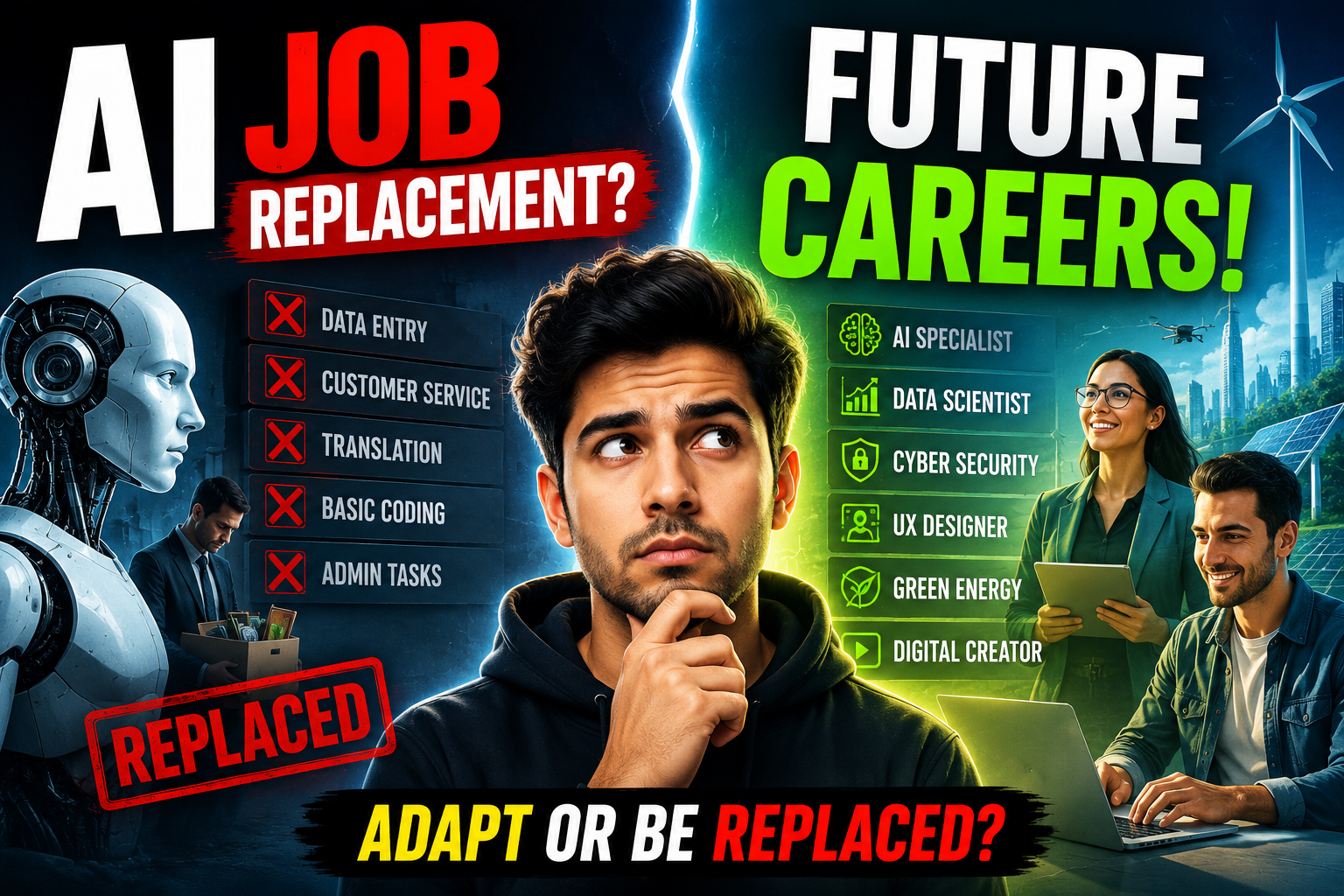
The conversation surrounding artificial intelligence has shifted dramatically. Just a few years ago, the idea of AI replacing human jobs was a distant, sci-fi concept reserved for assembly lines and basic data entry. Today, with the explosion of Generative AI (like ChatGPT, Midjourney, and Gemini) and advanced robotics, the question is no longer if AI will replace jobs, but which ones will go first—and what happens to the human workforce afterward.AI Job Replacement Future Careers
We are standing at the precipice of the Fourth Industrial Revolution. According to the World Economic Forum’s “Future of Jobs Report,” while AI is expected to create 97 million new roles by 2025, it will also displace roughly 85 million jobs. But this isn’t just a story of job loss; it is a story of task automation, role evolution, and the shifting value of human skills.
To understand which careers are on the chopping block, we must analyze what AI does best: pattern recognition, data processing speed, and repetitive task execution. Here is a deep dive into the careers facing the highest risk of automation in the coming decade.
Why These Jobs Are Vulnerable: The “Digital Replacement” Criteria
Before listing the careers, it is crucial to understand the “Risk Factors.” AI and automation are particularly adept at replacing jobs that fit the following criteria:
- Repetitive and Predictable: Tasks that follow a strict, repeatable pattern.
- Data-Heavy but Low-Strategy: Roles that require processing large amounts of data without needing high-level strategic interpretation.
- Rules-Based Logic: Work that relies on “If/Then” logic rather than creative intuition.
- Mid-Level Digital Skills: Ironically, some mid-level white-collar jobs are now more at risk than purely manual labor, thanks to Generative AI.
Here are the careers experts predict AI will replace first.
1. Content Creation and Copywriting (The Rise of Generative AI)
This is arguably the sector feeling the most immediate heat. For decades, writing was considered a distinctly human skill—a blend of emotion, voice, and creativity. However, large language models (LLMs) have proven they can mimic tone, structure, and style with alarming accuracy.
At-Risk Roles: Copywriters, Blog Writers, Social Media Content Creators, Technical Writers.
Why? AI can generate ad copy, social media captions, and basic blog drafts in seconds. Tools like Jasper and ChatGPT are already being used by marketing teams to generate “first drafts.” While a human editor is still required to fact-check and inject genuine emotion, the need for a large team of junior copywriters is diminishing. Businesses are realizing that for SEO-driven content, AI can produce a passable article at a fraction of the cost.
2. Translation and Interpretation
For years, translation was a secure career requiring deep cultural immersion. Today, real-time translation tools have improved exponentially.
At-Risk Roles: Translators, Interpreters (specifically for non-literary or non-conference settings).
Why? While nuance, poetry, and high-stakes diplomatic interpretation still require a human touch, the vast majority of business translation—emails, legal documents, user manuals—can now be handled by AI with near-perfect accuracy. The need for human translators in tourism and general business communication is rapidly shrinking.
3. Data Entry and Administrative Support
This is the classic “automation target.” Administrative roles are often a collection of micro-tasks: scheduling, data sorting, email correspondence, and file management.
At-Risk Roles: Data Entry Clerks, Executive Assistants (entry-level), Medical Transcriptionists, Receptionists.
Why? AI-powered virtual assistants (beyond the current Siri/Alexa level) can now schedule meetings, book travel, and organize emails without human prompting. Robotic Process Automation (RPA) can transfer data between systems without fatigue or error. In the medical field, AI transcription software is already more accurate than human transcriptionists, turning doctor-patient conversations into clinical notes instantly.
4. Accounting and Bookkeeping
Accountants often joke that they are the original data processors. For decades, accounting involved manually sorting receipts and inputting numbers into ledgers. That era is ending.
At-Risk Roles: Bookkeepers, Tax Preparers, Payroll Clerks.
Why? AI excels at pattern recognition and anomaly detection. Software can now scan thousands of receipts, categorize expenses, and flag potential tax deductions in minutes. Tax software like TurboTax was just the beginning. Now, AI can handle complex, multi-state tax filings and audit preparations. The role of the accountant is shifting from “number recorder” to “financial strategist,” but the traditional bookkeeper role is fading fast.
5. Customer Service and Call Centers
Anyone who has called a helpline recently has likely interacted with a chatbot before speaking to a human. That chatbot is getting smarter.
At-Risk Roles: Customer Service Representatives, Call Center Operators, Help Desk Technicians.
Why? AI chatbots powered by natural language processing (NLP) can handle increasingly complex queries. They don’t need sleep, they don’t get frustrated with angry customers, and they have instant access to the entire company knowledge base. For routine issues like password resets, order tracking, or basic troubleshooting, AI is faster and cheaper. The human agent will only be brought in for high-emotion, high-complexity issues, meaning the industry will require far fewer staff.
6. Entry-Level Graphic Design and Visual Art
The launch of DALL-E 2, Midjourney, and Adobe’s Firefly sent shockwaves through the creative industry. For the first time, a non-designer could generate a custom image with a simple text prompt.
At-Risk Roles: Junior Graphic Designers, Production Artists, Illustrator Assistants.
Why? AI image generators can create hundreds of mockups and concepts in the time it takes a human to draw one. While high-level creative directors and art strategists are safe—as they possess the taste and vision to guide the AI—the “production” side of design is being automated. Tasks like creating social media templates, generating stock photography alternatives, or designing basic logos are now being offloaded to AI, reducing the need for large in-house design teams.
7. Legal Assistants and Paralegals
The legal field is built on precedent and documentation. It is a world of vast archives, dense text, and meticulous citation.
At-Risk Roles: Paralegals, Legal Assistants, Legal Researchers.
Why? This is known as “eDiscovery.” AI can now scan millions of pages of legal documents in seconds to find relevant case law or specific clauses. It can draft standard contracts, non-disclosure agreements, and wills faster than a junior associate or paralegal. While AI cannot argue in court or provide the nuanced counsel a human lawyer can, the grunt work of legal research is increasingly being handled by algorithms.
8. Retail and Cashier Services
Self-checkout machines were just the beginning. The next wave involves full automation of the shopping experience.
At-Risk Roles: Cashiers, Stock Clerks, Retail Salespersons.
Why? Amazon Go stores have pioneered the “Just Walk Out” technology, where sensors and AI automatically detect what you take and charge you upon exit. Inventory management is now handled by robots that scan shelves and track stock in real-time. The human role in retail is shrinking to one of customer experience and problem-solving, rather than transaction processing.
9. Manufacturing and Warehouse Work
This is the oldest story in the automation playbook, but it is accelerating.
At-Risk Roles: Assembly Line Workers, Machine Operators, Packagers.
Why? Modern robots are no longer stationary, blind machines. They are equipped with computer vision and machine learning, allowing them to handle “dexterous” tasks previously reserved for human hands. They can sort irregular objects, pack boxes of varying sizes, and work alongside humans (cobots) without safety cages. As these robots become cheaper, the economic incentive to replace human labor in warehouses (like those run by Amazon) becomes overwhelming.
10. Financial Analysts and Traders
Wall Street has always been a numbers game, and AI is the ultimate number-cruncher.
At-Risk Roles: Entry-Level Financial Analysts, Stock Traders, Wealth Managers (Robo-advisors).
Why? Algorithmic trading now accounts for the majority of stock market trades. AI can analyze market trends, earnings reports, and economic indicators faster than any human team. “Robo-advisors” like Betterment and Wealthfront are already managing portfolios for millions of users, providing financial advice that was once the exclusive domain of human wealth managers. The human role is shifting to high-net-worth relationship management and complex financial engineering.
The Jobs That Are Safe: The Human Advantage
While the list above seems daunting, it is important to remember that AI is a tool, not a sentient being. It lacks genuine consciousness, empathy, and physical dexterity in unstructured environments. The jobs that will survive and thrive are those that require:
- Genuine Human Empathy: Psychologists, therapists, social workers, and nurses. AI can simulate empathy, but it cannot feel it. The healing power of human connection is irreplaceable.
- Complex Problem-Solving and Strategy: CEOs, entrepreneurs, scientists, and engineers. AI can provide data, but humans must decide what to do with it in the context of ethics, culture, and long-term vision.
- Skilled Trades: Electricians, plumbers, carpenters. These roles require working in unpredictable, physical environments (the “real world”) that robots struggle to navigate. A robot cannot yet crawl under a house built in 1920 to fix a pipe.
- Creative Direction: While AI can create art, it takes a human to have the original idea, the “spark.” High-level artists, authors, and filmmakers who tell stories about the human condition will remain in demand.
How to Future-Proof Your Career
The goal is not to compete with AI, but to work alongside it. The “Centaur Model” (named after the half-human, half-horse chess players who use AI to enhance their game) is the future.
- Become an AI Operator: Learn how to prompt, edit, and manage AI tools. A marketer who uses AI to generate 50 headlines and picks the best one is more valuable than a marketer who writes one headline.
- Double Down on Soft Skills: Communication, negotiation, leadership, and emotional intelligence will become the premium currency of the job market.
- Embrace Lifelong Learning: The half-life of skills is shrinking. Continuous upskilling is no longer optional.
Conclusion
The AI revolution is not a dystopian purge, but a radical restructuring. The careers that will be replaced first are those that are transactional, repetitive, and devoid of deep human interaction. The future of work isn’t about humans versus machines; it is about humans with machines. The challenge for the current workforce is to adapt, reskill, and move up the value chain—leaving the drudgery to the machines and reclaiming the uniquely human elements of creativity, empathy, and strategy.