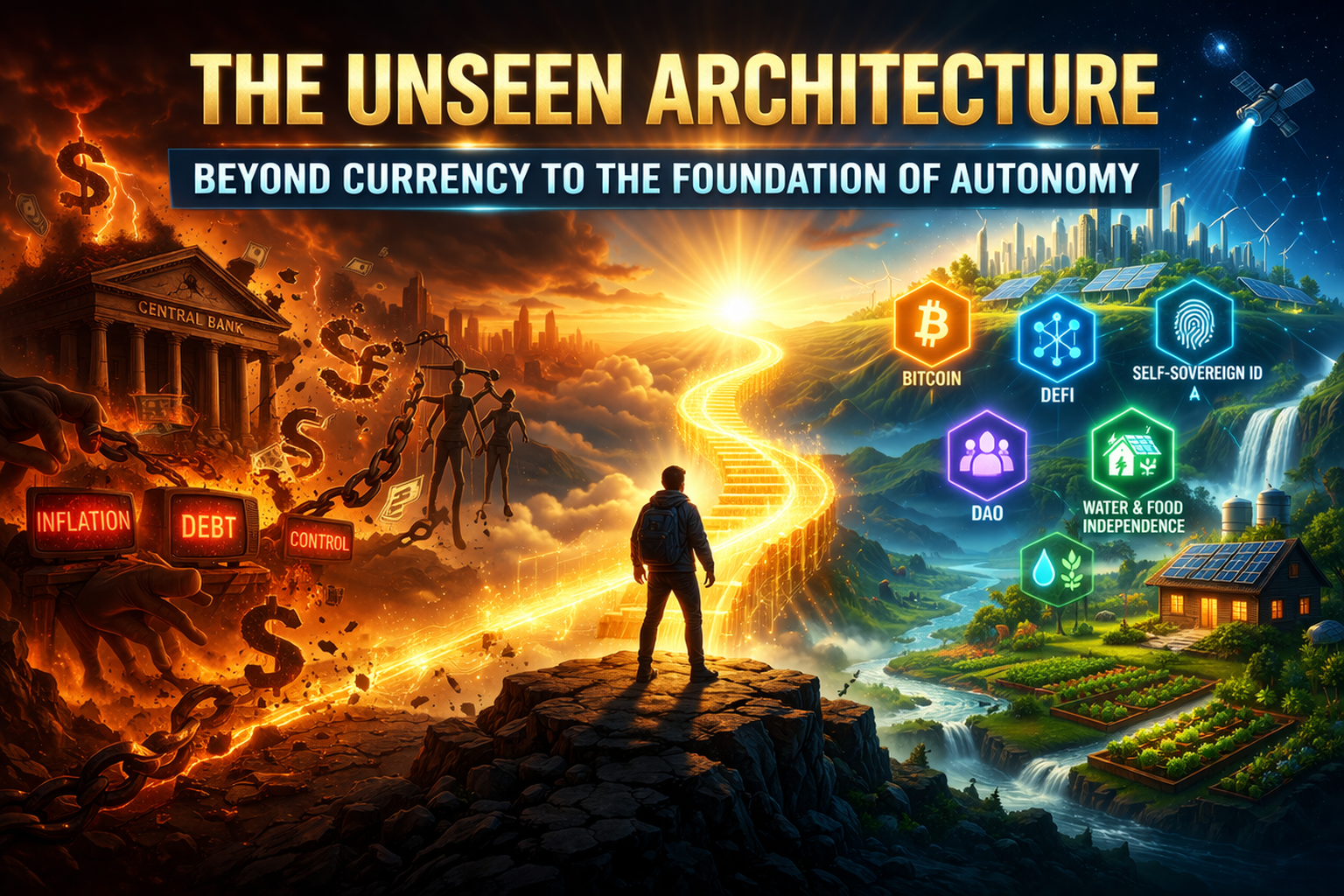
The Unseen Architecture Beyond Currency to the Foundation of Autonomy For the first decade of its existence, blockchain technology was held hostage by a single, albeit revolutionary, idea: currency. The public imagination, fueled by volatile markets and speculative frenzies, conflated the technology with the asset. We spoke of “crypto” as a monolith, blinding ourselves to the quiet, foundational shift occurring beneath the surface. As the noise of speculation fades into a cyclical rhythm of boom and bust, we are finally able to see blockchain for what it truly is: not a get‑rich‑quick vehicle, but the most significant invention since the internet for establishing trust, ownership, and coordination in a digital world that increasingly lacks all three.
The future of blockchain is not about replacing fiat currency; it is about replacing trust. It is about building a parallel architecture for human coordination where agreements are enforced by immutable logic rather than fallible institutions. This future will be defined by three profound shifts: the ossification of digital identity, the rise of decentralized physical infrastructure (DePIN), and the re‑architecture of corporate and legal structures. It is a future that will be quietly integrated, largely invisible, and ultimately, inescapable.
The End of the Password and the Birth of Sovereign Identity
The most immediate and transformative application of blockchain technology lies in the realm of identity. Our current digital identity system is a relic of a bygone era—a patchwork of usernames, passwords, and centralized honeypots of data. We do not own our identities; we lease them from Facebook, Google, or government databases. We are the product, and our personal data is the currency. This model is not only degrading to individual privacy but is structurally insecure. A single breach at a credit bureau or a social media giant can expose the personal information of billions, leading to a lifetime of fraud and impersonation.
Blockchain offers a radical alternative: Self‑Sovereign Identity (SSI). In this model, an individual’s identity is not a record held by a third party but a cryptographic key pair stored on a personal device. The public key, recorded on a blockchain, serves as an immutable anchor, proving that a specific identifier exists. The private key, held only by the individual, is used to sign claims and grant access.
The future will see the proliferation of verifiable credentials (VCs) anchored to these decentralized identifiers (DIDs). Imagine a world where you do not “log in” to a website. Instead, the website presents a request for specific information: “I need to verify you are over 21.” Your digital wallet does not send a copy of your driver’s license. Instead, it generates a cryptographic proof, signed by the issuing authority (the DMV), that attests to the fact of your age without revealing your date of birth, your address, or your height. The website receives a simple “true” or “false” statement, cryptographically guaranteed.
This shift has implications far beyond convenience. It dismantles the surveillance economy. When companies no longer hoard personal data, the business model of selling user information collapses. Data breaches become irrelevant because there is no centralized database to breach. Governments, too, will adapt. Estonia has already demonstrated the viability of a digital identity infrastructure, but it remains government‑controlled. Blockchain‑based SSI flips the model: the government becomes one issuer among many—hospitals, universities, employers—while the individual remains the sole custodian of their identity.
For billions of people without formal identification, this is a gateway to economic participation. A refugee with a smartphone can establish a verifiable identity anchored to a blockchain, enabling them to open bank accounts, access education, and prove their work history without relying on physical documents that may have been lost or destroyed. The United Nations has already piloted such programs, and the next decade will scale them into a global standard.
However, the path to SSI is fraught with challenges. Key management remains the Achilles’ heel. Losing a private key cannot be equivalent to losing one’s identity. The industry is moving toward social recovery mechanisms, multi‑party computation, and hardware wallets embedded in everyday devices. Biometrics will play a role, but they must be used without creating a new centralized honeypot. The future will standardize “wallet” interfaces much as the web standardized the browser—a universal layer for identity that works across jurisdictions and platforms.
Decentralized Physical Infrastructure Networks (DePIN)
The second pillar of blockchain’s future is perhaps its most surprising: the technology is leaving the purely digital realm to rebuild physical infrastructure from the ground up. For decades, telecommunications, energy grids, and transportation networks have been dominated by monopolies or oligopolies. Capital requirements were so immense that only governments or massive corporations could participate. Blockchain changes that by enabling decentralized physical infrastructure networks, or DePIN.
The principle is simple: instead of a single company building and owning a network, a distributed set of individuals contributes hardware and is rewarded with tokens that capture the value of the network. The blockchain handles coordination, accounting, and trust.
Consider wireless connectivity. Helium, one of the earliest examples, demonstrated that a global LoRaWAN (Low‑Power Wide‑Area Network) could be built by individuals purchasing inexpensive hotspots. In exchange for providing coverage, they earned tokens. Today, the model is expanding to 5G. Instead of waiting for a telecom giant to roll out towers in a rural area, residents can deploy small cells, collectively own the infrastructure, and earn from its usage. The result is faster deployment, lower costs, and networks that are owned by the communities they serve.
Energy grids are another natural fit. Rooftop solar, battery storage, and electric vehicles turn every household into a micro‑energy producer. Current grids are not designed for two‑way power flows; they are centralized, top‑down systems. Blockchain enables a transactive energy grid where households can sell excess solar power directly to neighbors, with every kilowatt‑hour tracked and settled in real‑time on a distributed ledger. This eliminates the need for a central utility to act as the sole intermediary, reducing costs and increasing resilience. In the future, local energy markets will operate autonomously, with smart contracts balancing supply and demand minute by minute.
Transportation and mobility will also transform. Decentralized ride‑hailing platforms are emerging where drivers and riders connect directly, with a protocol handling matching, reputation, and payment. No corporate entity takes a 30% cut; instead, the protocol charges a minimal fee distributed to node operators who maintain the network. Similar models apply to car‑sharing, parking, and even electric vehicle charging stations. When the infrastructure is collectively owned, the incentives align toward maintenance and expansion rather than rent extraction.
The common thread is a shift from capital‑intensive, centralized infrastructure to capital‑distributed, incentive‑aligned networks. DePIN projects face real-world hurdles—regulatory classification, hardware reliability, and the “cold start” problem of bootstrapping a network without existing coverage. Yet the trajectory is clear: as the cost of sensors, connectivity, and computing continues to fall, the economic case for decentralized infrastructure becomes overwhelming. By 2035, a significant fraction of the world’s wireless coverage, energy trading, and mobility services may run on blockchain‑coordinated networks, invisible to end users but fundamentally more efficient and equitable.
The Re‑Architecture of Organizations—DAOs Beyond Speculation
The third major frontier is the reinvention of human organizations. Corporations as we know them are a legal technology from the 17th century—joint‑stock companies designed to pool capital and limit liability. They are rigid, hierarchical, and optimized for a world of slow communication and scarce information. Blockchain introduces a new organizational form: the Decentralized Autonomous Organization (DAO).
The DAO has been caricatured as a loose collection of token holders voting on silly proposals. That was the experimental phase. The future of DAOs is far more sophisticated and will ultimately challenge the supremacy of the traditional corporation.
A mature DAO is not a chat group with a treasury; it is a legally recognized entity that uses smart contracts to automate governance, capital allocation, and operations. Rather than relying on a board of directors and a management team, a DAO encodes rules into software: how funds are spent, how proposals are passed, how disputes are resolved. Human discretion remains for strategic decisions, but execution is automated.
The advantages are profound. Transparency is total—every transaction, every vote, every code change is visible on the blockchain. Alignment is granular; instead of issuing shares that give blanket voting rights, DAOs can use “futarchy” or conviction voting to align incentives with specific outcomes. Capital efficiency improves because treasuries are deployed programmatically, often earning yield through decentralized finance protocols while waiting to be allocated.
But the most significant impact will be on employment. Traditional employment is a bundle of roles: you are a worker, a creditor (owed salary), and a fiduciary all at once. In a DAO, those roles are unbundled. You may contribute to a project for a few hours, receive instant payment in a stablecoin via a smart contract, and hold governance tokens that give you a say in the project’s future—but you are not an “employee” in the traditional sense. This creates a fluid labor market where people work across multiple organizations simultaneously, moving from project to project based on skills and interest.
Legal systems are scrambling to catch up. Wyoming, the Cayman Islands, and Switzerland have already created legal frameworks for DAOs, allowing them to hold property, pay taxes, and enter contracts. Over the next decade, more jurisdictions will follow, and we will see the rise of “hybrid” organizations—traditional corporations with DAO subsidiaries, or DAOs that register as cooperatives or limited liability companies. The boundary between corporation and community will blur.
Critics argue that DAOs are inefficient and prone to capture by large token holders. These are real challenges, but they are not fatal. New governance mechanisms—quadratic voting, holographic consensus, reputation‑based systems—are being developed to mitigate plutocracy. The future DAO will not be a pure direct democracy; it will be a sophisticated system of checks and balances, encoded in software but adaptable through carefully designed upgrade mechanisms.
Tokenization of Real‑World Assets—Liquidity Unleashed
For all the talk of cryptocurrencies, the largest opportunity for blockchain lies in assets that are not digital by nature: real estate, private equity, commodities, intellectual property, and fine art. The total value of global real estate alone is estimated at over $300 trillion, yet most of it is illiquid, fractional ownership is cumbersome, and cross‑border investment is mired in intermediaries.
Tokenization—the process of issuing a blockchain token that represents ownership of a real‑world asset—solves these problems by bringing liquidity, divisibility, and programmability to traditionally illiquid markets.
Imagine a commercial office building in a major city. Today, if you want to invest, you need millions of dollars and a lengthy legal process. In a tokenized future, the building is represented by a digital token, divided into 1,000,000 units. An investor anywhere in the world can buy 100 units with a few clicks, receiving immediate ownership rights and proportional rental income distributed automatically by smart contract. The token can be traded on secondary markets, providing liquidity that real estate has never enjoyed.
The implications extend far beyond real estate. Private equity and venture capital, currently locked in ten‑year funds, can be tokenized to allow limited partners to exit early. Fine art can be fractionalized, allowing multiple owners to share both the aesthetic enjoyment and potential appreciation. Intellectual property—music royalties, patent portfolios—can be tokenized to align incentives between creators and investors.
But tokenization is not simply about creating tradable tokens. The true innovation is programmability. A token can be programmed to automatically distribute revenue to owners, to enforce holding periods, to restrict transfers to accredited investors, or to comply with sanctions lists. Compliance becomes code, reducing the administrative burden of asset management.
Regulatory clarity is the key bottleneck. The United States, the European Union, and Asian financial hubs are all developing frameworks for security tokens—tokens that represent financial instruments. The EU’s DLT Pilot Regime, for example, allows market infrastructures to operate distributed ledger‑based trading and settlement. Once these frameworks converge, we will see an explosion of tokenized assets, with trillions of dollars migrating onto blockchains over the next two decades.
This shift also challenges the traditional role of exchanges. Centralized stock exchanges are essentially trusted intermediaries that match buyers and sellers and maintain the official record of ownership. Blockchain replaces the need for a central record‑keeper. The future will likely see a hybrid model: regulated exchanges that settle on public or consortium blockchains, drastically reducing settlement times from T+2 to near‑instantaneous.
Supply Chains and the End of Opaque Provenance
A less glamorous but equally transformative application is in global supply chains. Modern supply chains are labyrinthine, involving hundreds of actors across dozens of countries. Consumers have no way of knowing whether a “conflict‑free” diamond is truly conflict‑free, whether “organic” produce was grown with banned pesticides, or whether a luxury handbag was made with forced labor.
Blockchain offers a solution by creating an immutable, shared record of provenance. Each step in the supply chain—from raw material extraction to final sale—is recorded as a transaction on a blockchain. Because the ledger is append‑only and cryptographically linked, no single party can alter the history without detection.
The future will see this technology become mandatory in certain industries. The European Union’s proposed Digital Product Passport for batteries is an early signal. By 2030, similar passports may be required for textiles, electronics, and plastics. A consumer scanning a QR code will see the entire lifecycle of the product: where each component was sourced, how much carbon was emitted during manufacturing, and whether labor standards were met.
For businesses, the benefits are operational as well as reputational. Disputes over payments, delays, and quality can be resolved faster because every party shares the same immutable data. Smart contracts can automate payments upon delivery confirmation, reducing the need for invoice factoring and freeing up working capital. In a world where consumers increasingly demand transparency, blockchain‑based provenance becomes a competitive necessity.
The Evolution of the Underlying Technology
All these applications depend on the continued evolution of the blockchain infrastructure itself. The early blockchains—Bitcoin and Ethereum—were groundbreaking but limited. Bitcoin is secure but slow and lacks programmability. Ethereum introduced smart contracts but struggled with scalability and high fees.
The next generation of blockchains is solving these problems through three parallel innovations: modular architecture, zero‑knowledge proofs, and advanced consensus mechanisms.
Modular blockchains separate the core functions of consensus, data availability, and execution. Instead of every node doing everything, specialized layers handle specific tasks. This dramatically increases throughput while maintaining decentralization. Rollups—execution layers that post compressed transaction data to a base layer—are already enabling thousands of transactions per second at fractions of a penny.
Zero‑knowledge proofs (ZKPs) represent a cryptographic breakthrough that allows one party to prove to another that a statement is true without revealing any information beyond the validity of the statement. In blockchain terms, ZKPs enable “validity proofs” that allow a chain to verify huge batches of transactions with minimal computation. This not only scales the network but also enhances privacy—a critical requirement for enterprise adoption.
Consensus mechanisms are also evolving. Proof‑of‑stake has largely replaced proof‑of‑work for new networks, reducing energy consumption by over 99%. But further refinements—such as single‑slot finality, sharding, and directed acyclic graph (DAG) structures—promise to push latency down to sub‑second levels while maintaining security.
The result of these technical advances will be a blockchain infrastructure that is fast, cheap, private, and capable of handling global‑scale applications. End users will not know they are interacting with a blockchain, just as they do not know when they are using TCP/IP. The complexity will be abstracted away, leaving only the benefits: verifiable ownership, automated trust, and seamless coordination.
Conclusion: The Quiet Integration
The future of blockchain technology is not a single killer application; it is a fundamental layer of the world’s digital and physical infrastructure. Just as the internet moved from a curiosity to a utility, blockchain will move from speculation to invisibility. By 2040, we will likely take for granted that our identity is self‑sovereign, that our energy grid is a decentralized market, that many organizations are partially governed by code, and that every physical asset of value has a digital twin on a public ledger.
This future is not guaranteed. It requires regulatory frameworks that balance innovation with consumer protection. It requires user interfaces that eliminate the complexity of private keys and gas fees. It requires a cultural shift away from the “crypto bro” stereotype toward a more inclusive and pragmatic adoption.
But the direction is unmistakable. Every time a centralized system fails—a data breach, a banking collapse, a supply chain scandal—the case for a decentralized alternative grows stronger. Blockchain offers not just technological improvement but a philosophical realignment: from trusting institutions to trusting mathematics, from renting our digital lives to owning them, from passive consumers to active participants in the networks we depend on.
The architecture is being laid today, block by block. And when it is complete, it will be as foundational to the 21st century as steel and concrete were to the 20th. We will not talk about “blockchain” as a separate thing any more than we talk about “electricity” as a separate thing. It will simply be the unseen architecture that powers a more transparent, equitable, and autonomous world.
2 thoughts on “The Unseen Architecture Beyond Currency to the Foundation of Autonomy”