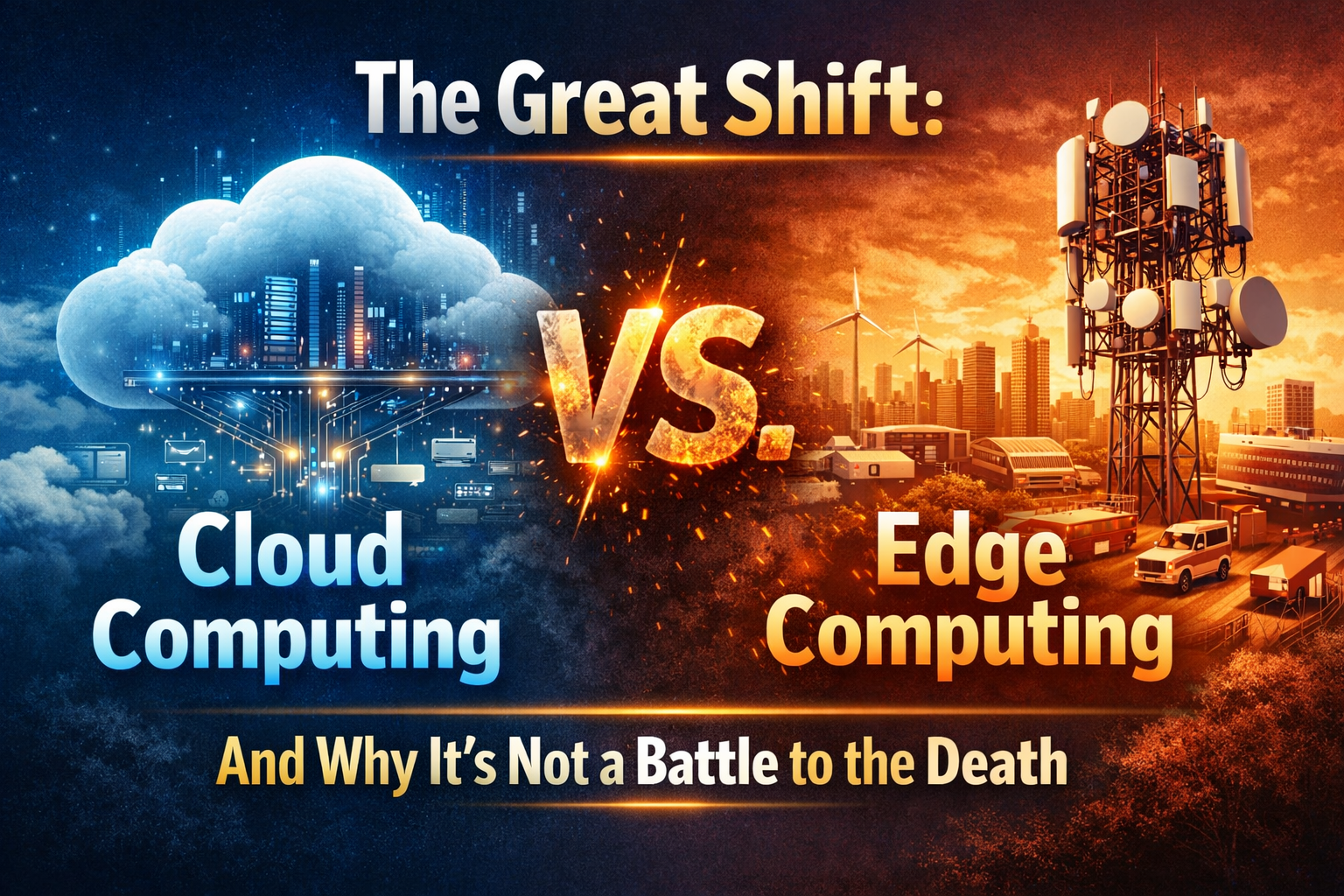
For the better part of two decades, “the cloud” has been the undisputed king of the digital world. We’ve been told to put everything up there—our photos, our work documents, our customer databases, even the software that runs our entire companies. The cloud became the invisible, all-powerful force that promised to solve every problem: unlimited storage, massive processing power, and the freedom to access your data from anywhere. It was, and still is, a revolution.
But lately, you’ve probably started hearing a new buzzword creeping into tech articles, industry conferences, and LinkedIn posts: Edge Computing. And if you’re like most people, your first reaction might be a mix of curiosity and confusion. Is edge computing replacing the cloud? Is it faster? Is it just another marketing term cooked up by hardware vendors trying to sell more boxes?
Let me stop you right there. This isn’t a war. It’s not about choosing one over the other. In fact, the real magic of modern technology is just beginning to reveal itself, and it lives in the relationship between the cloud and the edge. To understand where we’re going, we have to first understand what each of these things actually is, what they’re good at, and—more importantly—what they’re terrible at.
The Cloud The Distant Brain
Let’s start with the cloud, because we all think we know it. The cloud is not, despite popular metaphors, a fluffy white thing floating in the sky. It’s a network of massive, climate-controlled data centers—some the size of several football fields—located in strategic places around the world. Think of Northern Virginia, Dublin, Singapore, and São Paulo. Inside these facilities are row after row of servers, stacked to the ceiling, humming away, crunching numbers, and storing your vacation photos.
When you use Gmail, you’re using the cloud. When you watch Netflix, you’re pulling data from the cloud. When your company uses Salesforce or Zoom, that’s the cloud. The core concept is centralization. You send your data and your computing requests to a distant, powerful brain. That brain processes everything and sends the result back to you.
The benefits of this model are enormous and have driven the last fifteen years of digital transformation. First, economies of scale. It’s incredibly cheap for a single user to rent a tiny slice of a massive data center. You don’t have to buy your own server, maintain it, cool it, or pay the electricity bill. You just pay a monthly subscription. Second, elasticity. Need more power for a holiday sales rush? The cloud can give it to you in seconds. Need less in January? Scale right back down. Third, collaboration. Because your data lives in a central place, your colleague on the other side of the world can access the same file at the same time.
For a long time, this seemed like the final answer to all of computing. Why would anyone ever want to own a server again? The cloud was cheaper, more reliable, and more flexible. Case closed.
But then, something started to happen. The world got faster. And more demanding. And the cloud’s dirty little secret began to show.
The Latency Problem Nobody Wanted to Talk About
The cloud has a fatal flaw: distance. It’s not magic. Data has to travel. And it travels at the speed of light, which is incredibly fast, but not infinitely fast. More importantly, data doesn’t travel in a straight line. It bounces from your device to your home router, to your internet service provider, through a series of switching stations, possibly across undersea fiber optic cables, and finally into that massive data center. The server processes the request, and then the answer has to make the entire journey back.
That round trip takes time. We call this latency. For most everyday tasks, latency is measured in milliseconds (thousandths of a second). Sending an email? 50 milliseconds is fine. Loading a webpage? 100 milliseconds is annoying but bearable. Streaming a movie? Your device buffers a few seconds ahead, so you never even notice.
But what happens when 50 milliseconds is an eternity? What happens when you’re dealing with machines that need to react in real-time, in the physical world? This is where the cloud hits a wall. And this is precisely where edge computing walks in the door.
The Edge Computing in the Wild
Edge computing is not a single technology. It’s a philosophy. The core idea is simple: process data as close to its source as possible, rather than sending it all the way to a distant cloud data center.
The “edge” is the boundary where your digital system meets the physical world. It’s the factory floor, the inside of a car, a wind turbine in the middle of the ocean, a security camera on a city street, or even the smartphone in your pocket. An edge device is anything that can generate data and do at least some processing on that data before sending it anywhere.
Think of your smart thermostat. An old-school “dumb” thermostat just turns the heat on and off based on a simple bimetal strip. A cloud-only smart thermostat would have to send a temperature reading to a server in Virginia, wait for the server to decide it’s too cold, and then send a command back to turn on the furnace. That’s inefficient, and if your internet goes out, your house freezes. A modern smart thermostat, however, does the processing at the edge. It has a tiny computer inside that monitors the temperature, learns your schedule, and makes decisions locally. It only talks to the cloud to give you a report on your phone or to receive a software update.
That is edge computing in a nutshell. But the thermostat is just the beginning. The real potential of edge computing explodes when we consider the coming wave of the Internet of Things (IoT) —the billions of sensors, cameras, robots, and vehicles that are about to flood our world.
Why the Edge is Suddenly So Important
Three major forces have collided to push edge computing from a niche academic concept into a mainstream business imperative.
Force One: The Data Avalanche. We are generating more data than we know what to do with. A single autonomous car, for example, generates about 4 terabytes of data per day. That’s the equivalent of roughly 2,000 hours of HD video. Sending all of that raw data to the cloud is physically impossible. The bandwidth isn’t there, and even if it were, the cost would be astronomical. The only feasible solution is to process the data at the edge—in the car itself. The car’s onboard computers decide what’s relevant (a pedestrian stepping into the road) and what’s not (the pattern of leaves on a tree). It only sends the important, summarized data to the cloud for long-term learning and analysis.
Force Two: The Need for Speed. We already talked about latency, but let’s make it real. Imagine a factory robot that is programmed to stop immediately if a human hand gets too close to a spinning blade. If that robot relies on a cloud connection, the latency is a death sentence. By the time the camera sends the image to the cloud, the cloud processes it, and the command comes back, the hand is gone. With edge computing, the camera is connected to a small server right on the factory floor. That server runs a computer vision model locally. It detects the hand and commands the robot to stop in less than one millisecond. That’s the difference between a near-miss and a life-altering injury.
Force Three: Bandwidth and Cost. Bandwidth is not free, and it’s not infinite. Sending massive amounts of video or sensor data over cellular or satellite networks is expensive. By processing data at the edge, you filter out the noise. A security camera that is “smart” at the edge doesn’t need to stream 24/7 video to the cloud. It can watch locally, and only send a ten-second clip when it detects motion. That reduces cloud storage costs by 99.9% and slashes network bandwidth usage.
The Head-to-Head A Practical Comparison
A Practical Comparison
Let’s get down to brass tacks. How do these two actually stack up against each other when you’re trying to design a system? You need to know the strengths and, just as critically, the weaknesses of each.
Latency
- Cloud: High latency (50-200+ milliseconds). The physical distance to the data center is the enemy. Unacceptable for real-time control, autonomous systems, or immersive experiences like high-end AR/VR.
- Edge: Ultra-low latency (1-5 milliseconds, often less). Because processing happens locally, the reaction is nearly instantaneous. This is the only choice for time-critical applications.
Bandwidth & Network Dependency
- Cloud: Totally dependent on a robust, high-bandwidth internet connection. If your internet goes down, your cloud-dependent applications stop working. Also, sending huge volumes of raw data is expensive and slow.
- Edge: Very low bandwidth dependency. Most data is processed locally, so only small, aggregated results or alerts need to be sent. The edge system will continue to function even if the internet connection is severed entirely.
Computing Power & Storage
- Cloud: Virtually unlimited. Need a thousand GPUs to train a massive AI model for a week? The cloud can do that. Need to store petabytes of historical data? No problem. The cloud is where heavy lifting happens.
- Edge: Severely constrained. Edge devices are small, low-power, and often have limited memory and processing capability. You can’t run a massive database on a Raspberry Pi. You run efficient, specialized models.
Security & Privacy
- Cloud: A double-edged sword. Centralization means security experts can focus on defending a single fortress. But that fortress is a huge, juicy target for hackers. Also, sending sensitive data (medical records, financial transactions, personal video) across the public internet creates privacy risks and compliance headaches (like GDPR or HIPAA).
- Edge: Inherently more private because raw, sensitive data never leaves its source. The face scan to unlock your phone happens on the phone. That’s edge computing. However, a thousand edge devices are a thousand potential points of attack. Securing a distributed fleet of devices is a massive logistical challenge.
Cost Structure
- Cloud: Operational Expenditure (OpEx). You pay for what you use—storage, compute time, data egress. This is great for unpredictable or variable workloads. But costs can spiral out of control if you’re moving large amounts of data.
- Edge: A mix of Capital Expenditure (CapEx) for the physical hardware (sensors, gateways, local servers) and OpEx for management. Upfront costs are higher, but ongoing data transfer and cloud processing costs can be dramatically lower.
Where They Shine Real-World Scenarios
Let’s stop talking in abstractions. Let’s walk through some real situations where you would choose one or the other, and where you’d use both together.
Scenario 1: A Small E-commerce Business
You run a small online store selling handmade candles. You have a few thousand products and a hundred orders a day.
- You choose the Cloud. You don’t need instantaneous response. You need reliable, cheap, and scalable infrastructure to host your website, process payments, and manage your inventory. Building your own edge servers would be ridiculous overkill. The cloud is perfect.
Scenario 2: An Autonomous Fleet of Delivery Drones
You run a company that delivers medical supplies via drones to rural hospitals. A drone must avoid birds, power lines, and sudden wind gusts. It must navigate to a landing pad in real-time.
- You choose the Edge (in the drone). Each drone has an onboard computer (the edge) that processes sensor data from its cameras and LiDAR. It makes split-second decisions to avoid obstacles. It cannot wait for a cloud server 500 miles away. However, after each flight, the drone sends its flight logs and any interesting video clips to the cloud for analysis. The cloud is used to train better AI models for the next generation of drones.
Scenario 3: A Chain of 500 Fast-Food Restaurants
You need to manage inventory, scheduling, and point-of-sale systems across 500 locations, plus analyze security footage to monitor drive-thru wait times.
- You use a Hybrid Model. Each restaurant has a local edge server. This server processes security camera footage in real-time to track how long each car waits at the drive-thru. It keeps the restaurant running even if the corporate internet line goes down. At the end of each day, each restaurant’s edge server sends a small summary of data (total sales, inventory used, average wait time) to the central cloud. The cloud aggregates data from all 500 stores, runs analytics to predict demand for next week, and pushes updated menu pricing back down to the edge servers.
Scenario 4: A Remote Oil Pipeline in the Arctic
Sensors along a 1,000-mile pipeline monitor for pressure drops that could indicate a leak. There is no high-speed internet. There’s barely any power.
- You choose the Extreme Edge. You need ultra-low-power, ruggedized edge computers that can run on solar panels or batteries. They process the pressure data locally. 99.9% of the time, they do nothing. If a pressure drop is detected, the edge device sends a short satellite message (costly but rare) to a cloud server in a temperate city, which then alerts a human engineer. The cloud is the alert center and historical data warehouse, but the edge is the vigilant watchman.
The Secret They Need Each Other
Here is the single most important takeaway from this entire comparison: The edge is not a replacement for the cloud. The edge is a sophisticated, intelligent client of the cloud.
Think of the cloud as the brain and the edge as the nervous system. Your brain stores long-term memories and makes complex strategic plans. But you don’t use your brain to pull your hand away from a hot stove. That reflex is handled by your spinal cord—your biological edge. It’s fast. It’s local. It protects you. But your spinal cord doesn’t decide what you want to be when you grow up. That’s the cloud’s job.
The cloud does what the edge cannot:
- It stores years of historical data for trend analysis and machine learning training.
- It runs massive, complex simulations.
- It coordinates actions across thousands of edge devices.
- It provides a user interface—a dashboard, a mobile app—for humans to see what’s happening.
The edge does what the cloud cannot:
- It reacts in milliseconds to prevent accidents.
- It works when the internet is down.
- It preserves privacy by not transmitting sensitive raw data.
- It reduces costs by filtering out irrelevant data.
The most successful architecture you will build in the coming years will be a continuum. Data is born at the edge. The edge device makes a fast, local decision. If it’s a routine event, the edge handles it and forgets it. If it’s a novel or important event, the edge sends a summary up to a “fog” layer (a regional server, maybe in a cell tower or a local ISP hub). That fog node does more complex processing. And only the most critical, long-term insights get sent all the way up to the cloud for deep analysis and permanent storage.
The Hard Truths and Practical Advice
If you’re a business leader or a developer reading this, you need to know that edge computing is not a silver bullet. It’s hard. It’s messy. And the cloud vendors are trying very hard to make you think you don’t need it because they want to sell you more cloud services.
Here are the real-world challenges of edge computing that no one likes to talk about:
1. The Management Nightmare. Updating software on 10,000 edge devices scattered across a continent is a logistics problem from hell. You need sophisticated device management, over-the-air (OTA) update capabilities, and remote monitoring. This is one area where cloud providers are actually helping, with services like AWS IoT Greengrass and Azure IoT Edge, but it’s still vastly more complex than updating a single cloud server.
2. The Hardware Hell. Unlike the cloud, where everything is a standardized virtual machine, the edge is a zoo of different hardware. ARM chips, x86 processors, GPUs, TPUs, FPGAs, sensors with proprietary protocols. Your software has to be incredibly adaptable.
3. Security is Your Responsibility. In the cloud, the provider secures the data center. At the edge, you have a device sitting in a public parking lot, or a factory where a disgruntled employee might try to tamper with it. Physical security is now your problem. You need encrypted storage, secure boot, and a way to remotely wipe a device that is stolen.
4. Power and Heat. An edge device can’t be a screaming-hot, power-hungry Xeon server. It often runs on battery or a small solar panel. Your code has to be efficient. You have to care about CPU cycles and memory usage again, just like we did in the 1990s.
The Future A Symbiotic Dance
So, what does the future hold? Not a “cloud vs. edge” death match. Instead, expect the line between them to blur until it almost disappears.
We’re already seeing the rise of 5G and edge computing as a killer combo. The new 5G networks aren’t just faster for your phone; they are designed with “edge compute” built directly into the cell tower. That means a mobile network operator can offer you computing power that is physically just a few hundred meters away. This is called Multi-access Edge Computing (MEC), and it’s going to enable things like cloud gaming on your phone with zero lag, and real-time augmented reality navigation in your car.
We’re also seeing the emergence of AI at the edge. We used to think AI models were so huge and hungry that they could only run in the cloud. Now, we have techniques like model compression, quantization, and federated learning. These allow a powerful but efficient AI model to run directly on your smartphone, your earbuds, or your smartwatch. Your watch can learn your heart rhythm patterns locally, without ever sending your health data to a server. It only sends back anonymous, aggregated “learnings” to the cloud to improve the model for everyone.
This is the true promise. The cloud will become the orchestrator and the historian. It will be where the global intelligence lives. The edge will become the actor and the sensor. It will be where that intelligence meets the messy, fast, unpredictable physical world.
The Bottom Line
Don’t ask “Should I use cloud or edge computing?” That’s like asking “Should I use a warehouse or a delivery truck?” You need both. The warehouse (cloud) stores your goods in bulk, cheaply, and in one place. The delivery truck (edge) takes the right goods to the right place at the right time, fast.
If you are building a new system today, start with the cloud. It’s the easiest path. But as you design it, ask yourself three questions:
- Does this need to react in under 10 milliseconds? (If yes, you need edge.)
- Will this work if the internet goes down? (If no, you might need edge.)
- Am I generating terabytes of raw data that I can’t afford to transmit? (If yes, you need edge.)
The cloud gave us freedom from hardware. The edge is giving us freedom from the network. Together, they will finally let us build the truly responsive, intelligent, and ubiquitous systems that we’ve only dreamed about. The cloud is the sky. The edge is the ground. And the most interesting things in life happen where they meet.
1 thought on “The Great Shift Cloud Computing vs. Edge Computing And Why It’s Not a Battle to the Death”